FAQ
Veelgestelde vragen.
Korte, eerlijke antwoorden op de vragen die we het vaakst krijgen over B2B-marketing, Account Based Marketing en Sqrl.
54 vragen
Brand archetype Everyman: why don’t you use it?
That’s an interesting question! While many sources refer to the ‘Everyman’ or ‘Regular Guy’ archetype, we have deliberately chosen the term ‘Ally’ in our series on Brand Archetypes. Our approach somewhat deviates from the traditional interpretation as described in the book “The Hero and the Outlaw“.
Brand archetypes play a crucial role for companies in establishing their market position. They provide a fundamental framework through which brands can convey their identity, values, and message to the public. Given the importance of these archetypes, it’s essential that they are not only recognizable but also ambitious and motivating. An archetype that is too passive or unremarkable would not be the first choice for brands aiming for success and impact in their market segment.
The ‘Regular Guy’ or ‘Everyman’ archetype has qualities often associated with modesty, self-effacement, and a pursuit of simplicity and authenticity. While these are valuable and relatable traits, we have chosen to give a twist to this interpretation. Instead of focusing on these more reserved characteristics, we emphasize the idea of the ‘Ally’—a strong, reliable, and supportive archetype that actively stands by you. The idea is that brands positioning themselves as an ‘ally’ can play a more powerful and active role in their customers’ lives, thereby building a deeper and more meaningful connection.
Bekijk deze vraag
Brand archetype Everyman: Why don’t you use it?
That’s an interesting question! While many sources refer to the ‘Everyman’ or ‘Regular Guy’ archetype, we have deliberately chosen the term ‘Ally’ in our series on Brand Archetypes. Our approach somewhat deviates from the traditional interpretation as described in the book “The Hero and the Outlaw“.
Brand archetypes play a crucial role for companies in establishing their market position. They provide a fundamental framework through which brands can convey their identity, values, and message to the public. Given the importance of these archetypes, it’s essential that they are not only recognizable but also ambitious and motivating. An archetype that is too passive or unremarkable would not be the first choice for brands aiming for success and impact in their market segment.
The ‘Regular Guy’ or ‘Everyman’ archetype has qualities often associated with modesty, self-effacement, and a pursuit of simplicity and authenticity. While these are valuable and relatable traits, we have chosen to give a twist to this interpretation. Instead of focusing on these more reserved characteristics, we emphasize the idea of the ‘Ally‘ —a strong, reliable, and supportive archetype that actively stands by you. The idea is that brands positioning themselves as an ‘ally’ can play a more powerful and active role in their customers’ lives, thereby building a deeper and more meaningful connection.
Bekijk deze vraag
For which companies is Sqrl suitable?
Sqrl is developed for B2B organizations in the SME+ sector with complex sales processes and a deal value that matters. Think of companies with longer sales cycles that consistently want to generate more Sales Qualified Leads from their ideal target group, without an enterprise budget or a complex toolstack.
Bekijk deze vraag
How do you determine a company’s positioning?
You determine a company’s positioning by researching the marketing expressions and behavior of the company and its competitors. You then organize this information for all companies in the same way before drawing conclusions about positioning. Positioning models such as the competitor matrix and brand archetypes are very valuable for this final step.
Positioning research varies by situation, company, and market, but generally, you follow these steps:
Research marketing expressions and behavior
First, research and analyze all marketing and communication expressions of a company. This includes actions or other expressions of a company. It encompasses everything that shapes the image your target audience has of your company or a competitor. If multiple people are conducting this research, it’s wise to agree in advance on what exactly will be investigated. For instance, if one person spends a lot of time on Instagram and advertisements while another focuses on websites and Twitter, you’ll quickly end up comparing apples to oranges.
Organize market information
Now you have a lot of information about the company and its competitors, but how will you assess this? In this phase, it’s important to organize the information so that a comparable image emerges, and you give the correct weighting to various elements. For example, a single LinkedIn post says less than a trade show booth or a television commercial. Ensure you use the right elements as input for your positioning model. More on positioning models in the last step.
Conclusions: determine positioning
With all the market information in order, it’s time for conclusions: what is a company’s positioning relative to its competitors? A positioning model can be very helpful in this. For example, use the competitor matrix, where you use two axes to create an as objective as possible market image and place the market players on it. Or use the brand archetype model, where you place brands based on identity and behavior.
We have compiled various positioning models in a handy article. Perhaps there’s another model that better suits your needs.
Bekijk deze vraag
How does a search engine work?
Google’s algorithm does three things with your website: crawling, indexing, and ranking. This is how the search engine reads the information on your website, organizes it in the database, and determines when your website is shown in the search results.
As a visitor, you enter a few words in the search or address bar that describe what you are looking for, and soon a list of answers appears on your screen. You click on one of the answers and arrive at a website.
The Netherlands’ most important search engine, Google, does this so well that you usually find what you were looking for quickly. 90% of people do not click beyond the first 3 results. It is therefore crucial to be in that top 3, preferably in the first position. But how does a search engine determine which websites appear at the top?
Google’s algorithm does 3 things with your website: crawling, indexing, and ranking.
- Crawling is the reading of your website by the Googlebot. This crawler only reads HTML to determine what the page is about and looks for links. This way, it maps the content of pages and discovers new pages to crawl.
- Indexing is the evaluation and inclusion of this information in the Google database. Based on the information you provide to Google, the bot automatically assigns your website a place in the database.
- Ranking is the evaluation of your page according to the Google algorithm, which determines the position of your website in the search results. Google asks itself: for which search queries does this page provide a good answer?
With SEO, we address these 3 factors with the goal of reaching the top of Google. How do we do that? Read more about it on our online marketing page.
Bekijk deze vraag
How quickly will I see results with an ABM process?
ABM is a system, not a quick fix. In the first months, we build the foundation: target accounts, messaging, and the Sqrl platform. As a benchmark, we aim for 20% of your target accounts to become Sales Qualified Leads, with about 25% of those progressing to a concrete pipeline. From that moment, growth becomes predictable and scalable.
Bekijk deze vraag
How to determine the axes of my positioning matrix?
How to determine the axes of a positioning matrix or competitor matrix?It’s a question we often get from students, and the answer typically varies depending on the situation.
When you want to analyze the key factors for differentiation in a market, you need to determine these based on research. Investigate what the (future) key factors for differentiation are, place those on the axes, and choose the position of the brand and its competitors. Chances are, you will create multiple matrices and will have to make a choice.
The most practical approach is a marketing positioning matrix where we always distinguish two axes:
- Ego – Social
- Conservative – Progressive
The first axis revolves around the message: is the world or the customer central (social) or is the brand itself central (ego)? The second axis revolves around marketing; does a brand use other (more modern) methods than the rest of the market, or not (conservative)? In practice, many organizations find it incredibly helpful to have this clear picture.
Our reasoning is summarized below. This is a copy of the response we wrote to a student. For more information, of course, read our complete article on the Positioning Matrix.
The goal of a competitor matrix
The goal of a competitor matrix is to help determine a strategy and thereby behavior. So, you need to ask yourself: “What should this competitor matrix lead to?” Do you need to reposition, do you want to map out if you want to make adjustments, or are you perhaps introducing an entirely new brand to the market? That already greatly influences your choice.
Fortunately, we do have thoughts on this. Firstly, about positioning: how can we differentiate our service/offer from the competition in the consumer’s mind? How you market is a very relevant question in this regard. A brand that communicates solely through mail (think tax office) is inherently positioned differently than an online-only position (think of the Bunq bank). Therefore, we certainly include marketing activities as an axis. We like to use conservative <–> progressive, where what is common in the market stands in the middle. This makes you ask yourself, what is progressive in our market, and what is conservative? If you also think carefully about why you believe that, you already have the first building blocks for differentiation and know what your brand can do to distinguish itself in this area.
Differentiation ability
Differentiation is always a challenging axis; on what basis do you determine this? If Brand A focuses mainly on service, Brand B on price and fast delivery, but Brand C has a unique product range (think BCC, Mediamarkt, CoolBlue, and the Apple Store). Differentiation in this case cannot be captured on a single axis.
That’s why we often use the Ego <–> Social axis, where we look at the extent to which the brand (or organization) itself is central in the message or whether it is thought and spoken from the perspective of the world, market, or target group. In practice, we often see a nice division between brands that mainly talk about themselves (the largest, the best, most products, service, etc.) and brands that put the customer central based on their problem, worldview, wishes, dreams, etc.
Purpose and focus
Companies with a clear purpose are, for example, often more social than companies that primarily want to make money (with a good service).
Bekijk deze vraag
Lead Generation meaning: what is Lead Generation?
Lead generation meaning
Lead generation is the process of attracting and identifying potential customers (leads) who are interested in a company’s products or services. It involves collecting relevant contact information and creating valuable interactions to increase the likelihood that leads will eventually become customers.
What is lead generation?
Lead generation is an essential part of the sales and marketing process, focusing on finding interested prospects who may be interested in a company’s products or services. The goal is to identify leads and further develop their interest so that they can eventually be converted into paying customers. This is usually done through various strategies such as content marketing, email marketing, social media, events, and search engine optimization, to attract and engage leads throughout the customer journey.
Lead generation refers to the process of attracting and identifying potential customers. It goes beyond simply collecting contact information; it involves understanding the needs and interests of potential customers to create valuable interactions. The ultimate goal is to generate qualified leads who are in the buying phase and ready to engage with the company.
Why is lead generation important?
Lead generation is crucial for businesses because it forms the foundation for expanding the customer base and driving revenue growth. By implementing effective lead generation strategies, companies can generate a steady stream of qualified leads and feed their sales pipeline. This allows them to work more efficiently, optimize their marketing efforts, and sell more effectively.
How does lead generation work?
The lead generation process involves several steps. First, research is conducted on the target audience and ideal customer profiles are created. Next, attractive and valuable offers, such as whitepapers, e-books, or webinars, are created to capture the attention of potential customers and collect contact information. These leads are then followed up through email marketing, phone calls, or other channels to further develop their interest and guide them towards conversion.
What strategies are used for lead generation?
Various strategies and tactics are used for lead generation. Content marketing plays a significant role, where valuable and relevant content is created to attract and inform potential customers. Social media is used to reach a broader audience and engage with them. Email marketing is employed to nurture leads and send them relevant information. Additionally, search engine optimization, paid advertisements, events, and networking are used to generate and qualify leads.
Lead generation is a dynamic process that requires continuous attention and optimization. By adopting a strategic approach and applying the right tools and techniques, companies can generate a steady stream of qualified leads and achieve their growth objectives. Merkelijkheid assists businesses with lead generation by developing a strategy, setting up marketing campaigns, creating content, and of course, optimizing and reporting.
Bekijk deze vraag
LinkedIn paid ad specs
The recommended LinkedIn ad format is 1200 x 627 pixels (aspect ratio 1.91:1). This is not only the format for the images in the most commonly used LinkedIn ‘Single Image’ ads but also for so-called ‘Promoted Posts’. To ensure your advertisement is always sharp, we recommend using 2400 x 1254 pixels for your image.
LinkedIn ad format
LinkedIn ads come in many different shapes and sizes. Sometimes it takes a bit of searching to find the correct resolution for your image. LinkedIn has determined minimum and optimal ad formats for each type of advertisement. We have listed them for you:
- LinkedIn Single Image Ads
- LinkedIn Video Ads
- LinkedIn Carousel Ads
- LinkedIn Text Ads
Important: read everything about LinkedIn ad campaigns and their structure on our page LinkedIn advertising. On this page, we share best practices and tell you which ads are optimal for your campaign.
LinkedIn Single Image Ads format
The recommended ad format for Single Image Ads is 1200 x 627 pixels. This is an aspect ratio of 1.91:1 and is used to display ads on both desktop and mobile. LinkedIn also offers the possibility to use square images (1:1 aspect ratio), or a 1:1.91 ratio used exclusively for mobile.
Can you use images smaller than 1200 x 627 pixels? Yes, LinkedIn maintains a minimum of 360 pixels, making a square image of 360 x 360 the smallest image you can use in your LinkedIn ad. However, this is not recommended; your image will quickly look low-quality, which can come across as unprofessional.
Can you use larger images? That is no problem either; the maximum number of pixels for a LinkedIn ad is 7680 wide by 4320 high for a horizontal ad. A square image has the same maximum of 4320 pixels, which is also the maximum height for a vertical ad. Note that your image cannot exceed 5 MB, as the platform will not accept larger files.
LinkedIn Video Ads format
The specifications for LinkedIn Video ads are very similar to those of Single Image ads. The minimum number of pixels is 360, so you can upload videos with a 1:1 aspect ratio at a resolution of 360 x 360 pixels. If you want to show a horizontal video—commonly used for monitors and TVs—a 640 x 360 pixel video is the minimum. The popular ‘short’ format seen on TikTok and YouTube has an alternative aspect ratio of 4:5 and must be at least 360 x 450 pixels. It is also possible to use a different portrait aspect ratio; the 9:16 ratio requires 360 x 640 pixels.
However, low pixel counts result in low-quality video and likely poorer results. What is the ideal resolution for your video? The standard widescreen resolution of 1920 x 1080 pixels is optimal for LinkedIn and ensures a sharp image on all devices. This is also the maximum resolution for this aspect ratio.
Applying this maximum to the aspect ratios mentioned earlier results in a maximum resolution of 1920 x 1920 for square videos. With 1080 x 1350 for the recommended vertical 4:5 aspect ratio and the alternative 9:16 aspect ratio at 1080 x 1920 pixels, the resolutions are complete.
A video can be a maximum of 500 MB; LinkedIn will not accept anything higher. Using the H.264 or VP8 codec, you can still upload long videos; LinkedIn states a maximum of 30 minutes. However, the best-performing videos last between 15 and 30 second—the algorithm is designed for this.
For video, there is another aspect: the thumbnail. This must have the same aspect ratio and resolution as the video and can be a maximum of 2 MB in size.
LinkedIn Carousel Ads format
Carousel ads present a series of square images as cards that users can click through. LinkedIn uses the same specifications here as for square Single Image Ads: a minimum of 360 x 360 pixels and a maximum of 4320 x 4320 pixels. We recommend using at least 1200 x 1200, but preferably 2400 x 2400 pixels. LinkedIn indicates that the total maximum size of all Carousel Ad cards combined is 10 MB.
LinkedIn Text Ads
The dimensions of the logo displayed with LinkedIn Text Ads can be a maximum of 100 x 100 pixels.
LinkedIn Text Ads are an option provided by LinkedIn to place a very short message in the platform’s sidebar, comparable to a Google Search ad.
Bekijk deze vraag
Our market is very specific. Does ABM work here?
We hear this often, and time and again the opposite proves true. We have yet to encounter a B2B market where Account Based Marketing does not work. Especially in specific niche markets, the power of a targeted approach is greatest: you know exactly who your ideal customer is, so you communicate very relevantly.
Bekijk deze vraag
We do not have the people or the knowledge to carry this out
That’s not necessary either. Our entire approach is built on working with the team you already have. We train you, guide you step by step, and the software takes care of the heavy lifting. Do you really have too little capacity? Then we take over more of the execution. We’ll work together to find what fits.
Bekijk deze vraag
What are archetypes?
Archetypes are universal symbols, themes, or character forms that appear in cultures worldwide throughout human history. The concept was prominently introduced by Carl Jung, a Swiss psychiatrist and psychoanalyst. According to Jung, archetypes are fundamental aspects of the ‘collective unconscious’ – a layer of the human unconscious shared by all people regardless of culture, era, or background.
What are archetypes?
These archetypes are deeply rooted in our psychological makeup and manifest in our stories, myths, legends, and dreams. They stem from shared human experiences and are embedded in our collective memory. Traditional archetypes include the Hero (overcoming obstacles and achieving greatness), the Mother (symbolizing care and nurturing), and the Shadow (the dark, often hidden aspect of the self).
Archetypes and brand archetypes: the connection
In the modern world, archetypes extend beyond mythology and literature to play a crucial role in branding and marketing, known as ‘brand archetype’.
Brand archetypes adapt traditional archetypes to give a brand a distinct, recognizable, and emotionally resonant personality. By associating with a specific archetype, a brand can forge a deeper emotional connection with its audience. It helps consumers quickly grasp a brand’s values, promises, and differentiation from competitors.
For instance, consider the Hero archetype. A brand embodying this archetype might emphasize qualities like courage, determination, and overcoming challenges. Nike, with its slogan “Just Do It,” exemplifies a brand representing the heroic aspirations of athletes worldwide. Conversely, a brand embodying the Caregiver archetype may focus on protection, care, and comfort – think of brands like Johnson & Johnson or Dove.
Why are brand archetypes so effective? The answer lies in their universal recognizability. Rooted in human experience, archetypes tap into universal feelings, aspirations, and desires. When brands align with these archetypes, they appeal not only to consumers’ rational thinking but also to their emotions and deepest desires.
Another advantage of using brand archetypes is consistency in branding. By adopting a brand archetype as a guide, brands can maintain a consistent tone, message, and presence across all marketing channels. This builds consumer trust and reinforces brand identity.
Conclusion
Whether in ancient mythic tales or modern business branding, brand archetypes are a powerful means of communication and connection on a profound human level. In the marketing realm, the concept of brand archetypes enables companies to build a recognizable and emotionally engaging personality, enhancing their ability to communicate effectively and resonate with their target audience.
Bekijk deze vraag
What are dead-end links?
Dead-end links are references to pages that no longer exist. This is called a 404 error, and you will see the familiar “oops this page could not be found!” message.
A dead-end link is one of the more urgent SEO issues that you need to resolve as soon as possible. You are not the only one being directed to this page; the Google crawler also lands on this page and cannot continue crawling. A website with (many) dead-end links cannot be properly crawled and indexed by Google, which translates into a lower ranking.
Want to read more about technical SEO? On our online marketing page, we collect all our tips and advice.
Bekijk deze vraag
What are H1 and H2 headings?
H1 is the title of your page. Use H2 to indicate chapters and sometimes even H3 to denote subheadings. On your page, use H1 only once, namely in the title of your page. You can use H2 and H3 as many times as you want, keeping in mind that the purpose of headings is to create an easily readable hierarchy of the information you are trying to convey.
Just like the meta description and the structure of your website, visitors appreciate different headings. It makes the text clear and helps people quickly find the information they are looking for. Headings are also relevant for Google; the crawler expects you to share important information in your headings about what a visitor can expect and thus what the text is about.
Want to know more about technical SEO? Then check out our online marketing page.
Bekijk deze vraag
What are internal links?
Internal links are links on your own website to different pages. These internal links help the search engine crawler understand the structure of your website and index more pages.
The crawler of a search engine follows the various links on your website to crawl and index new pages. As an example of an internal link, we take this blog from Merkelijkheid which contains a link to the positioning page.
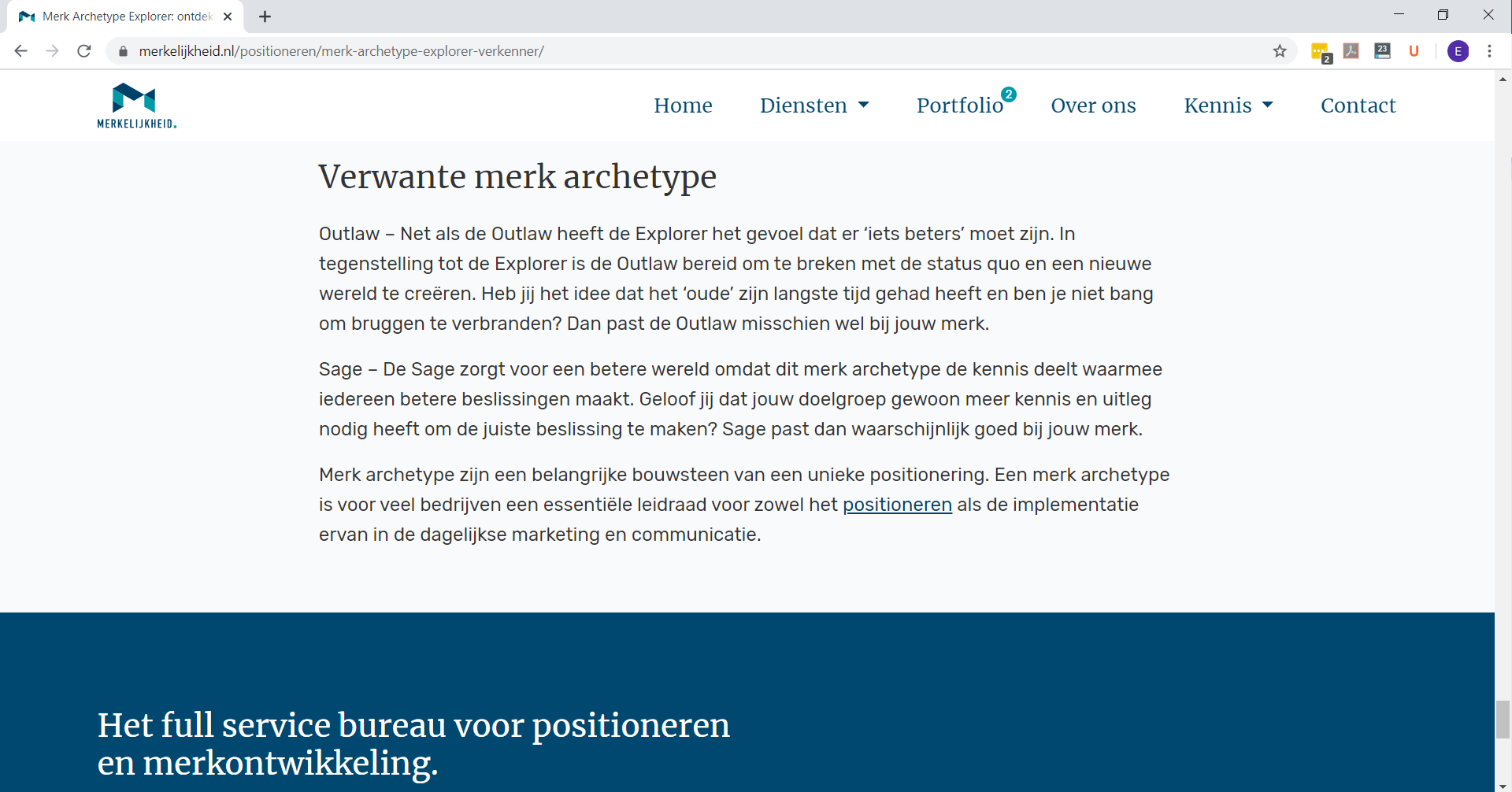
Would you like to read more about indexing your website by search engines and online marketing? We collect all our knowledge and tips on our online marketing page.
Bekijk deze vraag
What are longtail keywords?
Longtail keywords are longer search phrases made up of multiple words. These keywords typically have a lower search volume but a very clear search intent.
What Are Longtail Keywords?
Longtail keywords are specific phrases that people type into search engines when they are looking for something particular. Because they are more detailed, they usually attract fewer searches, but the people who use them are more likely to find exactly what they are looking for. This makes longtail keywords very valuable for businesses.
An Example of Longtail Keywords
Let’s explain with an example. Imagine you sell chocolate cookies with nuts and real chocolate that are sustainably produced. “Chocolate cookies” is a keyword you want to be found for, but it is a very general term. Is the person searching for chocolate cookies to buy them or to find a recipe to bake them?
Longtail keywords for your cookies could be:
- “buy chocolate cookies with nuts”
- “sustainable chocolate cookies”
- “price of chocolate cookies with nuts and chocolate”
With these longtail keywords, you will generate less traffic, but the intent of these visitors is much more aligned with your product, making them far more valuable.
Why Longtail Keywords Matter
When someone searches using a longtail keyword, they often know exactly what they want. For instance, a person searching for “buy chocolate cookies with nuts” is likely ready to make a purchase, whereas someone searching for “chocolate cookies” might be looking for recipes or nutritional information. This means that traffic from longtail keywords is more likely to convert into actual sales.
How to Use Longtail Keywords
- Content Creation: Create content that specifically targets these detailed search terms. This can include blog posts, product descriptions, and FAQs.
- SEO Optimization: Make sure your website is optimized for these keywords. This includes using them in titles, headings, and throughout your content.
- Pay-Per-Click Advertising: Use longtail keywords in your PPC campaigns to attract more targeted traffic and get a better return on investment.
The Bottom Line
While longtail keywords might attract less traffic overall, the traffic they do attract is more valuable because the search intent is clear. By focusing on these specific phrases, you can better meet the needs of your potential customers and improve your chances of making sales
Bekijk deze vraag
What are the 12 Jungian archetypes ?

Carl Jung invented the archetypes that have late rbeen adjusted for use with the marketing of brands.
12 Jungian archetypes: what are they exactly? Carl Jung, one of the founders of depth psychology, proposed that there are universal, archetypal symbols and themes within the collective unconscious of humanity. These archetypes are basic and universal concepts recognized worldwide, regardless of culture or era. They form the core of many stories, myths, and religions.
In the world of marketing and branding, the concept of Jungian archetypes has been adopted and adapted to help brands define their story and identity. By associating with a specific archetype, a brand can create a deep emotional connection with consumers. We have written several articles on this topic and a central brand archetype page with extensive information on the origin and use of this theory. You can view it here.
More information about Carl Jung.
12 Jungian archetypes
The 12 Jungian archetypes are:
- Hero brand archetype
- Caregiver brand archetype
- Explorer brand archetype
- Outlaw brand archetype
- Sage brand archetype
- Magician brand archetype
- Innocent brand archetype
- Creator brand archetype
- Jester brand archetype
- Ruler brand archetype
- Lover brand archetype
- Ally brand archetype
What does it mean that Merkelijkheid is officially a Sqrl partner?
As an official Sqrl partner, Merkelijkheid is certified to implement and manage the Sqrl platform. We know the ABM methodology inside and out and translate it into a working growth system for your organization, from strategy to daily execution.
Bekijk deze vraag
What does SEO mean?
SEO stands for Search Engine Optimization. SEO is the technique of optimizing your website so that it can be optimally indexed by search engines like Google. Optimally indexed means that your website ranks high on Google without paying for it.
SEO therefore means: optimizing your website so that Google finds it, indexes it, and gives it a high position in its search results. It is good to first consider what that entails: finding and indexing well. Finding well means that Google knows your website exists and which pages there are. Only then can the search engine send its automatic crawler to map your site. Next, Google must index the information on your pages, or give it a place in its own database. This database is what Google then uses to perform searches. By making it as easy as possible for Google to index your pages, you take the first, crucial step towards optimization. If you do it well, this will bring you visitors – and leads.
On our online marketing page you can read more about SEO.
Bekijk deze vraag
What is a backlink?
A backlink is a link from another website to your website. For example, when another organization mentions you in a blog or other webpage and includes a link to your website.
What Google reads from a backlink
A backlink is a reference to your website and is read by Google. Google extracts three things from the link:
- The anchor text used by the website to link to your website.
- The page to which the link refers—where the reader lands on your website.
- The relevance of the information on the linking website to your website.
When these three aspects align and provide Google with additional information about your website, we refer to it as a high-quality backlink. Such references are increasingly valued by Google and are therefore becoming more important for SEO.
Bekijk deze vraag
What is a content strategy?
Content strategy is the common thread in your content marketing and consists of four elements: content, goal, target audience, and distribution.
Your strategy becomes the common thread in your content marketing, so you don’t have to figure out what’s needed every week or every month. With the four elements mentioned above, you create a content marketing strategy. After that, you are ready to purposefully distribute valuable and relevant content and engage your target audience.
Want to know more? Read more about content and online marketing, for example why content marketing is truly an indispensable part of your online marketing strategy.
Bekijk deze vraag
What is a functional positioning?
A functional positioning is a basic concept for positioning a brand. Functional positioning focuses on solving a specific problem or on one clear benefit.
This basic concept usually has a clear or practical approach and often seems simple due to its straightforward nature.
A brand with successful functional positioning is associated by the entire market with one benefit or solution and thus occupies a unique market position.
There are two major risks or pitfalls with functional positioning as a basic concept:
- If the relevance of the benefit or solution on which the functional positioning is built decreases, the market position can be drastically affected. Although good positioning always allows room to respond to changing market conditions, it is difficult to completely change the basic concept. A brand that was once ‘the cheapest’ does not suddenly become ‘the best’.
- It often happens that functional positioning is insufficiently translated into a benefit or solution for the customer. Especially in a B2B environment, there is a tendency to sell the drill instead of the hole. This makes it harder for customers to assign a position to the brand compared to competitors.
Read more about functional positioning and other types of positioning that you can use as a basic concept for your positioning.
Bekijk deze vraag
What is a keyword?
By keywords, we literally mean the words used in search engines to look for information.
The keywords your target audience uses are essential for both your SEO and SEA strategy and activities. You want to optimize your website and campaigns to be found as much as possible for the keywords of your (potential) customers. Keywords therefore form the basis of your SEO, SEA, and content strategy.
On our online marketing page, you can read more about SEO, SEA, and keywords.
Bekijk deze vraag
What is a meta description?
Your meta description is a short summary of the webpage that tells visitors what they can expect from the page. This is the piece of text you see in Google search results, directly below the blue page title.
Keywords definitely count for your meta description, but not because of the value Google assigns to them. The meta description is increasingly meant for the user experience. A good meta description clearly explains what information someone will find on this page and matches their search query.
With a good meta description, you attract users. Google then considers the click-through rate important and includes that in the ranking.
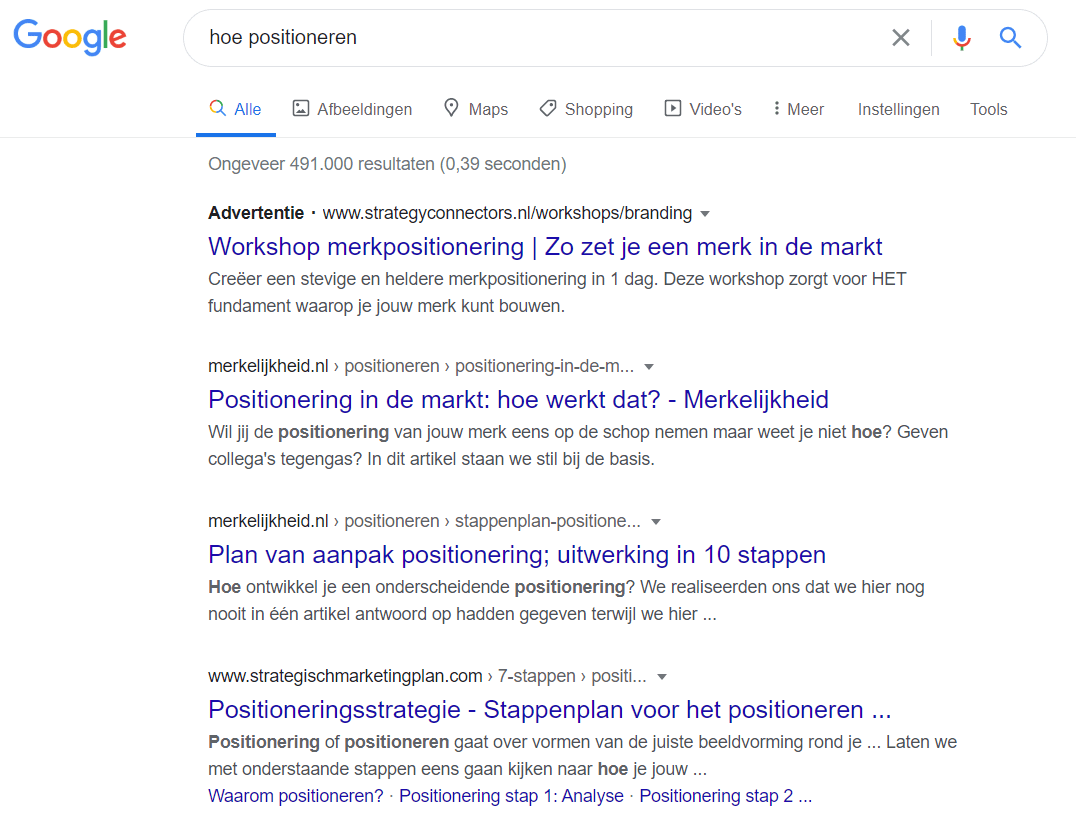
On our online marketing page, you can read more about technical SEO.
Bekijk deze vraag
What is a positioning?
A positioning is the actual or the desired position of a brand relative to the competition in the mind of the customer.
The word positioning is used to indicate both the actual and the desired position of a brand. This can sometimes be confusing, which is why in practice we often use internal and external positioning to distinguish the difference. Internal positioning is then the position the brand wants to take, external positioning is the position the market currently assigns to the brand.
Internal positioning
Internal positioning refers to the desired position of a brand relative to the competition in the mind of the customer. This is the positioning the brand must adopt under the influence of efforts in marketing, communication, and sales. Usually, this at least includes a corporate story, but in practice it is often supplemented with a positioning report containing, for example, strategic framework, market, internal analysis, and other information.
External positioning
External positioning refers to the actual, current position of a brand relative to the competition in the mind of the customer. In practice, this is often difficult for organizations to separate from the desired, internal positioning due to the proverbial blinders brands wear when it comes to their own market position.
Bekijk deze vraag
What is a search engine crawler?
A search engine crawler is the robot used by search engines that reads your website. This crawler follows links and discovers new pages and information, so your website is included in the search engine’s database.
If you hear the term search engine crawler for the first time, it might sound like a scary mythical creature, but in reality, we are talking about the robots that scour the internet for information. We have already briefly discussed what the crawler does, namely the primary process of the search engine: crawling your website.
This crawler follows links and discovers new pages and information. If the crawler is blocked by, for example, an incorrect link structure or poorly readable pages, it cannot crawl and index the information on your website, and you will not be found on Google. It is therefore essential to give the crawler the best possible access to your website!
Read more about search engine marketing on our online marketing page.
Bekijk deze vraag
What is a strong brand?
A strong brand is positioned in such a way that the target audience can make a clear choice for its products or services, thereby providing a competitive advantage over its competitors.
Fictitious example: a market for ballpoint pens has three suppliers, each with one type of pen. All the pens perform excellently, have similar ease of use, and are sold in the same places. Someone looking for a new pen goes to such a place and then chooses from these three pens. In principle, each supplier in this situation should expect a market share of 33.3%.
A strong brand in this case would ensure that the well-positioned brand, for example, has a larger market share because the target audience has a preference (can easily choose) for that brand.
Of course, there are various other benefits/indicators that can also be associated with a strong brand:
- higher margin (premium pricing)
- lower product quality with constant market share
- lower sales costs
- negotiation position of (re)sellers
In short, a strong brand provides a significant (commercial) advantage in the market.
The opposite is also true, of course: a brand that manages to position itself distinctively but fails to gain an advantage from it is not strong.
Bekijk deze vraag
What is a two-sided positioning?
A two-sided positioning is a basic concept for positioning and was developed by Floor and van Raaij. A two-sided positioning connects the characteristics of a brand with the values pursued by the target audience by explaining how it solves the problem x so that lifestyle y becomes possible.
This basic concept combines transformational and informational positioning and thus links brand characteristics with the values of the target audience.
A brand with a successful two-sided positioning takes a strong stance against its competitors because it both solves a problem and seeks connection with the values of the target audience. This makes a brand more agile and provides ample room for diverse marketing and communication.
The two-sided positioning was developed by Floor and van Raaij and is explained by them in their book. Merkelijkheid usually finds the positioning basic concepts of Floor and Van Raaij too abstract and of less practical use when developing a new positioning. Therefore, be sure to read more about two-sided positioning and other types of positioning that you can use as a basic concept for your positioning.
Bekijk deze vraag
What is an execution positioning?
An execution positioning is a basic concept for positioning and was developed by Floor and van Raaij. An execution positioning does not focus on the characteristics of the brand or the values of the target audience but rather on a specific campaign.
This basic concept does not start with your own product, service, or target audience but revolves around a campaign with which the brand wants to distinguish itself in the market. It is mainly applied in markets where individual brands, and their products or services, are not very distinctive.
A brand with a successful execution positioning can still differentiate itself from the competition in a homogeneous market and thereby gain a higher market share.
The downside of an execution positioning is, of course, that the success of the brand depends entirely on the success of the campaign. This makes execution positioning quite risky and often capital-intensive.
Execution positioning was developed by Floor and van Raaij and is explained by them in their book. Merkelijkheid usually finds the positioning basic concepts of Floor and Van Raaij too abstract and of less practical use when developing a new positioning. Therefore, be sure to read more about execution positioning and other types of positioning that you can use as a basic concept for your positioning.
Bekijk deze vraag
What is an experiential positioning?
An experience-oriented positioning is a fundamental concept for brand positioning. An experience-oriented positioning uses sensory interaction – touch, smell, color and shape, sound, or taste – to associate a specific feeling with the brand.
This basic concept revolves around emotion. By linking the brand to a particular experience or feeling, the target audience feels a profound connection.
A brand with a successful experience-oriented positioning knows how to distinguish itself in a unique way from its competition by offering its own, unique experience. The brand can even create an entire world around itself, thereby taking an almost untouchable competitive position.
The best example of experience-oriented positioning is probably Red Bull. Red Bull not only gives you wings, step into the world of Red Bull and fly, bike, snowboard, jump, and fall with the biggest daredevils there are.
Read more about experience-oriented and other types of positioning that you can use as a basic concept for your positioning.
Bekijk deze vraag
What is anchor text?
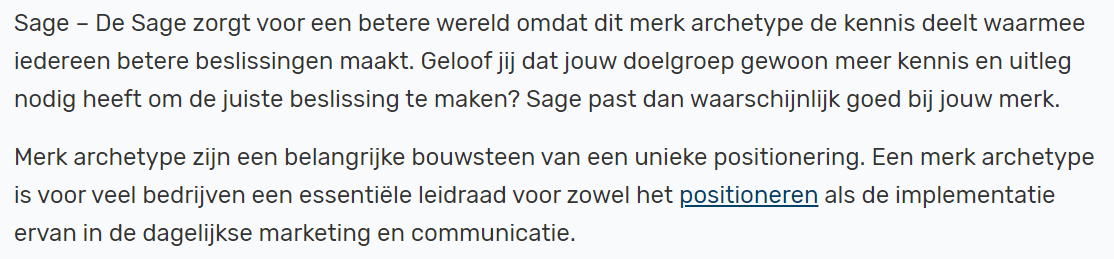
Anchor text is the clickable text of your hyperlink. Often, the anchor text on a website is underlined or colored, as shown in our example.
Importance in link building
For link building, it is important that this text indicates something about the link and the page it leads to, as this helps Google better index the link and the page. Therefore, we prefer not to use anchor texts like “click here” because they don’t provide any valuable information about the page.
Example of effective anchor text
In our example, the anchor text is blue and underlined. Here, the word “positioneren” links to our Dutch page on the subject, so the anchor text indicates something about the content of the page
What is content marketing?
Content marketing is a strategic marketing approach focused on creating and distributing valuable and relevant content with the ultimate goal of attracting or retaining a specific target audience.
Want to learn more about content marketing? Then also check out our online marketing page.
Bekijk deze vraag
What is Domein Autority?
Domain Authority (DA) is an algorithm that predicts how valuable your website is in search results. DA ranges from 1 to 100, and the higher your score relative to your competitor, the greater the chance that your website will rank at the top of Google.
Factors affecting Domain Authority
Various factors determine your Domain Authority, such as the age and quality of your domain, but the most important factors are the number of links and the number of different domains from which you receive links. The more links and different domains, the better. Domain Authority is therefore an important metric when you are actively working on link building.
Read more about Domain Authority.
Bekijk deze vraag
What is informational positioning?
An informational positioning is a basic concept for positioning and was developed by Floor and van Raaij. An informational positioning explains how a product or service solves a specific problem.
This basic concept is based on information and facts. The informational positioning links the features of your product or service to the solution the target audience is looking for. Therefore, we also call the informational positioning the ‘problem solver’. The Witte Reus slogan “Washes a mountain, costs a little” is a classic example of this.
A brand with a successful informational positioning quickly becomes inseparably linked to (the solution of) a problem due to its focus and simplicity. The target audience no longer has to think about a choice.
The downside of informational positioning is that many purchasing decisions, especially in B2B, involve longer consideration. This simple positioning concept then loses out because the customer realizes that there is not just one solution to the problem. Witte Reus loses when the customer wonders: all detergents clean, but does it also smell nice?
The informational positioning was developed by Floor and van Raaij and is explained by them in their book. Merkelijkheid usually finds the positioning basic concepts of Floor and Van Raaij too abstract and of less practical use when developing a new positioning. Therefore, be sure to read more about informational positioning and other types of positioning that you can use as a basic concept for your positioning.
We also call an informational positioning the ‘problem solver’. Your product or service is essential for solving a problem, and you build the positioning around that.
Bekijk deze vraag
What is keyword research?
Keyword research is the process of identifying which keywords your target audience uses and which are relevant to your website.
You always start keyword research with yourself: which products or services do I offer, and into which markets, target groups, or categories can I divide them? Then you look for other relevant terms related to your product, such as different names, technologies, and topics or questions that interest your target audience.
We evaluate the keywords based on the level of competition, volume, and search intent. Ultimately, we want a list of possible (longtail) keywords and the expected monthly search volume.
Read more about keyword research on our online marketing page.
Bekijk deze vraag
What is linkbuilding?
Link building is a crucial part of online marketing that helps improve your website’s visibility on search engines like Google. Imagine you have a website about gardening. Link building is like getting recommendations from other websites that tell Google your site is trustworthy and valuable.
What is Link Building?
In simple terms, link building is the process of getting other websites to link back to your website. These links are called backlinks. Think of backlinks as votes of confidence from other websites. The more votes (backlinks) you have, especially from reputable sites, the more likely Google is to rank your website higher in search results.
Why is Link Building Important?
Google uses complex algorithms to decide which websites to show first when someone searches for something. One of the factors it considers is how many quality backlinks your site has. Quality is key here. A link from a well-respected site, like a major news outlet or a well-known blog, is worth much more than a link from a small, obscure site.
How Does Link Building Work?
- Creating Valuable Content: The first step in link building is to have high-quality content on your website. This could be informative articles, helpful how-to guides, or engaging videos. When other websites find your content useful, they are more likely to link to it.
- Outreach: This involves reaching out to other website owners, bloggers, and influencers in your industry to let them know about your content. If they find it valuable, they may link to it from their own websites.
- Guest Blogging: Writing articles for other websites in your industry is another effective link-building strategy. In return for your contribution, these websites will usually allow you to include a link back to your site.
- Engaging in Online Communities: Participating in forums, social media groups, and online communities related to your field can help you build relationships and naturally earn backlinks.
The Bottom Line
Link building is about creating relationships and sharing valuable content. It’s a way of telling Google that your website is worth visiting, which can help you attract more visitors and grow your online presence. By focusing on quality and relevance, you can make your website stand out in the crowded online world
Bekijk deze vraag
What is online marketing?
Online marketing is the use of online channels and resources to promote and sell a brand, product, or service on the internet.
The online marketing field is large and very diverse; channels include your website, newsletter, social media, and email. Online marketing encompasses all the ways we can utilize these channels and techniques we apply such as SEO, SEA, and content marketing to ensure that your brand, product, or service stands out. Depending on your strategy, this means guiding your target audience as far as possible through the purchasing process.
We regularly write articles about online marketing and gather all our knowledge and tips on our online marketing page.
Bekijk deze vraag
What is Sqrl?
Sqrl is an Account Based Marketing platform specifically built for B2B organizations in the SME+ (mid-market). It combines software with strategy to systematically identify, nurture, and convert valuable target accounts into Sales Qualified Leads. As an official Sqrl partner, Merkelijkheid implements both the platform and the associated methodology.
Bekijk deze vraag
What is symbolic positioning?
A symbolic positioning is a fundamental concept for brand positioning. A symbolic positioning connects the brand with a specific group, role, or (higher) self-image that appeals to the target audience.
This basic concept revolves around status and identity. By becoming a customer of a symbolically positioned brand, the customer claims the same traits or status.
This is evident with luxury brands like Hermès or Louis Vuitton: the customer buys status, prestige, or position within a group. But many well-known brands in B2B are also symbolically positioned. Think, for example, of McKinsey or IBM; it’s all about status and prestige. For years, it was even said about IBM: nobody got fired for hiring IBM.
A brand with successful symbolic positioning across the entire market is associated with a certain group, position, or status and thus occupies a unique market position. Additionally, the positioning is abstract, which makes it easier for a brand to adjust and respond to changing market conditions. As long as the same symbolic positioning remains central.
Read more about symbolic positioning and other types of positioning that you can use as a foundational concept for your positioning.
Bekijk deze vraag
What is the cost of a Sqrl program at Merkelijkheid?
A Sqrl program operates with a fixed annual investment, depending on your ambition and the number of target accounts. In an introductory meeting, we calculate together which pipeline that realistically generates, so you know in advance what you will get back. More impact, less waste. That’s what we focus on.
Bekijk deze vraag
What is the definition of positioning?
The purposeful connection of a brand with such a collection of characteristics, associations, and attributes that the brand acquires a unique own place in the mind of the customer compared to the competition.
Al Ries and Jack Trout first used the term ‘positioning’ in their article: ‘Positioning is a game people play in today’s me-too market place’ and then wrote the book ‘Positioning: The Battle for Your Mind’.
They were the first to explain that the target audience visualizes a map of the market in their mind in which they place brands relative to each other. Each brand has its own positioning. Positioning is then the (re)direction of the position of a brand in the mind of the target audience.
Merkelijkheid is a positioning expert and has written, in addition to this FAQ, dozens of articles about positioning.
Bekijk deze vraag
What is the definition of proposition?
The definition of a proposition is: “An easy-to-understand reason why a customer should choose a specific brand, product, or service now, over all competitors and alternatives.”
A proposition is the simple statement that convinces people by emphasizing the truly distinctive power of an offer and creating urgency. At the moment of truth (Moment of Truth), a customer chooses a brand. This applies to a consumer in the supermarket, but also to the purchasing committee of a large company in a meeting room. All marketing and sales efforts have led to this moment, and it is the proposition that can make the difference at such a moment.
A simple statement ensures there is a clear choice, your brand or the competition, and that your customer can easily remember it. The clearer the consideration, the easier it is to convince people when it matters. By focusing on the truly distinctive power of your brand, you stand head and shoulders above the competition. Finally, there is the opportunity to create urgency—why is now the moment to choose your brand?
We also wrote extensively about the difference between positioning and proposition.
Bekijk deze vraag
What is the difference between ABM and traditional lead generation?
In traditional lead generation, you fill the funnel with as many individual leads as possible. With Account Based Marketing (ABM), you reverse this: you select the accounts that truly matter in advance and focus marketing and sales specifically on them. We believe in ABM. It results in fewer, but much more valuable appointments and leads.
Bekijk deze vraag
What is the difference between proposition and positioning?
The proposition must convince people at the moment of truth to choose a brand, while the positioning determines the position the brand occupies in the customer’s mind relative to the competition.
The proposition therefore aims to make a sale, whereas the positioning must distinguish the brand as clearly as possible from the competition. They are related but at the same time completely different concepts.
Think of a high-end, luxurious brand whose product is certainly 30% more expensive than that of other brands in the same market. Buying a product from this brand carries a unique status due to the positioning, partly because of the lifetime warranty and an excellent user experience.
But suddenly you get the following offer (proposition): Today only, 50% off.
That is the difference between positioning and proposition.
Bekijk deze vraag
What is the LinkedIn Insight Tag and how does it help your campaigns?
What is the LinkedIn Insight Tag?
The LinkedIn Insight Tag is a piece of code you place on your website to track the behavior of your visitors. It collects data about visitors who interact with your LinkedIn ads. For example, it measures demographic information such as age, job title, and location, as well as actions like filling out a form, clicking on links, or viewing specific pages. By gathering this information, you gain better insight into how your campaigns perform and can make targeted improvements to reach your audience more effectively.
How does the LinkedIn Insight Tag work?
The LinkedIn Insight Tag is a piece of code placed on your website that tracks your visitor’s behavior. When someone visits your website, this code is activated and collects data, such as demographic details (e.g., job title, company, and location), pages visited, and actions taken. This might include filling out a form, clicking a link, or completing a purchase. Additionally, the tag tracks whether visitors have seen or clicked on your ads. The collected data is sent to your LinkedIn account, where you can analyze how your campaigns perform and what actions visitors take.
How do you install the LinkedIn Insight Tag?
Installing the LinkedIn Insight Tag is straightforward and requires just a few steps. You can add the code to your website’s source code or use a tool like Google Tag Manager. LinkedIn provides a guide to validate the installation and ensure the tag is working correctly. For comprehensive and accurate data collection, it’s recommended to place the tag on all pages of your website, giving you a complete overview of visitor behavior.
Why should I use the LinkedIn Insight Tag for my campaign?
The LinkedIn Insight Tag is a valuable tool for businesses using LinkedIn ads. By placing the tag on your website, you gain detailed insights into who your ads are reaching and what actions they take. This information allows you to better tailor your campaigns to your audience and apply strategies like retargeting for visitors who have already been to your website. With these insights, you can optimize your ads, leading to more conversions and a higher return on investment (ROI).
How can I track the performance of the LinkedIn Insight Tag?
To ensure the LinkedIn Insight Tag is working correctly, you can view the collected data in your LinkedIn Campaign Manager. Here, you can monitor your ad performance, such as the number of conversions, clicks, and impressions from users who interacted with your site. Additionally, you can use the ‘conversion tracking’ feature in your LinkedIn account to see what actions visitors took after viewing or clicking on your ads. This provides detailed insights into your campaign’s effectiveness and helps verify that the tag is installed correctly, and the data is being collected accurately.
How do I comply with privacy and data usage regulations?
When using the LinkedIn Insight Tag, it’s important to comply with privacy laws, such as the General Data Protection Regulation (GDPR). Ensure that you inform your visitors about the use of cookies and data collection through a privacy policy. You can also add a cookie banner that allows visitors to give consent before the tag collects any data. LinkedIn provides a guide on how to use their tools in a way that adheres to privacy regulations.
Is the LinkedIn Insight Tag free to use?
Yes, the LinkedIn Insight Tag is completely free to use. There is no cost to install the tag on your website and collect data. This makes it an accessible tool for businesses of all sizes. However, keep in mind that using the tag within LinkedIn campaigns requires an advertising budget. Nonetheless, the tag itself provides valuable insights at no cost, helping you optimize your ads and improve your marketing results.
Bekijk deze vraag
What is transformational positioning?
A transformational positioning is a fundamental concept for positioning, developed by Floor and van Raaij. A transformational positioning focuses on how the brand enables a certain lifestyle or way of living.
This basic concept is also called the ‘lifestyle’ positioning because the brand is connected to (enabling) the desired lifestyle or way of living of the target audience.
A brand with a successful transformational positioning can expect a higher margin or market share because it connects so deeply with the desires and identity of the target audience.
The downside of a transformational positioning is that its success is determined by the degree of authenticity. If your brand and organization merely pretend to tell a story, the target audience will see right through it and ignore it.
The transformational positioning was developed by Floor and van Raaij and is explained by them in their book. Merkelijkheid usually finds the positioning basic concepts of Floor and Van Raaij too abstract and less practical when developing a new positioning. Therefore, be sure to read more about functional positioning and other types of positioning that you can use as a basic concept for your positioning.
Bekijk deze vraag
Why is a positioning so important?
A distinctive positioning is the foundation of successful marketing Positioning is about the place your brand holds in the minds of your target audience compared to the competition. Additionally, positioning helps you make decisions in marketing and communication. Brands with unique positioning are more successful: they sell more, have higher margins, or can more easily attract good employees.
Importance of positioning
In our minds, we have given each brand a place within each category or market (in both B2B and B2C). Think, for example, of a car brand like BMW. How does BMW differ from Mercedes-Benz and Audi? Within a second, your feelings about these three brands emerge. But can you put this difference into words? You likely have a preference for one of these brands—so which one do you choose?
This is the power of distinctive positioning. Your target audience can effortlessly distinguish your brand from the competition and thus make the right choice. It’s almost subconscious, which makes clear positioning crucial for modern brands. Positioning helps your brand stand out while your audience is bombarded with marketing from all sides.
Positioning is not only important for your communication with customers but also internally. Positioning helps you make decisions. Should your brand attend a trade show or organize an online event? Do you address people as ‘you’ or more formally? Do you include people in your photos or not? When you answer these questions with your positioning in mind, you can make decisions more easily and ensure that your communications do not contradict each other. Everything you do conveys the same message: the positioning.
Bekijk deze vraagGeen vragen gevonden. Stel je vraag gerust direct aan ons.
Staat je vraag er niet tussen?
Stel hem direct aan een van onze specialisten. We denken graag met je mee.