Price & positioning: the difference between price and value
What do you do when your potential customers say your product or service is too expensive? Many entrepreneurs then think of a promotion or price reduction, while they actually need to go in the opposite direction. By focusing on value, a brand can sustainably differentiate itself, retain customers, and lay the foundation for a unique positioning. We take the question from a car company as a starting point to discuss the role of price in positioning.
Price & positioning: is it all about price?
 As experts in positioning, Merkelijkheid often receives questions from graduating students about the theory and application of it in, for example, a thesis. We are happy to share interesting questions and corresponding answers as articles or in the FAQ so that other students and marketers can also learn from them.
Price often causes confusion, as we received the following question:
“Interviews and surveys among current and potential customers of a car company show that they see price as a determining factor in whether or not to become a customer. Should price therefore be a prominent part of my positioning or proposition and an axis in the positioning matrix?”
The role of price in positioning
Everyone finds price important. For many people, price and value are the same. Most consumers assign more value to a 10% more expensive Apple iPhone than to a Samsung phone with similar specifications. We see the same with service providers such as car companies. A dealer almost by definition charges a higher price than a regular car company, while both apparently fulfill the same need: a running car.
So it’s about value. With (approximately) equal price, people choose the product to which they assign the highest value. If people indicate that they do not choose your company because of the price, it is not a matter of lowering the price but of increasing the value perception!
As part of a positioning process, we always investigate what the most important factors for differentiation are in a market. Interviews with customers, suppliers, and other relations are often invaluable to determine how your brand can sustainably differentiate itself in the market. Our proven methodology ensures that you can quickly get started with your positioning. Learn more about our approach.
Alternative to price in positioning: value
Much more interesting is a conversation about what ‘value’ means for your brand; how do you increase the value of your product or service?
This student is therefore working for a car company that has difficulty conveying their value. The competition offers, for a comparable price, a service that the customer perceives as more valuable. How can this company ensure that customers are willing to pay a certain price for their services? How can you increase the value perception?
Differentiation of car companies
Everyone has their own image of car companies. But based on our experience, we would approach the following:
- Ensure a neat, clean, and well-lit workshop
- Provide a pleasant, tidy reception
- A nice waiting area
- Something nice to drink
By addressing the above points, customers get a good feeling about a car company. They gain more confidence in the quality if it is in order on points they do understand. But we don’t stop there; you can do much more to further differentiate your brand:
- Communication: always be friendly, concrete, and clear. Tell when the work will be finished, what it costs and why, what options the customer has, inform proactively, and think along
- Reliability: doing what you say is still underestimated far too often. Make sure the car is actually ready at the agreed time and that the price is correct (no tricks!).
- Exceed expectations: For a major repair, have the car ready washed, clean the interior, or perform some important checks (oil level, tire pressure, brakes). Even if someone comes by for a tire change.
- Show, don’t tell: Let the customer speak about how you made a difference for her, a mechanic explains everything about a maintenance inspection, or a salesperson shows a new car inside and out. In automotive, content marketing is still underutilized.
What we describe above are aspects of excellent service: everything around the core product is arranged down to the last detail. Marketing and communication then ensure that your customers know why they should choose your company.
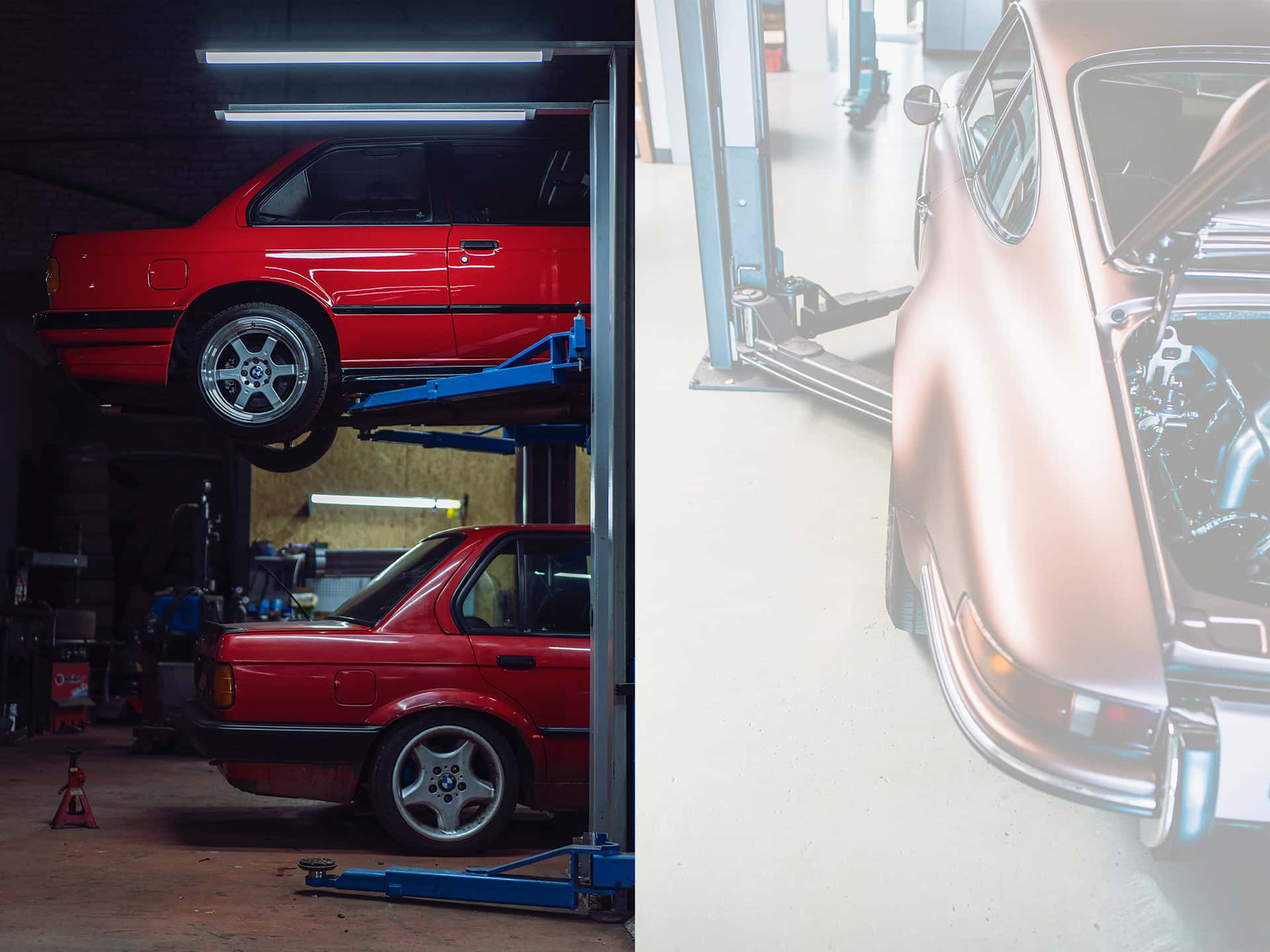
Which garage can ask the highest price?
Other markets
The point we make in this article naturally applies just as well in other markets. If a customer chooses between two manufacturers; one is a traditional dark factory while the other environment is clean and well-lit. Which one do you think gets the preference?
And these are more than hygiene factors. A neat, well-lit work environment stands for dedication and attention to your product or service. Especially when the customer finds it difficult to estimate the end result, such factors are often decisive. From this, they infer what kind of quality they actually have. It is therefore worthwhile to look attentively at your own service to find points of attention with which you can further increase the value perception of your product or service.