Translating Brand Strategy into Positioning in 5 Steps
What exactly is the difference between brand strategy and positioning? After reading this article, you will know the difference between the two concepts and how to translate a brand strategy into a positioning.
Difference between brand strategy and positioning
Brand strategy and positioning are very closely connected. Brand strategy is the way a brand (or brands) is used to achieve the (business) objectives. Positioning is then taking a unique position relative to competitors in the mind of the customer. Of course, these two concepts go hand in hand when it comes to success for your brand and organization.
In this article, we explain how to translate your brand strategy into a distinctive positioning. Want to know more about brand strategy? We also wrote an extensive article about it.
From brand strategy to positioning
For convenience, we assume here that you have a solid brand strategy. We therefore focus on presenting distinctively; positioning.
 Step 1: Map out competitor positioning
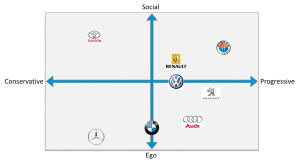
To map the market, and especially the positioning of the competition, we use our own positioning matrix. We usually use the degree of progressiveness and ‘sociality’ of the competitors’ marketing/positioning as both axes. By mapping the marketing activities of the main competitors and then placing the competitors in the matrix, a clear market picture emerges. If other factors are decisive in your market, you can also use these as axes.
Step 2: Objectively determine your own position
You now have a good picture of the competition, but where do you stand? Place your brand in the matrix based on current efforts and you can view the situation in a very different light. It is essential here not to think too much from your own perspective, but from the target audience’s. If necessary, ask some customers what they think of you. The big danger here is that companies do not do this objectively but tell how they want to be seen.
Step 3: Where is there room for a distinctive positioning?
Now that you are in the matrix, you can easily see where there is room to position your brand distinctively. Often a market consists of ‘penguins’, companies that mainly look at each other, and are therefore all in a certain quadrant. Identify places that are ‘free’ and associate characteristic behavior that belongs to this ‘positioning’. To really be able to choose, we recommend working out at least 3 free positions.
Step 4: Determine remarkable positioning
Now that we have a list of ‘free’ positions and the behavior associated with them, we use the brand strategy to specifically develop each position for your brand. These are often brain teasers, because one of the pillars of your brand strategy might be innovation, and then it is difficult to think of a conservative way of communicating. But it is precisely these apparent contradictions that create an interesting and remarkable positioning!
Step 5: Implementation
We could write a whole book about this last step, because coming up with it is one thing, executing it is quite another. The success of both brand strategy and positioning depends on whether your colleagues can work with it. They have to put it into practice and make it central in every customer contact. It is your task to provide them with the explanation, training, resources, and support they need. So also ask yourself: How does this advertisement contribute to the story my colleagues tell our (future) customers?
Now that you can concretely name the difference between brand strategy and positioning, you are able to make the translation from brand strategy to positioning. The mentioned steps are of course unique for every company and every market, and so you will also encounter unique challenges and questions for your brand during this process. Let us know if we can help you with this.