Positioning
Why positioning is essential.
Positioning is the process by which an organization presents itself to stand out from the competition and create a positive brand image. Done right, it drives revenue, fuels growth, and energizes your team. Let us help you (re)position your organization for success!
Defining Positioning
The strategic act of connecting a specific set of characteristics, associations, and traits to a brand so that it occupies a unique place in the customer’s mind relative to the competition. And within that unique position, you must strive to be the best.
We explore this in depth in ‘The meaning and definition of positioning‘.
While we cover all aspects of positioning here, we can’t dive into every detail in a single post. Throughout this guide, you’ll find links to dedicated articles for deeper dives. If your question isn’t answered yet, feel free to email us and we’ll gladly add it!
Many brands behave like penguins. They mimic one another—using the same buzzwords (think: “customer-centric,” “innovative”), adopting identical color palettes, and telling the same story. Even their hospitality feels interchangeable, missing a prime opportunity to differentiate. The result? Zero distinctiveness. Like penguins on an ice floe, they are impossible to tell apart. This makes it incredibly difficult for customers to choose.
In the real world, companies in this situation often end up in a race to the bottom on price. But there is a better way. What do you do when prospects say your product or service is too expensive? Many entrepreneurs immediately think of discounts or price cuts, but they should be heading in the opposite direction. By focusing on value, a brand can stand out permanently, build customer loyalty, and lay the foundation for a unique position. Positioning and price go hand in hand.
A brand with a unique story can distance itself from the pack and claim its own market territory. It builds brand affinity with its target audience. That process—systematically working toward a strategically desirable market position—is called positioning.
Why position? The value and absolute necessity
While the economy may be thriving, the lean years are still fresh in the minds of many business owners. During those times, many companies played it safe, settling for “business as usual.” Positioning was ignored, and opportunities were missed. Now that there’s room to grow again, that passive attitude often lingers—and it’s a mistake. We’ve identified seven reasons why working on your positioning is crucial.
- Lack of differentiation due to a “watered-down” brand
- The shifting customer journey
- A remarkable story is more important than ever
- Competitors are using virtually the same positioning
- Employees don’t feel a connection to the brand
- Customers are starting to shop around
- The need to capitalize on a strong economy
Read more about the background of these reasons in ‘7 reasons why your positioning is more important than ever’. Even from the customer’s perspective, there are 7 key points on which a B2B buyer evaluates your positioning and brand—and that list might surprise you.
There are also larger strategic questions where positioning plays a vital role. For instance, what happens when you acquire another company? Is it better to serve the market under a single brand, or would that destroy value? Brand strategy during acquisitions is a sudden, critical issue for many firms. Markets never stand still; the brand architecture and hierarchy that worked yesterday might be obsolete today. But how do you determine that? A major part of positioning is how you put brand strategy into practice, which is why we’ve outlined the 5 essential steps for you.
At Merkelijkheid, positioning has been our North Star since day one. We view it as the bedrock for all marketing and communication. We aren’t the only ones who think so anymore, but to clarify the necessity of this process, we developed the Merkelijkheid Matrix.
The Merkelijkheid Matrix
The Merkelijkheid Matrix represents the core of positioning: how you want to be perceived versus how the market actually sees you. It’s clear that a brand that views itself as “an Apple” but is seen by the market as “a Dell” has a problem. The matrix provides a clear picture of both the current situation and the strategic path forward to change it.
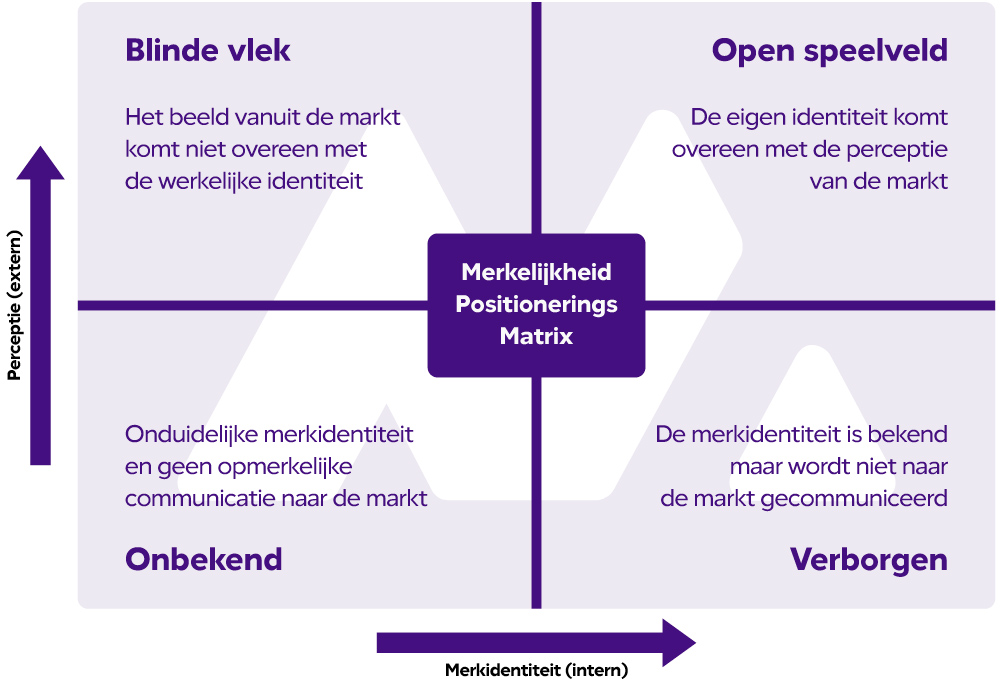
Our ideal clients often find themselves in the ‘Hidden’ quadrant. The brand knows exactly why they are great, but they struggle to communicate that value to the market. We discuss the model and its quadrants in detail in ‘The Merkelijkheid Matrix for brands and organizations‘.
Once people see the Matrix, it usually clicks: “We need to work on our positioning.” But what does that actually look like in practice, and when can we call it a success?
What makes for strong positioning?
We distinguish four crucial aspects of positioning. These give direction to the process, allow you to evaluate ideas, and serve as your guide for implementation. The key pillars of rock-solid positioning are:
- Purpose – A clear, understandable goal gives your team direction and helps customers make their choice.
- Emotion – Even the most rational engineer subconsciously lets their feelings influence a buying decision. Your positioning must evoke the right emotion.
- Consistency – Innovation tomorrow, lowest price today? Eventually, no one knows what your brand stands for. Be consistent!
- Flexibility – Positioning must be “broad” enough to grow and evolve with the brand.
In ‘4 aspects of rock-solid positioning‘, we use examples to dive deeper into these pillars. We also outline the 7 steps to distinctive positioning.
The goal is clear and the necessity is obvious, but now for the hard part: where do we start? To determine that, you need an overview of the “moving parts” involved.
The components of positioning
Because positioning is so versatile and multi-faceted, several elements work together to form the whole. These are:
- Positioning Concept
- Positioning Pitch
- Brand Story
- Value Proposition
- Core Values
Think of the Concept, Pitch, and Story like a newspaper article. The headline (the Concept) tells you the most important bit and sets the tone; the first paragraph (the Pitch) delivers the core of the message; and the rest of the piece (the Story) provides the background that leads to full understanding. The Value Proposition then translates this into the actual “offer” you make to customers.
For many companies, Core Values are an end in themselves—using “customer-centricity” as a value to force employees to behave better. We prefer to put positioning at the center, with core values serving as helpful reminders.
We discuss these components in ‘Positioning components: what exactly makes up a position?‘.
Many brands are tempted to simply “choose” the positioning they find most attractive. Why shouldn’t a startup computer manufacturer position itself like Apple? In reality, the comparison isn’t that simple, and the downsides are often less obvious.

Positioning is not a mask you can easily swap or take off.
Choosing your positioning: Is there an ideal spot for your brand?
Brands working on their positioning for the first time are often looking for “the best one.” They believe there is a single magical position that will make leads pour in and brand awareness skyrocket.
In practice, positioning isn’t something you can just “fabricate.” Critical factors like organizational culture and history aren’t easily changed. And then there’s your market: positioning in professional services is a different beast than in heavy industry, to name just one example.
In ‘Choosing positioning: is there an ideal spot for your brand?‘ we discuss the influence of corporate culture, market dynamics, and competition to help you determine which position fits your brand best. To be clear: that isn’t necessarily the positioning of Tesla or Apple.
Enough theory? Let’s make it concrete.
Positioning Roadmap (10 Steps)
Our roadmap breaks every positioning project down into 10 steps:
- Burning platform (The “Why”)
- (Market) Research
- Strategic Framework
- Ambitions and (Brand) Values
- Competitive Differentiation
- Positioning Pitches
- Brand Story
- Defining Proposition and Core Values
- Compiling the Positioning Document
- Implementation
While we’ve touched on many of these individually, ‘Positioning Roadmap: a 10-step plan of action‘ lays them all out. We discuss the high-level goals of each step and share resources for deeper study.
Crucially, we provide short, actionable tips for every stage. You can dive even deeper when needed—for example, mapping the customer journey during your market or positioning research. In the fifth step (Differentiation), it’s essential to decide with your team which factors you will use to set the brand apart from the pack.
To guide the actual drafting of your position, it helps to understand the different “flavors” available.
Types of positioning: What are the different approaches?
Classic textbook positioning often references the theory of Floor and van Raaij. They distinguish four types:
- Informational positioning
- Transformational positioning
- Two-sided positioning
- Execution-based positioning
We make these concrete in ‘4 Types of positioning: from SAP and IBM to Airbnb‘, weighing the pros and cons with plenty of real-world examples.

Caterpillar has succeeded like no other B2B company in its positioning.
Because many of our clients find it hard to translate consumer brand examples into a B2B environment, we offer an alternative approach in ‘10 Surprising Alternatives to Functional Positioning in B2B‘.
In this piece, we take classic B2C examples and translate them into B2B/industrial equivalents. We expand your horizons by categorizing them into these core concepts:
- Functional Positioning
- Symbolic Positioning
- Experiential Positioning
There are numerous models you can use to find the “type” that fits your brand. We’ve highlighted the ones you can use immediately.
Positioning Models: Which ones should you use?
Every team has its preferences. Fortunately, there is a positioning model for every taste. Depending on the situation, we use one or more of the following:
- MCD Model
- McKinsey Brand Driver Model
- Unilever Brand Key Model
- Positioning Matrix
- Golden Circle Model
- Competitive Matrix
We discuss three common scenarios and how these models apply to them in ‘Positioning Models: which one should you use?‘.
Many other models exist, but we often find them less practical. They tend to be process-oriented—telling you what to research, but not what to do with the results. The models above are chosen for their practical utility.
The difference between Positioning and Proposition
“Proposition” and “Positioning” are often used interchangeably, leading to confusion. However, a powerful proposition and strong positioning can amplify each other significantly.
In the detailed article ‘The difference between Positioning and Proposition‘, we set the definitions side-by-side. The proposition aims to close a sale, while the positioning aims to distinguish the offer from the competition. Put simply: the proposition is the “offer” a brand makes.
When looking at famous brands, it’s clear that the proposition flows from the positioning. Toms Shoes has a proposition of ‘One for One,’ while the brand’s positioning centers on creating a better world.

Distinctive positioning in the market is the primary challenge for many companies.
Positioning in the market
You have the theory and the tools—now, how do you use them in the real world? How do you move an entire organization? Using a clear example, we explain how these elements relate and give you the tools to take decisive action.
Everyone has a different idea of what positioning means. This is tricky because if we aren’t aligned, we can’t work as a team. In ‘Positioning in your market: how does it work?‘, we discuss how to manage this alignment.
Positioning Research: Mapping the competition in 5 steps
The “market” can feel like a vague constant. Many brands think they know their competition and wear proverbial blinkers during the positioning process. This is dangerous, as you’ll likely overlook significant opportunities to stand out.
But what exactly should you research? This varies by company and market. Large corporate firms often have a small target audience, making customer research less fruitful than competitive research. For a car manufacturer, it’s a different story. We always research the competition, and we focus on that in ‘Positioning Research: mapping the competition in 5 steps‘.
The biggest pitfall after research is letting subjective feelings about competitors take the lead. Statements like: “They say that, but it isn’t true,” are common—but your customers don’t have that insider knowledge. You must compare the competition as objectively as possible.
The Positioning Matrix
A realistic, objective view of the market is critical to success. With a positioning matrix, you plot all competitors based on their message and behavior, providing a visual overview.
Here is an example of a positioning matrix for car brands:
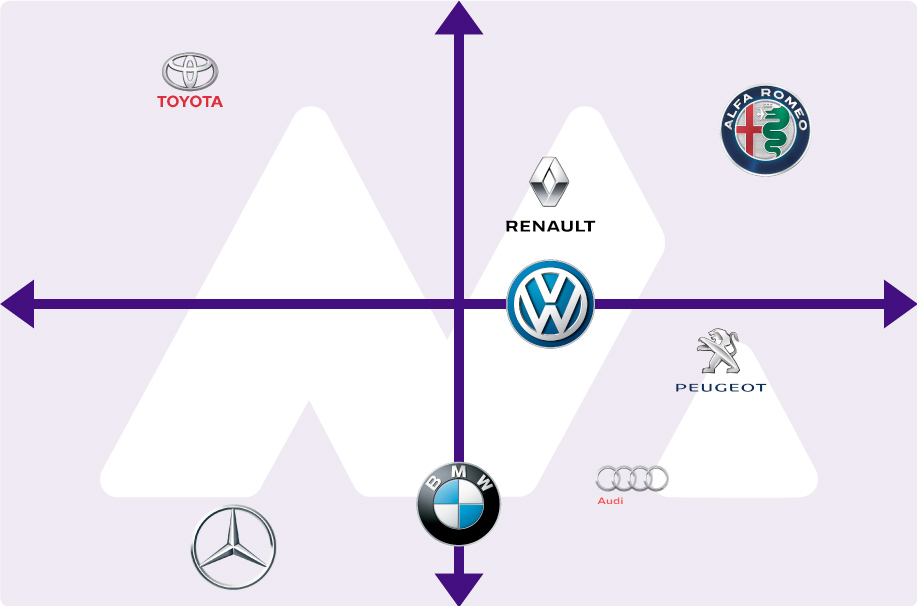
We often use axes ranging from Progressive to Conservative, and from Ego to Social. The first refers to brand behavior and marketing style. For example, ING was the first major Dutch bank to offer a true mobile app experience, making them “Progressive.” We capture the content of the message with the Ego vs. Social axis—who is at the center of the story? The company, the customer, or the community?
These axes aren’t set in stone. Use the factors that matter most in your market, determine the average, and plot each competitor relative to that average and one another. You’ll quickly see where the “white space” is. Read more in ‘Creating a positioning matrix for your brand: explanation and examples‘.
To stick with the banking example: why is Van Lanschot successful? They are far less social and progressive than their competitors, but that’s exactly why it works—it allows customers to make a deliberate choice for a specific brand identity.
For the students out there: a positioning matrix is also sometimes called a competitive matrix. Confusing, isn’t it?
Positioning Lessons and Pitfalls
Failing to objectively compare your brand and desired position against the competition is the biggest pitfall the matrix tries to solve. But there are more lessons to share.
‘Zero differentiation: 5 classic positioning mistakes‘ discusses the errors identified by the founders of positioning theory. In today’s world, one stands out:

Great people are crucial, but they aren’t a basis for distinctive positioning.
Your people are not a USP
Subconsciously, we all assume the best people work for the biggest/best companies. If you have a high reputation, the market already assumes your people are great.
There are many ways to get it right, too. We share ‘6 lessons that have remained central since 1970‘. The overarching theme? Simplicity. Ensure you are known for one thing and use a clear message to convey it.
We also offer inspiration through 5 positioning quotes.
What exactly is a Positioning Strategy?
By now, you know what positioning is, but what about the strategy? A positioning strategy defines how a brand will occupy its desired position.
In the positioning phase, you’ve made choices regarding channels, style, and tone. In the strategy phase, you turn these into an actionable approach. We discuss this further in ‘Positioning Strategy: a short and clear explanation‘.
Your positioning strategy forms the basis for your implementation.
Implementing your positioning in 9 steps
Implementation is often the overlooked stepchild of the positioning process—as if it will just solve itself. In reality, implementation is what makes or breaks your brand. Here are the practical steps to a successful launch:
- Develop Customer Profiles
Create detailed buyer personas: who is your potential customer? - Map the Customer Journey
Identify the key decision moments for each customer profile. - Develop Propositions
Create a primary proposition for each profile—a summary of why they should choose you. - Formulate Objectives
What does success look like? Define your goals clearly. - Determine KPIs
How will we measure our progress toward those goals? - Align Organizational Behavior
Ensure your team’s behavior fits within the new positioning. - Select Channels and Media
Where does your target audience spend time? Be there. - Track Results
Measurable data makes marketing practical and proves its value. - Annual Evaluation
Schedule a formal review to look at the previous steps and adjust as needed.
For a deep dive, read ‘Implementing your positioning in 9 steps‘.
Positioning and Design
The most impressive brands ensure their visual language and photography align perfectly with their position. Color is the most basic building block of this. Why do so many companies choose blue?
A color and emotion wheel is a great tool for choosing the right shade for your identity:
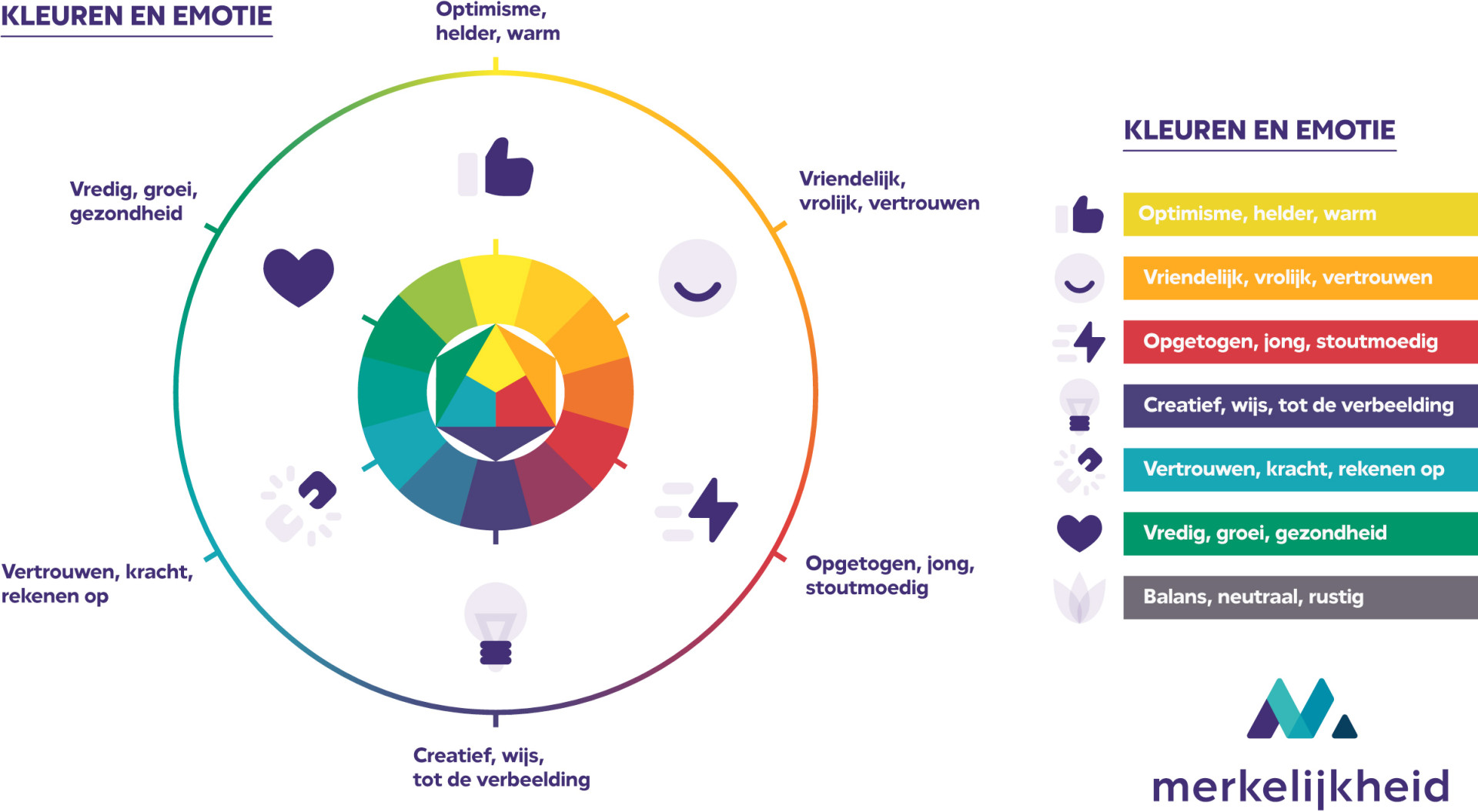
Research shows that people have a stronger preference for brands where the color and the brand identity feel like a “fit.” It’s worth being intentional. In ‘Determining the best color for your positioning and brand identity‘, we examine 7 color groups with examples.
Brand Positioning
Brand positioning is a strategic process of identifying unique characteristics and values to set a brand apart. This applies to products and organizations alike. Effective brand positioning fosters brand loyalty and a strong market presence, leading to higher margins and market share. For owners, a strong brand can significantly increase the company’s valuation during a sale.
We’ve written an extensive article on the nuances, including a roadmap and recommended reading.

Positioning Examples
We frequently analyze the positioning of famous brands. Here are a few highlights:
- Starbucks Positioning
We examine the world’s most famous coffee chain through the lens of the controversies that surround it. - Albert Heijn vs. Jumbo
The battle of the supermarkets. Which strategy is winning the #1 spot? - KPN Positioning
A brand constantly in flux. We ask: does KPN’s positioning actually work? - Red Bull: 5 Lessons
Whether you like the drink or not, the brand is phenomenal. What can we learn from it? - Gamma and Praxis
Is Gamma truly well-positioned, or is it just top-of-mind through TV ads? - DSM Positioning
DSM is pivoting, but is it too late? Is a split-off inevitable? - Unilever Strategy
Unilever changed course from top to bottom—and success followed. - Rabobank Positioning
Traditional banks struggle with differentiation. Where does Rabobank stand? - Siemens Positioning
Siemens communicates as a storyteller, often putting itself in the background. How can you apply this? - Mercedes-Benz
“The Best or Nothing” is a masterclass in positioning. But how is the brand faring today? - Netflix Positioning
How Netflix became a market leader through clear communication and strategy. - Nike Positioning
How Nike successfully claimed specific values to own its market. - HEMA
HEMA is under pressure and trying everything, even health insurance. Does it fit? - Meta (Facebook)
What can you learn from Meta’s core values and their fit with their positioning? - Heineken
How Heineken turned the tide and built a successful global position. - Sony vs. Microsoft
The console wars: how these giants position themselves for the latest gaming generation. - Centraal Beheer
“Just call Apeldoorn.” Everyone knows the name, but do they know what they buy? - The Society Shop
Can they truly differentiate themselves from Suit Supply? - James Bond
Even 007 has a brand position, and he’s finding it harder to maintain than ever. - Katnapolsky
A cat hotel with a truly unique brand position. - LEGO
Can the world’s most famous toy withstand its market imitators? - IKEA: 5 Lessons
How the first budget brand won over the masses. - Café Royal and Nespresso
A case of blatant copycat positioning. - Coolblue for Lawyers?
What the legal profession can learn from a service-first retail giant. - Apple’s Positioning Decay
Is Apple facing a dilemma between its roots and its bottom line? - Tesla’s Strategy
The influence of Elon Musk on the winning strategy for electric vehicles. - MediaMarkt: WOW or Copycat?
Is MediaMarkt’s new position unique, or just a Coolblue imitation?