Creating a Positioning Matrix for Your Brand: Explanation and Examples
Do you want to create a positioning matrix for your brand? In this article, we explain using a practical example how to create, fill in, and use a positioning matrix to achieve a distinctive positioning for your brand.
Positioning Matrix Meaning and Definition
The definition of a positioning matrix is:
A positioning matrix is a strategic tool that allows a brand to determine its positioning relative to the competition and identify opportunities for differentiation.
What is a Positioning Matrix
A positioning matrix is a matrix, a rectangle with one horizontal and one vertical axis. These axes represent the two most important elements of differentiation in the market and are used to place brands or companies. The axes also divide the matrix into sections, creating quadrants that categorize brands. The position in the matrix naturally reflects the positioning of a brand relative to the competition.
Kotler Positioning Matrix
The positioning matrix by Kotler – one of the founders of modern marketing – is still a widely used variant. Price and quality are the axes on which he classifies brands, and it looks like this, for example:
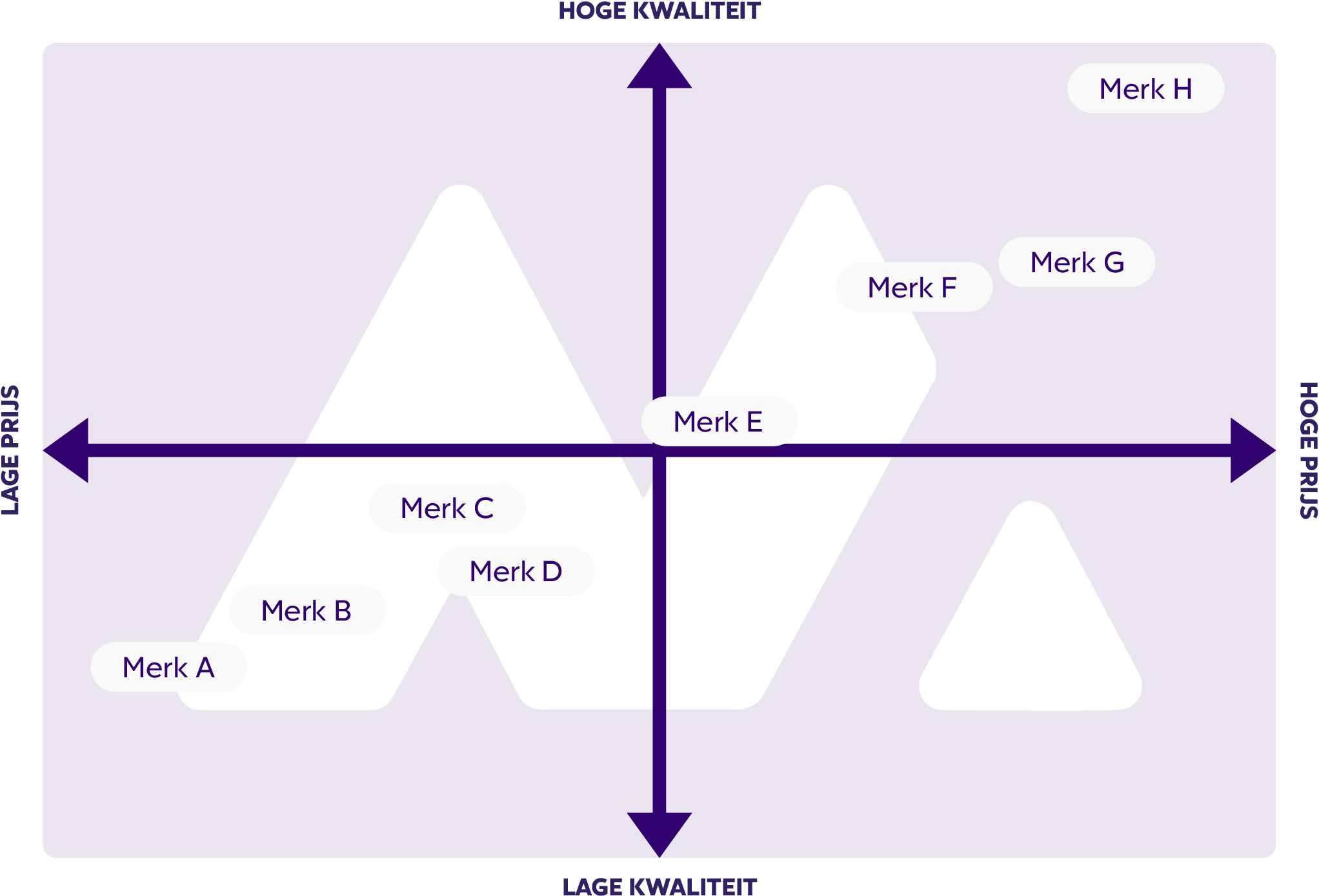
Kotler positioning matrix: price and quality are the axes
Kotler, and much of the marketing literature, is based on consumer product marketing, specifically Fast Moving Consumer Goods (FMCG) such as detergent. This is probably not the right positioning matrix for contemporary brands to use. Unless you also sell detergent or fruit juice, your competitive landscape is likely more complex than just price and quality.
Why Create a Positioning Matrix?
We create a positioning matrix to find opportunities for differentiation compared to our competition. This should help us, for example, achieve a larger market share or better margin.
But the biggest opportunities for differentiation are not about percentage price differences or slightly higher quality. The greatest opportunities for differentiation come when you reinvent your product or service. Apple reinvented the mobile phone, Tesla turned our idea of electric driving upside down. These are now two of the most valuable brands in the world. This principle also applies in B2B; IBM continually reinvents itself and changes what it stands for.
In the book Blue Ocean Strategy INSEAD professor W. Chan Kim argues that brands should not aim to beat their competition but rather create a new market in which they are the undisputed leader. Think of the traditional circus and Cirque du Soleil; both are circuses in a tent, but you will agree that the two concepts are miles apart.
Do you grasp that difference in positioning on the axes price and quality?
Positioning Matrix Axes

Samsung and Apple: two brands with different views on differentiation in the same market
The axes of the positioning matrix are naturally determined by you. Which factors are the most important elements for differentiation in your market? This also makes the axes the biggest pitfall when using the positioning matrix.
For Apple, differentiation probably revolves around design and ease of use, while Samsung’s mobile division will talk about camera and screen quality. Both companies lead in their own matrix, but Apple accounts for the majority of the profit. Which matrix then best reflects what differentiation represents in the market?
Positioning Matrix Company
In the case of a corporate strategic issue, we always spend a lot of time for our clients determining the right axes for the positioning matrix. We analyze the competition and available market information to determine what the (future) key factors for differentiation are. In consultation with the client, we then determine the axes.
In such situations, it is also common to create multiple positioning matrices so the client can test the market view. This helps, for example, in making strategic decisions regarding investments, product development, and acquisitions.
Positioning Matrix Marketing: Objectivity is Crucial
But usually, a client needs a marketing positioning matrix. With this, we map the landscape purely from a marketing perspective with the goal of determining the desired marketing strategy. In this case, many corporate strategic choices and assumptions are taken as given.
Objectivity is very important here. Every team has blinders on regarding their own brand and a red haze when it comes to the competition. While it’s about how the target audience views their brand. Therefore, we almost always use the same axes for a marketing positioning matrix: medium and message. The positioning matrix then looks like this:
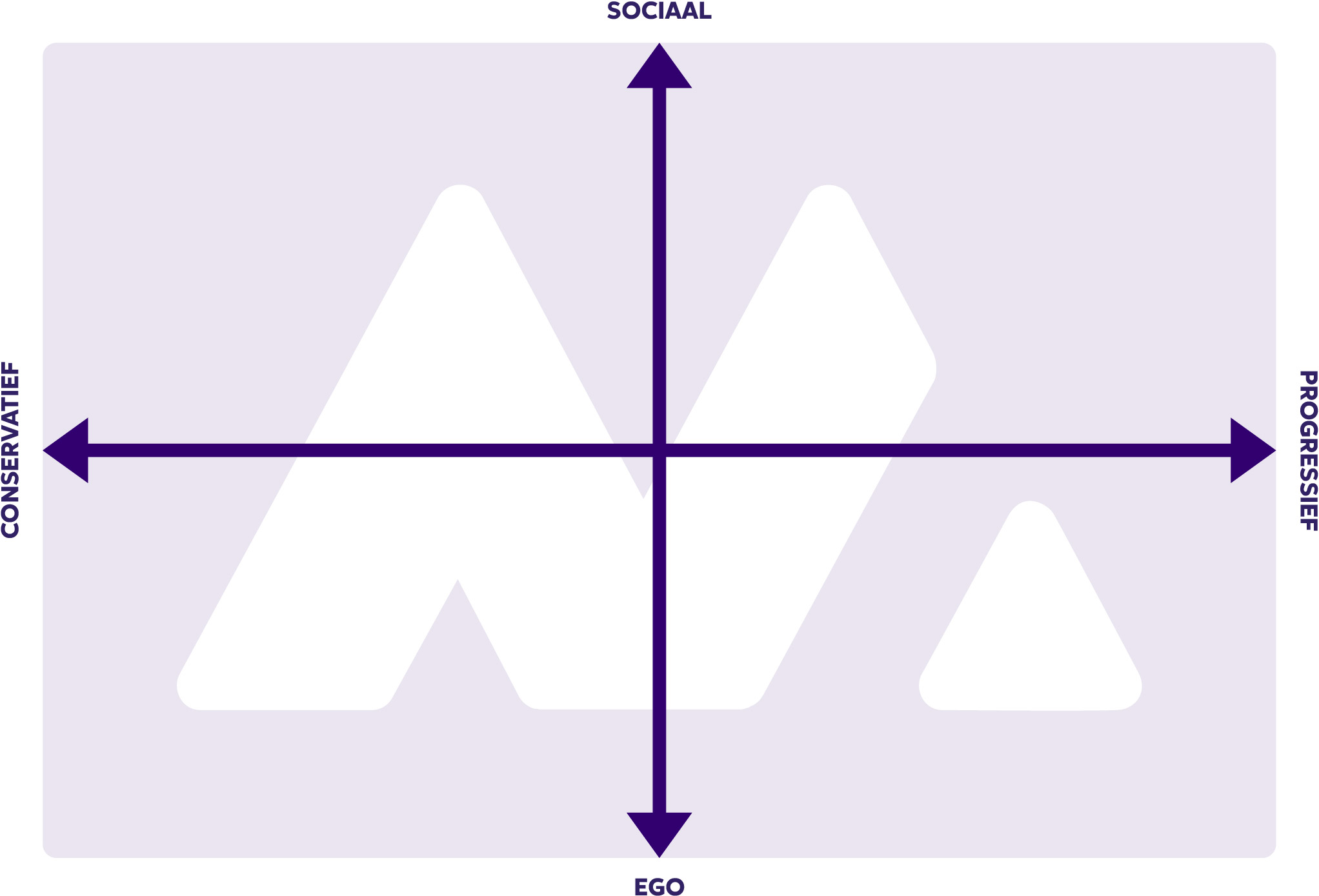
An empty Merkelijkheid Positioning Matrix
Don’t be mistaken, there are plenty of extremely successful brands that feel right at home in the Ego/Conservative quadrant. It’s not about where your brand is located in the model but whether it has found a truly unique position there. Objectively looking at your own brand and market is difficult, which is why we chose the following axes:
Positioning Matrix Axis: Medium
The horizontal axis runs from conservative to progressive, referring to how you conduct marketing. Does the brand use new techniques and technology, try new things, or is it progressive in another way? Then the brand is progressive. If the brand mainly uses traditional marketing tools and media, it is conservative.
Positioning Matrix Axis: Message
The vertical axis runs from Ego to Social and concerns the brand’s message; are you mainly focused on yourself or is the other person central? Being mainly focused on yourself is not wrong; many people prefer the biggest/best/most well-known brand simply because they value that certainty. But in many markets, the Ego attitude is the norm, so a brand differentiates itself with a more social message.
Of course, this positioning matrix is also subjective; they all are. But by choosing these more objective axes, you can look at your own market without blinders. Let’s take an example, supermarkets, and show you that it is quite possible to quickly arrive at a clear market view.
Positioning Matrix Example Supermarkets
The image below is an example of a positioning matrix:
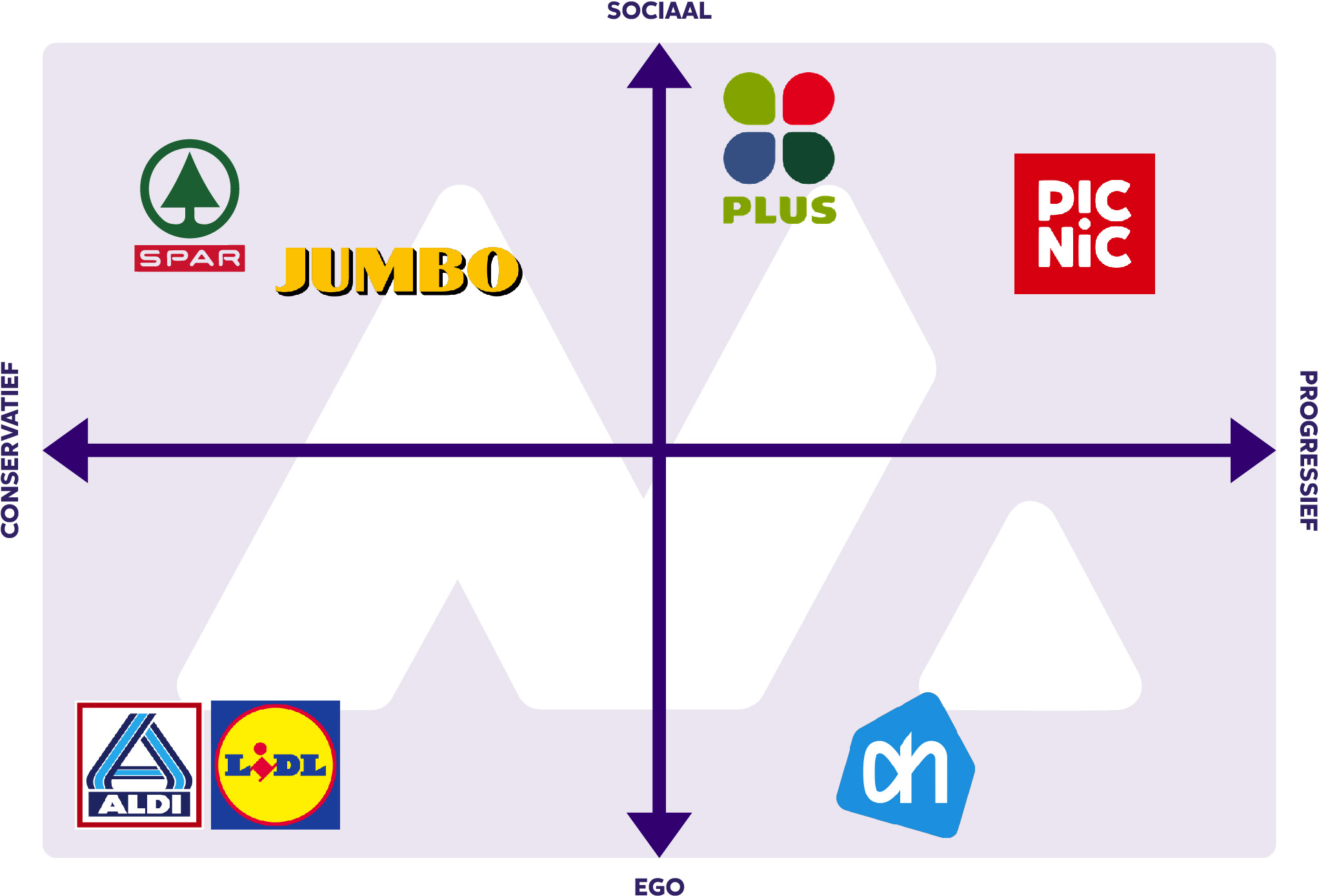
Positioning matrix supermarkets with newcomer Online Supermarket Picnic
Albert Heijn leads the supermarket market but is the market leader and those are often focused on themselves. Major competitor Jumbo is much more social but their background (and target group) is also more conservative. The price fighters have a conservative marketing approach (flyers, ads, design) and continue to emphasize their low price level.
Challenger Picnic, the online supermarket, is, for example, at the top right of the matrix. They sell only via an app, also take packages back, and don’t fuss about bottle deposits. They also tell you how much rain you missed, how much CO2 you saved, and that you spend less money because they have no stores. Sounds like they found a gap in the market, doesn’t it?
Competition Positioning Matrix
An important step for placing competition in your positioning matrix is research and analysis. Before you start the research, discuss as a team which marketing and communication aspects will be weighted in the positioning. It is essential that every competing brand is measured in the same way. Otherwise, it will be difficult to compare later. For clients in B2B, for example, we look at:
- Social media activity (LinkedIn, Twitter, Facebook, Instagram)
- Website design and texts
- Blogs and articles
- Trade show booth(s)
- Advertisements in trade magazines
- Online advertisements
Only when this is listed for all competitors and your own brand can you start analyzing. Then ask yourself, what is the norm and average in this market and where is this brand positioned relative to that? By going through this process as a team, you will arrive at a clear market view together with the positioning matrix.
Positioning Matrix B2B Example
Positioning is becoming increasingly important in B2B environments as well. The positioning matrix is therefore gaining more attention in B2B. The example below is the B2B market situation of one of our clients.
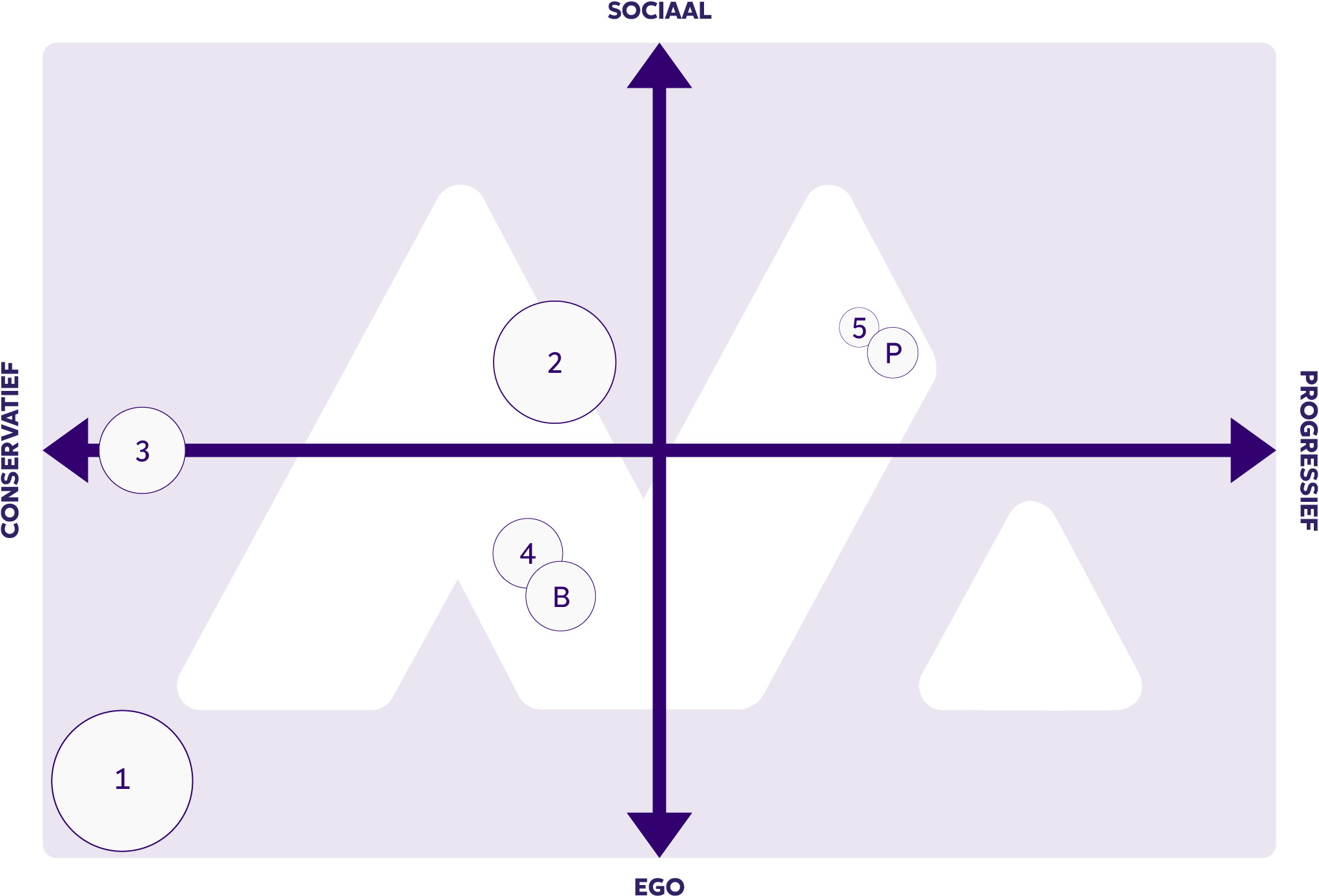
Positioning matrix example from B2B practice
Especially in more traditional (B2B) markets such as industry or business services, the above market view is common. We see the following here:
- The market leader (1) wants to maintain market share itself (ego) and therefore uses proven marketing tools, channels, and methods (conservative)
- The number 2 in the market challenges the market leader and therefore positions itself more socially but does not want too much contrast with the market leader
- A number of smaller players choose their position based on the positioning of the big two
Our client noticed that they were insufficiently able to convey their differentiation to the market. The above matrix explained why. Partly driven by the personal motivation of the CEO, they chose to behave more progressively and tell a more social message.
In the future, this should be further implemented; the company should act even more socially. But changing a positioning never happens in huge steps; the impact on the organization and the target audience would then be too great. A brand gradually moves toward the positioning it wants to take.
Filling in the Positioning Matrix in 7 Steps
You fill in the marketing positioning matrix according to the following steps:
- Select competitors, also consider new competitors with perhaps little market share yet
- Determine what you will research
- Conduct competitor research
- Analyze the results of the competitor research
- Place competitors in the positioning matrix
- Place your own company in the positioning matrix
- Discuss where opportunities for differentiation lie and what consequences this has for your positioning, marketing, and behavior
Do you need help or would you like an expert to guide this process at your company? Read more about our services in the field of positioning.
Brand Positioning Matrix
The positioning matrix originated from the idea that a brand belongs to a product. Coca-Cola fought Pepsi, Persil fought Robijn, and Nutella fought Duo Penotti. But what if a brand stands for a much more complex combination of products and services? In that case, the positioning matrix is often a good tool to strategically look at a specific product-market combination. But to look at the positioning of a brand as a whole, you often need more.
We have collected various positioning models on a handy page where you will also find links to even more extensive sources. A model that often helps us in practice is the brand archetype model; take a look at that as well.