Brand strategy during acquisition: maintain the second brand or integrate quickly?
Is it better to serve the market under a single brand? This brand strategy often seems the most logical solution during an acquisition because it is cost-efficient and the acquiring party prefers its own brand. A student asked us this exact question on behalf of her graduation company, and in this article, we will therefore delve deeper into our thinking and approach. At the end of the article, we will concretely discuss how we view the different options such as a hybrid brand architecture or an endorsed brand. What is your ideal brand strategy during an acquisition?
Brand Strategy During Acquisition
As part of her graduation research, a student contacts Merkelijkheid with an interesting question regarding brand strategy during acquisition:
“The company where I am graduating recently acquired a company with which it broadens its services in the same market; they will provide additional services. There are clear opportunities here, the market in which we operate is developing, and the additional services allow us to serve our customers even more broadly. They wonder: How can we position these companies as one brand in the market?
But I first wonder if one brand is the right choice or if there are other possibilities (brand structures)?”
This smart student has a clear question but prefers to take a step back first. Before starting to position one brand, she wants to determine which brand structure best fits this organization.
What Do I Do With an Acquired Brand?

The real work begins once the contracts are signed
In practice, we encounter this issue regularly. Some entrepreneurs immediately put their brand on the facade of the acquired company, but fortunately, most take more time for this. There are many concerns and interests at play, such as:
- Do we lose goodwill if we let go of the old brand?
- What do the employees – our new colleagues – think about it?
- What do customers think about it?
- Can two independent brands not differentiate themselves better?
If you make this decision based on feeling or practical considerations, you risk not extracting the full value from your acquisition. But how do you make this a well-considered decision?
Strategic Framework
As positioning specialists, we naturally look at this issue very differently than the entrepreneur. We know the possibilities of positioning and marketing but know much less about the market and the involved organizations. The entrepreneur sees an opportunity, and we have experience with similar challenges, companies, or markets. By bringing this together, we arrive at unique insights and make the right decision together.
Creating a shared strategic framework is central to our methodology. By this, we mean the process through which we ensure that everyone involved in the decision (e.g., entrepreneur, management team, advisors) has the same information and knowledge and applies the same principles.
What does this mean in practice? A shared strategic framework ensures, for example, that everyone looks at the playing field (the market) in the same way. For this, you need to answer questions such as; what determines distinctiveness in our market, how are our competitors positioned, how are we positioned ourselves, where are opportunities and why? We also always pay attention to:
- Business economic factors and considerations
- Product or service
- Marketing maturity of the organization(s)
- Culture and identity
- Target audience
- Customers

One of the tools in the strategic framework is the positioning matrix in which we compare the main players in a market against each other.
With the strategic framework in hand, we can look ahead and get things done. Where is the market heading? What does our target audience need, and where are the opportunities? Based on the answers to these questions (in combination with the strategic framework), it becomes clear with which brand structure or brand architecture your company will achieve its goal.
Do you have a concrete question about positioning, brand architecture, and brand structure? We are happy to think along with you without obligation. Our questions will certainly help you move forward, and you will gain inspiration and energy from our conversation. Schedule a (video) appointment here.
Brand Structure and Brand Architecture During Acquisition
But you are reading this article because you are looking for answers. Like the student who asked us this question, you also want to know what to do. Therefore, we share some considerations and thoughts on this subject.
Brand Strategy: When Do I Merge Two Brands?
For example, we choose to merge brands if one brand is clearly stronger than the other. By looking at factors such as brand awareness, spontaneous inquiries, and domain authority, we determine which brand is preferred. Then choose a clear approach with a manageable schedule so that the new brand also appears on the other facade. This prevents resistance or frustration in the acquired organization.

All activities at GE are united under one brand
Another reason to merge brands, even if both brands have a strong, unique positioning, can be costs. Achieving cost savings or having a budget that allows less marketing works best with one brand. All efforts then benefit that one brand.
Brand Strategy: When to Market Two Brands?
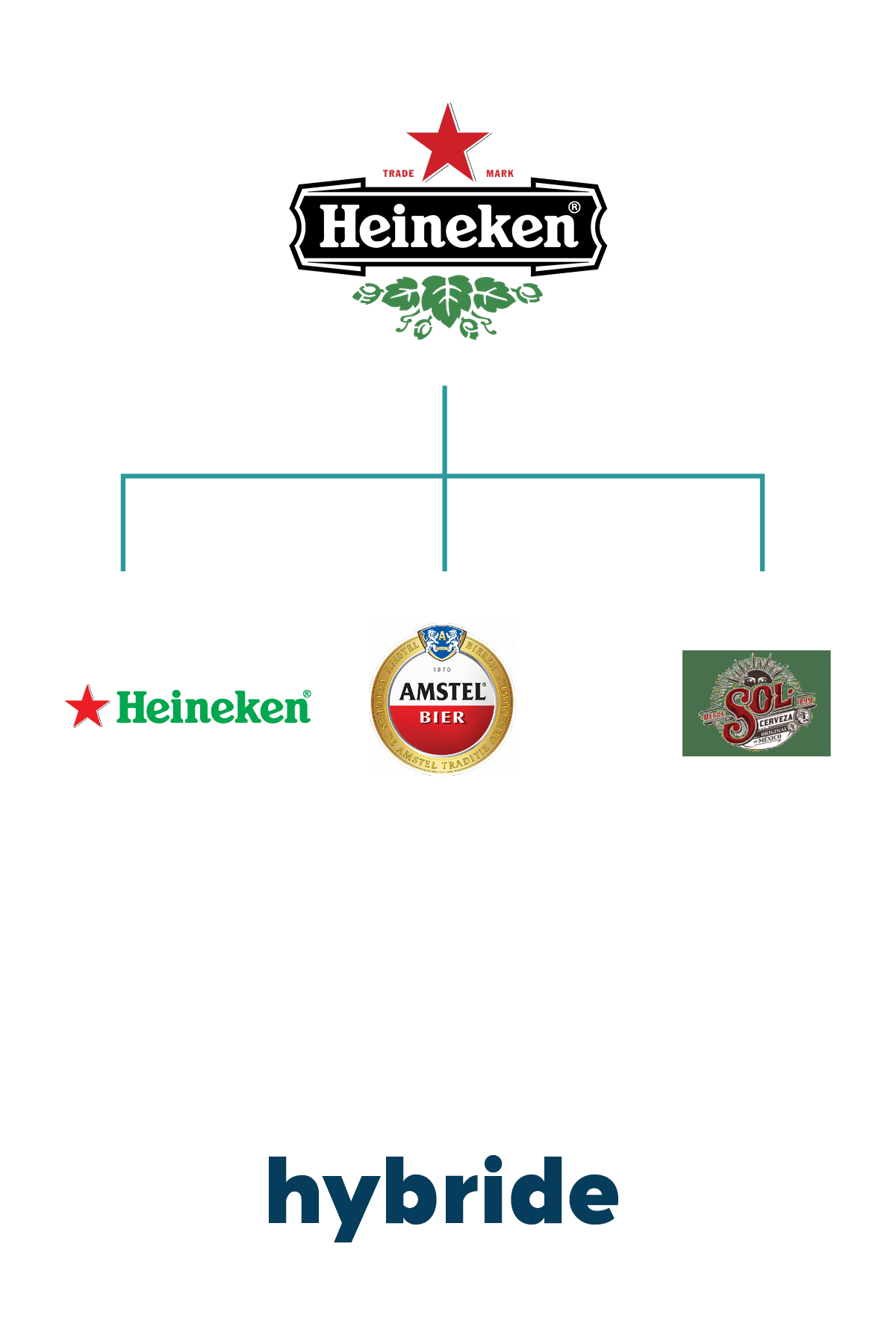
Heineken uses a hybrid brand architecture
A good reason to market two brands separately is the customer or target audience. If the two established brands, for example, have an established, unique proposition that appeals to a clear target group, there is sometimes little to gain with a single brand. Choosing between two target groups is sometimes a shame.
But if you choose to maintain two brands, you can always consider opting for a hybrid brand architecture or endorsed brand. Your original brand then takes a prominent position, and you can use its brand value to further support your new brand.
If you expect more acquisitions (within a few years), your brand strategy becomes even more important. Will your original brand perhaps become the strong group brand that connects all new brands, will you now build hard on the brand value of one brand so that all new companies benefit from it later, or will you build individually strong brands with a completely unique proposition that appeals to a completely unique target group? We have seen good examples of all these possibilities and are happy to think along about which best fits your company.
Positioning During Acquisition
The positioning of a brand is becoming increasingly important – also in B2B. Brands with a unique, distinctive positioning attract personnel more easily, get to the table sooner, and command a higher margin. It is therefore essential to map out the position of the new and the old brand during an acquisition – but actually already before it takes place. This ensures that you can make well-considered decisions about brand architecture and brand structure.
Merkelijkheid approaches positioning in a unique way. Together with the decision-makers, we build a strategic framework, think about the possibilities, and bring the creativity necessary to arrive at a distinctive positioning and market approach. Want to know what that looks like in practice? Contact us.