Brand Matrix: Positioning of Brands and Organizations
The Merkelijkheid Matrix helps you optimize your marketing efforts. In this article, we will discuss the complete matrix and especially don’t let the simplicity of the matrix mislead you; providing a truly accurate answer to the questions posed is very challenging. Central questions are: how do I determine my brand’s position in the matrix and what can I do next to improve my market positioning? You compare your positioning against your competitors with the positioning matrix.
PositioningMatrix
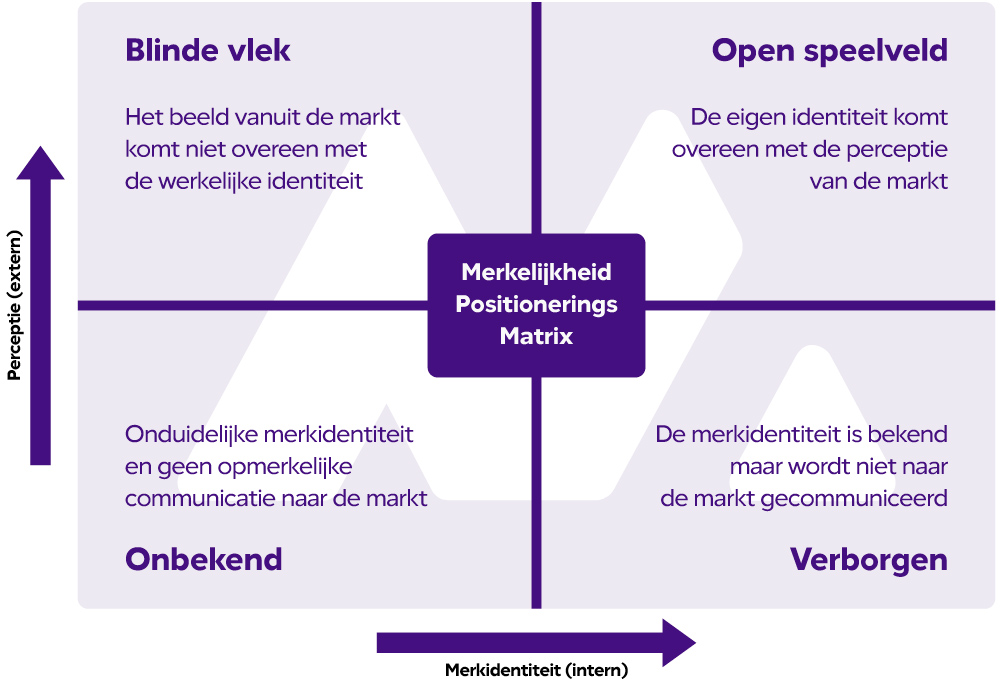
We developed the Merkelijkheid Matrix to clearly visualize the most important tension within marketing strategy and positioning. This is the tension between the questions: “Who am I?” and “How does the market see me?”. Once the market’s perception fully aligns with your identity, you have succeeded. If the identity is clear but the market does not reflect this, you need to adjust communication and vice versa.
Read all about positioning in this article.
Determining Positioning
If you want to determine your brand’s position in the Merkelijkheid matrix, you must first establish the brand identity. Brand identity says something about the organization: “Who are we and where are we headed?”. The concepts of culture and ambition are often used for this. A distinctive positioning and corresponding position or claim in the market is a direct result of this identity. The more conscious and certain you are of the identity, the further to the right the brand can be placed in the matrix. Perception then represents the extent to which you succeed in conveying this to the market; the clearer, the higher.
A common pitfall in positioning is that organizations work with the desired identity and positioning instead of the actual identity. They then try to implement this top-down. However, from our experience, an identity change often proves to be an insurmountable obstacle. The many years-long culture and organizational change processes are proof of this.
The reason this pitfall is often overlooked is due to a certain (unconscious) dissatisfaction with what the market reflects. Both employees and management often feel that the market does not notice what makes them special and then imagine a situation where this would be the case. They do not realize that the market does not look at intention but at how the organization behaves, and it is this behavior that must be worked on, not the identity. Organizations must therefore gain insight into the actual identity, the culture, and ambition of the entire organization, and align the market perception accordingly.
To illustrate, the following two lines from Benjamin Franklin in Poor Richard’s Almanack from 1741:
Beauty, like supreme dominion
is but supported by opinion
The ultimate and only test of success is therefore to what extent you embody the positioning in the eyes of the customer. The best positioning, meaning the easiest to convey, is therefore the positioning closest to the brand’s identity.
Improving Position within the Merkelijkheid Matrix
Soon after evaluating the actual identity and the positioning that belongs to it, the next question arises; “What now? How do I make this happen?”. Strategists often do not deal with this question and prefer to delegate it to an advertising agency. Meanwhile, monitoring the process and understanding the core of both identity and positioning is essential (and at advertising agencies, creativity itself is often leading).
Because the Merkelijkheid Matrix works with your actual identity and the positioning that belongs to it, we can link areas of attention to each possible quadrant:
Unknown – Something must happen very soon; you can hardly pinpoint your own identity and it proves difficult to communicate remarkably to the market. We often see brands in this quadrant communicating purely reactively with the market or adopting a positioning that sounds nice but has no connection with the organization and its behavior. It is crucial to clarify the identity, embed it in the behavior and thinking of the organization, and then communicate it consistently to the market.
Blind Spot – There is a communication problem. You are unable to convey the right message, consisting of brand values and/or product attributes. The chosen communication strategy has not been successful in that sense and you have not achieved the desired positioning. What makes this quadrant interesting is that all parties involved are dissatisfied. The market attributes certain unintended characteristics to the brand, and the organization is frustrated that no one sees them as they (want to) are.
There are two paths to a solution: you adapt and fulfill the role assigned by the market, or you strive to change the market’s perception. In both cases, the offering then fits the behavior and they reinforce each other. A major barrier here is often the leadership of the organization, which sometimes needs to be convinced that they have been steering on ambition instead of reality.
Hidden – Internally, everyone feels good. Both employees and management know exactly who they are and which positioning fits. What frustrates is that they cannot communicate this remarkably to the market. You see the brand as “the best-kept secret” and regret that the market ‘cannot’ see this. It is crucial that you first provide the organization with the insight that they are responsible for this themselves, so that it can then be addressed. For example, by highlighting other aspects of the identity more than before or changing the means by which they want to convey this.
Open Space – If you find yourself in this quadrant, your brand is aligned with the market. The market recognizes the characteristics you want to convey and through remarkable communication can place the brand well relative to the competition. For example, you receive many inquiries through recommendations; your customers can excellently explain why someone should become a customer of yours! Although your organization is undoubtedly successful, you cannot passively wait to see what the future brings; you must continue to evaluate and, if necessary, adjust the strategy. Optimization and evaluation are central here.
Merkelijkheid helps organizations position themselves distinctively
Merkelijkheid therefore does not stop at providing non-binding advice but also commits to the actions that result from it. The question, how do you give your positioning weight in the market, is one we regularly answer.
Want to know more about positioning and how you can get started yourself? Read our page about positioning and find there, besides in-depth articles, also dozens of examples and models for every possible positioning challenge.