Free marketing with a content strategy, fact or fiction?
We regularly see inactive business Twitter accounts where the last post is already two months old. In the period before that, posts were regularly made, but the company has stopped again. In this article, we will discuss the probable cause and how you can prevent this for your organization.
 The biggest challenge of a content strategy is not getting started, because setting up a ‘free’ marketing channel is quick and easy. In practice, however, persistence proves to be more difficult. The dip always comes after realizing that a lot of time and effort goes into creating a dialogue. That is why it is important that you start by setting achievable goals and expectations before you get started. But how do you ensure that you set realistic goals and what role does the content strategy play within your online marketing strategy?
Successful implementation of a content strategy depends on how you become ‘wiser’ step-by-step
Before an organization starts with its own content strategy, there is often a (un)conscious orientation. The initiator has heard a great success story in their personal circle or sees that a customer or supplier is followed and actually in dialogue with a large number of contacts. Mentally, the following process arises: action + content = x followers/dialogue. Usually, the action is underestimated. Take the following (successful) example:
 Astrid van Ballegoy works as a communication professional for a collection of companies and has 1,300 followers. A large part of these come from the market in which her company is active. Her effective reach is one that many trade magazines would be proud of. For you, this could mean spending less on advertisements. But before you conclude that you can achieve this just like that, take a look at her number of Tweets; 11,454. This means that over a long period, besides her own posts, she responds a lot to her followers and actively engages in conversation. She has developed a habit, the habit of checking and responding to her accounts several times a day. But she also started without followers and had to find her way in this.
Besides the fact that you probably lack this habit, you are also not set up to regularly produce unique content and the positioning of your organization does not focus on these new media. Those three elements are the core of your challenge. The successful implementation of a content strategy therefore depends on how you become ‘wiser’ step-by-step in these three matters and set the right goals, so that it remains an achievable challenge.
You build a strategy that ensures you immediately generate awareness in the market when launching a new service
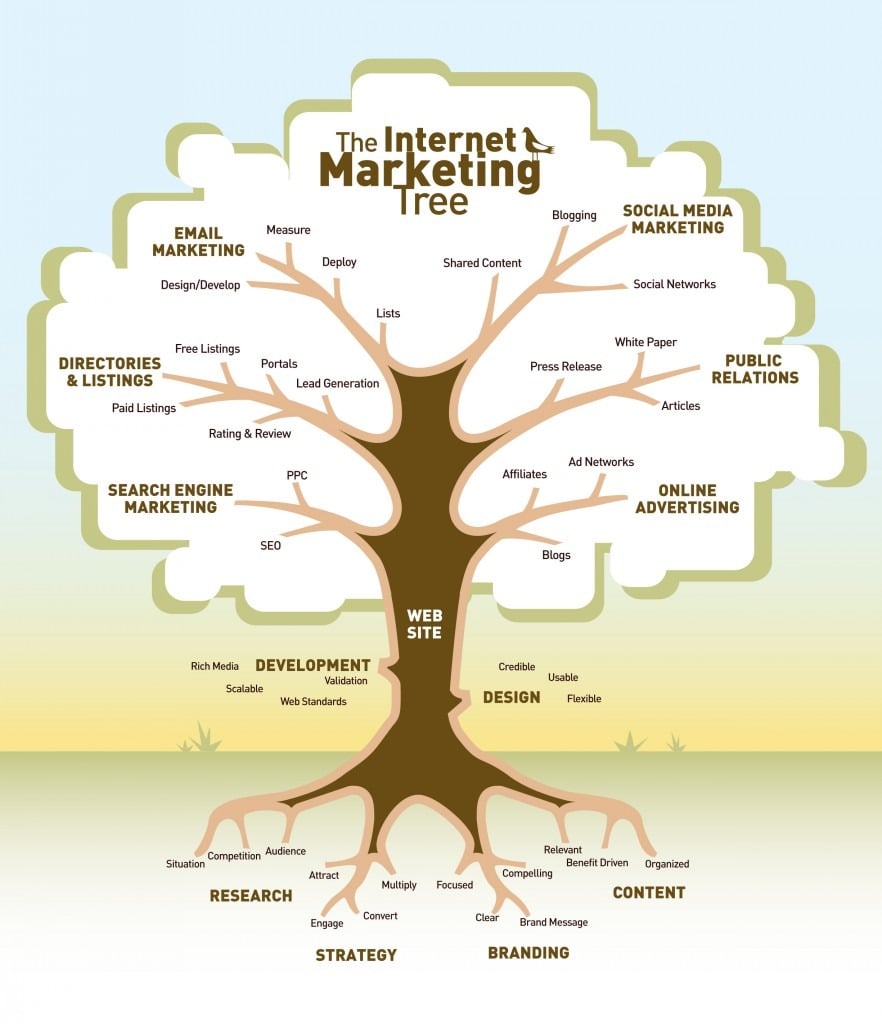 While you are working step-by-step on the content strategy, it is important that all your efforts also contribute to the marketing goals of your organization. On the right, you see the internet marketing tree (via Mainline Media), where the own website is the trunk. This is also the most important fact within your strategy, after all, all efforts must ultimately lead to concrete and measurable results. Results are, for example, website visits or sales. You are building a reputation that ensures that when you launch a new service, you immediately generate awareness in the market, and your sales department sells better. In addition, new media increasingly contribute to the findability of your website in search engines.
Get started with social media in 4 steps
- Research – Look at the playing field, which channels do your competitors use and what do they share there? Which of your customers and contacts are active and where are they mainly? If you search for important keywords, which pages or profiles come up? You can draw important conclusions from this regarding size, turnover rate, channel choice, etc., which you can all include in the strategy.
- Branding – Discuss and concretely articulate what role your brand will play on new media. What behavior is a logical consequence of your positioning? Give some concrete examples. What charge does this then give back to your brand? By consciously reflecting on this, it is easier to articulate the strategy, but above all, it ensures that you do not have to give the positioning a place afterwards.
- Strategy – What exactly are you going to do, which topics will you cover and which target audience will you address? What goals do you connect to this and how do they develop? By directly linking the how to the desired result, you ensure focus, which makes it easier to persevere.
- Content – Creating content is a learning process in itself. Perhaps you like writing, but it may also be that you enjoy taking photos or recording videos. In any case, it is advisable to have an expert review your final result, at least in the beginning. The primary thought in this part should be; which content is valuable to my target audience? Then plan the content to be created, for example per month, so you can create coherence between the topics and the positioning is broadly reflected.
Whole books are written about this topic, but with these first thoughts you can at least get started. We have already written ‘The what, how and why of social media; a complete and short introduction‘ and ‘10 arguments against using social media‘.