The advantages and disadvantages of AMP + case study
The first Accelerated Mobile Pages are already at the top of the search results, and Google talks as if this is just the beginning. What exactly are AMP pages, and should you implement them on your business website if they become this important? We discuss what Accelerated Mobile Pages are, the pros and cons, and whether you should have these pages on your website. We do this not only from theory but also share the results of our own online marketing experiment with the open-source project from Google and Twitter.
We primarily published this article (with a more concise explanation of AMP) on Frankwatching.
What is AMP?
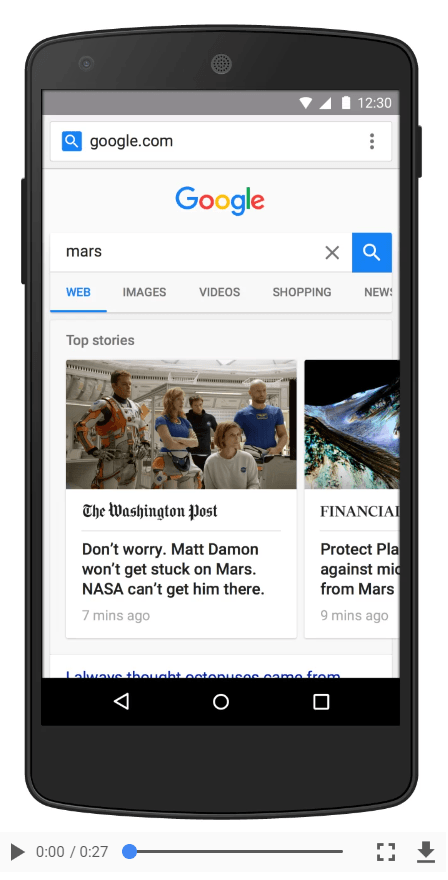 AMP stands for Accelerated Mobile Pages and is an open-source initiative by Google and Twitter that ensures mobile pages load lightning fast. AMP is the open-source answer to Facebook’s Instant Articles project and Apple News, which aim for the same.
In the project announcement, Google writes on its blog:
Smartphones and tablets have revolutionized the way we access information, and today people consume a tremendous amount of news on their phones. Publishers around the world use the mobile web to reach these readers, but the experience can often leave a lot to be desired. Every time a webpage takes too long to load, they lose a reader—and the opportunity to earn revenue through advertising or subscriptions. That’s because advertisers on these websites have a hard time getting consumers to pay attention to their ads when the pages load so slowly that people abandon them entirely.
Source: Googleblog
In other words, by ensuring mobile visitors have immediate access to an article, a publisher will get more visitors and thus more revenue.
An exceptional claim, but how does it work?
How do Accelerated Mobile Pages work?
Now it gets a bit technical. If the technology doesn’t interest you much, you can skip this section and jump to the bold summary.
 AMP consists of three elements:
- HTML
- Javascript
- Caching
HTML
HTML is the language a programmer uses to determine how websites look. AMP uses a heavily stripped-down form of HTML so that every browser displays the content the same way. This is jokingly called diet-HTML.
Javascript
The Javascript library developers can use in AMP is also heavily stripped down, all to make content loading as fast as possible. The core of these adjustments is that everything is loaded asynchronously. The advantage of asynchronous loading is that, for example, loading an image does not delay loading the rest of the page.
Caching
Google validates all AMP pages you submit, and once approved, Google caches the entire page. This means all your content is effectively stored on Google’s servers. Google can then preload the content before you even click. Once you click, the page is immediately available—faster is impossible!
AMP is thus both the way a page looks and the way the reader receives it. All AMP pages are 100% hosted on Google’s servers, not on your own server.
Accelerated Mobile Pages on your website
The only one loading your AMP pages from your server is Google, but that is the necessary first step. For the world’s largest content management system, WordPress, there is already a plugin to help you implement AMP on your website. Most of the work lies in adapting the standard AMP setup to your own preferences and content.
Even if you use another CMS, implementation is relatively simple. All documentation can be found on the AMP site.
But before you dive into implementation, we need to discuss the most important question:
Should I use AMP on my business website?
To answer this, we extensively experimented with AMP and mapped out the possible pros and cons. We discuss the latter below and explain our own experiment later.
The advantages of Accelerated Mobile Pages (AMP)
Google and Twitter, besides their own agenda, have great insight into what their visitors want. And that is exactly where the advantages lie.
Higher position in Google search results
AMP pages get a preferred position in Google through the Top Stories carousel at the top of the page or a special icon next to the search result. This results in a higher click-through rate.
User-friendly
An AMP page loads really fast; if you haven’t experienced it yet, grab your phone now. The page is also very pleasant to read; all clutter is removed, and you see only text and approved images. Very easy to read.
Potential SEO impact (later)
Google suggests that the presence of AMP pages will also lead to higher search engine rankings in the future. However, this is not yet the case since AMP pages are 100% separate from other pages on your website.
We wrote an article about the impact of mobile-friendly website design on search results: Mobile-first website design: how important is it?
The disadvantages of Accelerated Mobile Pages (AMP)
AMP is quite a change, as you could see in the technical overview. That means there are indeed disadvantages to the implementation. You can read which ones here.
Very limited or no brand identity
Because AMP pages lack everything except the actual content, it is practically impossible to connect your brand identity to the content. Your AMP page looks practically the same as your competitor’s, nothing you can do about it.
Limited conversion options
Advanced styling, forms, and much Javascript simply cannot be used on AMP pages. This makes converting or funneling your visitors much harder.
Whose visitor is it?
When a visitor visits an AMP page, they remain in Google’s ecosystem. It seems like they are on your site, but that is an illusion. The distinction is still marginal now, but ask yourself: is it really your visitor if they never see your “real” website? Doesn’t it come down to you simply giving your content away to Google (for free)?
Accelerated Mobile Pages in practice: an example
Merkelijkheid closely monitors all developments. When AMP was announced, we still had to see an actual integration in search results. A year later, it happened, and we built AMP pages. We discuss the results and our conclusions based on one of our most-read blogs.
Blog: Positioning Albert Heijn vs. Positioning Jumbo
This blog, which compares the positioning of Jumbo and Albert Heijn, is visited monthly by about 750 people. Enough to provide insight into what adding AMP pages to a business site means.
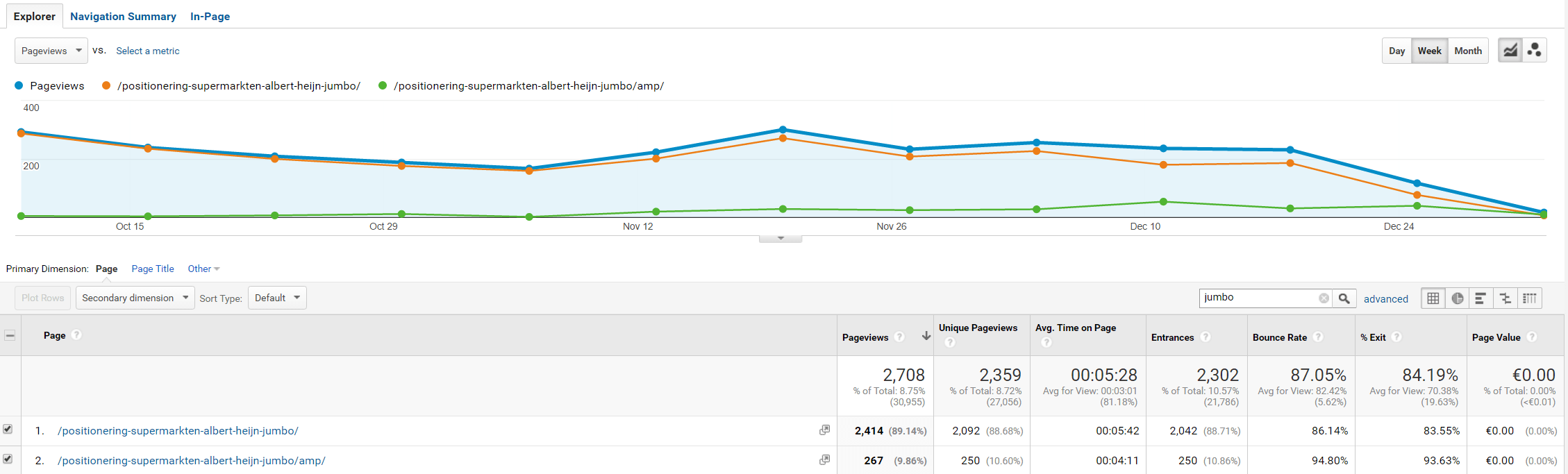
The visitor data from the moment we implemented AMP pages is as follows:
We also wondered how desktop visitors, ‘normal’ mobile visitors, and AMP visitors differed. The following data corresponds:

Based on this data and our knowledge of the pros and cons, we came to the following conclusions:
Visits to the AMP page come at the expense of visits to the ‘normal’ page
In the first graph, you see that the total number of visitors remains fairly constant (blue line), but the share of visitors seeing the AMP page increases. So we don’t get more visitors; we only serve a different page without brand identity or conversion options.
Users stay longer on the AMP page than on the normal page
This difference is huge and underlines the value AMP pages can have for publishers. Visitors spent on average 3 times longer on the AMP page than on a normal page!
We do NOT get more visitors through AMP
Because many readers scan headlines, this is stated twice. The first conclusion focuses on brand identity and conversion; here, pure numbers are central. Both are negative, for clarity.
AMP visitors have a higher bounce rate
Our bounce rate is high, averaging about 80%. It is an important challenge for Merkelijkheid to reduce the bounce rate below 60%. AMP pages have a drastically higher bounce rate and therefore contradict this goal.
Ending the AMP experiment for Merkelijkheid
The disadvantages outweighed the advantages for Merkelijkheid, so we discontinued the AMP implementation.
The Merkelijkheid brand was hardly noticeable on the AMP pages, and although visitors read an article longer, they visited fewer pages on our website than a regular visitor. Add to that that we could hardly build conversion methods on the page itself, and the story is complete.
The reason we produce content is partly to inform our existing customers but also to generate new contacts. An important goal of the website is converting visitors into contacts, and an AMP page seems much less suitable for that so far.
Of course, our website is mobile-first designed and already works optimally on mobile phones. Does it load as fast as via Google’s server? No, but loading within a second makes us faster than 95% of sites on the web.
Reasons not to implement AMP on merkelijkheid.nl
- Could not sufficiently load Merkelijkheid identity (house style) on the pages
- Higher bounce rate
- No conversion options
Use AMP or not on your business website?
Although marketing for companies often revolves around the brand behaving as a publisher (content marketing), using AMP is probably not an improvement for you.
The lack of branding, brand identity, and conversion options outweighs the preferred position in Google. That this position for Merkelijkheid also does not result in more visitors only strengthens this fact.
Google suggests that search results may be influenced by AMP in the future, but so far, there is no sign of this. Whether this will be introduced depends on AMP’s success. Our expectation is that news sites will embrace AMP, but all other sites will not really benefit, and real success will remain absent.
Our advice is therefore:
If you manage a business website, let Accelerated Mobile Pages (AMP) pass you by.