11 concrete benefits of inbound marketing
Were you, like me, also a bit fed up? I am immensely irritated by vague lists and meaningless texts around content marketing. This causes people to get too little out of it and quickly lose interest. A shame, because the impact can be enormous. We wanted to set this right. A first step is this article in which we briefly discuss the main benefits and pillars of online marketing.
The definition of inbound marketing
Inbound marketing is marketing and communication aimed at attracting customers to products and services through content marketing, social media marketing, or Search Engine Optimization.
This is in contrast to outbound marketing, where you approach customers yourself with your proposition.
As you can see, social media marketing, content marketing, and Search Engine Optimization fall under the umbrella of inbound marketing. Inbound marketing is often called content marketing because the content is central and the other two are usually channels to make that content findable or to distribute it.
The benefits and pillars of inbound marketing
1. Segmenting and qualifying
An important advantage of an inbound marketing strategy is the ability to segment and qualify visitors, but what exactly does that mean?
Segmenting means dividing visitors or contacts into groups based on content they read or certain actions.
Qualifying is assigning a certain value or ‘potential’ to a visitor. In the inbound world, this is called a Marketing Qualified Lead; a lead with a higher potential to become a customer than the more general leads. It often comes down to wanting to obtain certain data from visitors in a particular segment to create a higher chance of sale.
Practical example
After a Google search, you land on a general informative page. Halfway through this page, you see a Whitepaper that lists all decision factors for your search (e.g., a mortgage for people over 50). You click the download button and get a form where you have to fill in details like name and address and some other questions before you can download. The company now knows not only what you are looking for but also who you are. Time for an offer! Within a few days, a salesperson calls you with a very tempting offer.
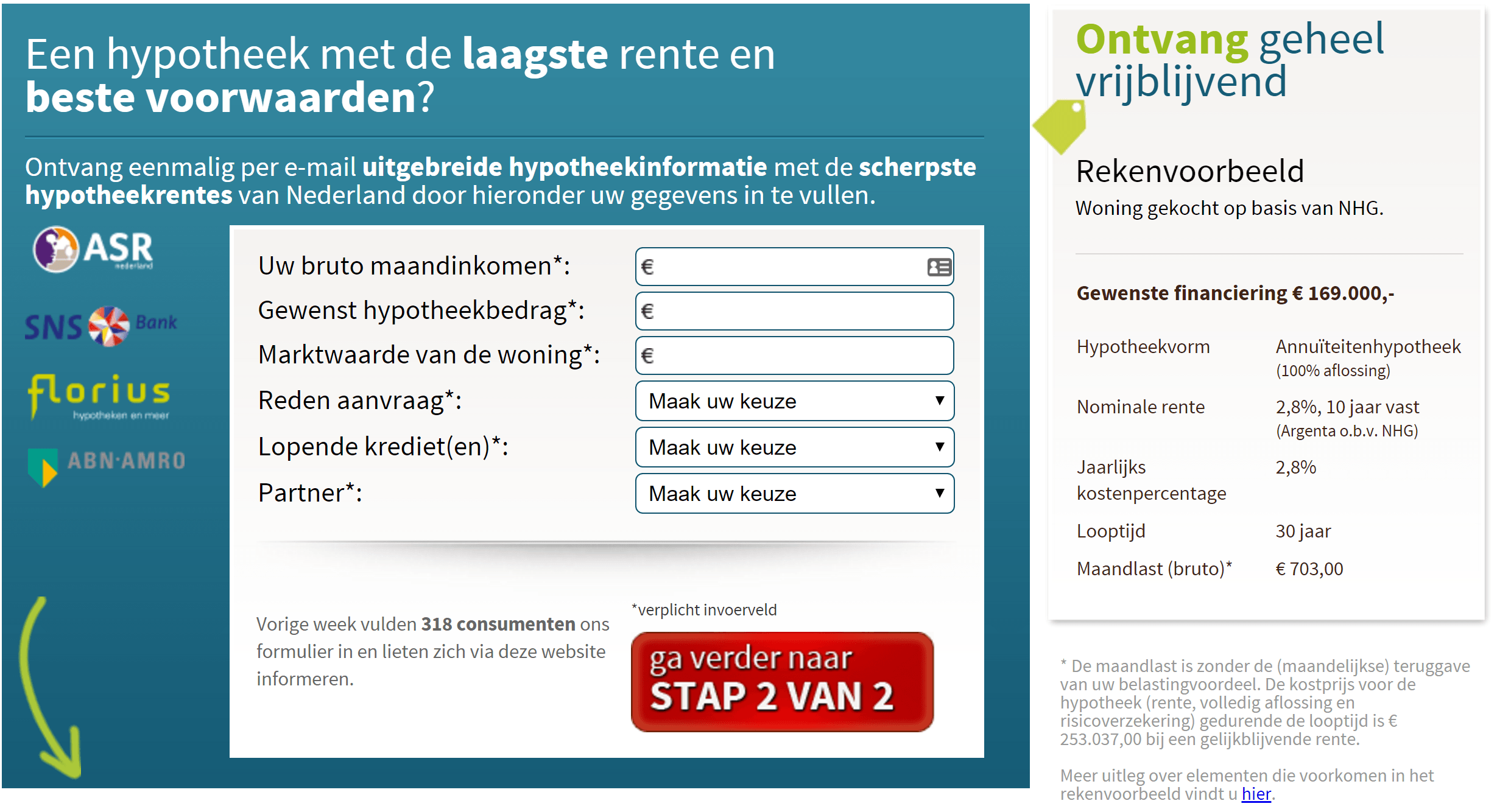
A striking example of qualification
2. Moving to the next phase of the customer journey
The customer journey is the path your customer takes from introduction to purchase. This has changed enormously in recent years, partly due to the internet. Where people used to orient themselves on things like cars by visiting different dealers and collecting brochures, nowadays they scour the internet and have basically made their choice before visiting a dealer. If people no longer need to knock on your door in the early phases of their customer journey, how do you ensure they find you when it gets serious?
Inbound marketing plays a crucial role in the early phases of your customer journey. If you already get noticed here, you will have more leads when people want to make a purchase.
3. Building relationships with content
The newsreader of the 8 o’clock news is (or was) a trusted person and well-known Dutch figure. Unconsciously, we assign values to our information sources and the person behind them. By sharing knowledge or explaining developments in your industry, you effectively build your relationship with readers. A relationship is, of course, a prerequisite before a transaction can take place, and this is an essential part of inbound marketing.
4. Expertise, authority, loyalty, and branding

Timeless content is called ‘Evergreen,’ just like trees that always have leaves.
Before people build a ‘personal’ relationship with you, they must first trust you and assign a certain authority.
Inbound marketing is ideal for both. By producing substantive content that addresses important topics or issues for your market, you establish yourself as an authority. By doing this consistently and with a certain degree of objectivity (always be clear about your own interest), you inspire trust. Enough trust and authority built up? The customer will naturally come to you when they have a question that matches your expertise.
For existing relationships, consistently sharing knowledge also inspires loyalty. These contacts are ‘confirmed’ in their choice for you as a supplier, which gives them a good feeling about themselves.
Depending on how you distribute the content, under your own name or solely as a brand, all this also greatly influences the value of your brand. Substantive knowledge and experience linked to your brand identity is a substantial part of your value proposition.
5. “Evergreen” content, content that is always up to date
Content that is always relevant is called, inspired by plants that have leaves all year round, ‘Evergreen.’ Content that consistently attracts visitors, year after year, has a much higher long-term Return On Investment than a one-time hit. So look for topics in your market that remain interesting and make this the basis of your inbound marketing.
 Many brands try to stand out with funny topical content. Heineken is, for example, a master at this. It sometimes generates a huge amount of traffic but often drops off just as quickly. With this strategy, it is therefore important to ‘score’ again and again.
Practical example: Our article about the Positioning of Heineken is still well visited months after publication and is therefore ‘Evergreen.’
6. Ensures that your reach really belongs to you
The organic reach of a Facebook page is somewhere between 3 and 15%. That means, to be clear, that your Facebook post, on your very own page, reaches only 16% of the people who like your page! How do you solve that? By advertising, says Facebook. We may have opinions about that, but it doesn’t change the fact.
Inbound marketing is an important tool for building and expanding your own organic reach that you, and perhaps most importantly, actually own! Facebook is a tool to achieve that, but make sure you don’t put all your effort into a channel that will squeeze you as much as possible.
7. Leads and sales, inbound vs. outbound
 The conditions for a successful sale are quite complex. The offer must be good and the price too, but another important factor is timing. A good offer that you get too long before or after the purchase moment naturally has no impact.
By using inbound marketing, you ensure that customers find you at the moment that suits them, when it is relevant. This also results in a higher ‘hit rate’ on quotes for leads you generate via inbound in your market.
8. 100% measurability
“50% of our marketing is wasted, we just don’t know which half.” This famous saying is still true for many companies, but this is no longer necessary!
Most traditional marketing tools, commercials, ads, and brochures/flyers are naturally hard to measure. You never know if that commercial during GTST or during that football match led to the most purchases. Inbound marketing is mainly digital and therefore 100% measurable. By properly setting up your channels and website, you quickly get crystal clear what the result is of all your different actions, promotions, and expressions.
9. Inbound leverages what you already have: knowledge and experience
For both inbound and outbound, content must be created. But where you spend a lot of time and money on outbound to create a commercial, ad, or trade show stand, you already have the most important ingredient for inbound: knowledge and experience.
Your people hopefully have enough stories to tell. After all, they have worked with your product for years and know exactly what moves your customers. This is the basis you use to create content for your outbound marketing.
10. Being and staying top of mind
Even your best customer does not want to be called weekly by you if there is no reason for it. By sharing content on the channels you know your potential customer looks at when it suits them, you stay top of mind. The idea is that you remain or get on the shortlist once it is drawn up.
It is especially interesting if this potential customer responds to a topic you did not think interested them. This can work both ways; the customer might discover that your offer is much broader than they previously thought.
11. Knowing what is happening
By having an active inbound attitude, you learn what is happening in your market. Besides publishing your own content, you also see what is happening with the competition and your customers themselves. This creates a good ‘feeling’ for what is alive in the market. You can of course immediately convert this into relevant and distinctive content but it is also crucial conversation material in customer talks.
The main obstacle
Of course, every advantage has its disadvantage, or in the case of inbound, one important disadvantage: it is difficult. Outbound is a simpler idea for many brands; we invest some money and then a certain number of people see our pitch. And let’s be honest, many companies have grown with and still operate perfectly on 100% outbound. It is therefore understandable that management and executives are often skeptical until they do see the opportunities. The two disciplines work amazingly well together, as Red Bull [positionering red bull post link] proves every day.