LinkedIn CPM: a complete explanation
You probably already know what CPM stands for: Cost Per Mille. But what does this amount mean? In this article, we explain everything about CPM on LinkedIn. It is a valuable KPI to assess how well your campaign is performing. That’s why we share the average LinkedIn CPM for different campaign objectives and how you can further optimize a LinkedIn campaign based on CPM.
Understanding LinkedIn CPM is an essential prerequisite for setting up an effective LinkedIn campaign. It is an important bidding strategy and a useful KPI to manage. But first, the answer to the question: what does CPM mean?
CPM meaning

CPM stands for Cost Per Mille, or the cost per 1,000 impressions. On LinkedIn and many other advertising platforms, you can see this at both campaign and ad level, so how much it costs to show your campaign 1,000 times and how much it costs to show a specific ad 1,000 times.
Why do we use CPM?
CPM is a widely used metric on (online) advertising platforms. This makes it a handy KPI to compare costs and effectiveness across different platforms. But there are more reasons to use CPM when analyzing and optimizing campaigns:
- Cost control: with CPM you quickly see how much it costs to display your ad. In many campaigns and bidding strategies, CPM determines the costs, so insight into CPM also makes it easier to control costs.
- Budget planning: If you roughly know in advance what CPM to expect, you can use this to align your budget and target audience. If you know beforehand that your target audience is too large for the available budget, you can adjust this for a more focused campaign. Of course, it can also be the other way around: setting your budget based on the target audience size.
- Audience optimization: the average CPM is not the same for every target audience. Based on CPM, you can make choices to approach your different audiences as cost-effectively as possible.
- Comparison with other platforms: as mentioned, CPM makes comparing different advertising platforms very easy.
- Measurability and ROI: Are the campaigns delivering the desired result? CPM is one of the factors with which you can easily determine how a campaign is performing.
- Optimization: like other campaign KPIs, CPM is a valuable factor to optimize, improving both your ad spend and campaign effectiveness.
LinkedIn CPM compared to other platforms
LinkedIn is often known as a relatively expensive advertising platform. Indeed, LinkedIn CPM is higher compared to, for example, Instagram or Facebook. However, a higher CPM does not necessarily mean you should ignore LinkedIn as an advertising platform. It is good to understand why LinkedIn CPM is higher, so you know for which audiences and campaigns LinkedIn is effective.
LinkedIn has a unique business focus
The main difference between LinkedIn and other (social) advertising platforms is the strong business focus. This is reflected in the users, content, and options to compose the target audience. Not only do you know on LinkedIn that you reach people with a certain focus or interest in work and career-related topics, they are also more inclined to share and consume content with a business focus. The options to compose a target audience also have a unique business focus, think of company names, job titles, education, and skills as audience attributes. These three factors together make an impression or click on LinkedIn, from a B2B perspective, considered more valuable and therefore more costly.
High-quality leads
Although this also comes from the platform’s business focus, we find it worth mentioning separately. LinkedIn’s business focus combined with campaign and audience options means you collect very high-quality leads via the platform.
Competition
Although LinkedIn is known for higher costs per 1,000 views, in practice this varies greatly per audience. The level of competition strongly influences CPM; marketers, IT professionals, and healthcare professionals are prime examples of audiences where we see higher CPMs. But in niche markets, CPM can be relatively low while retaining the benefits of the business audience.
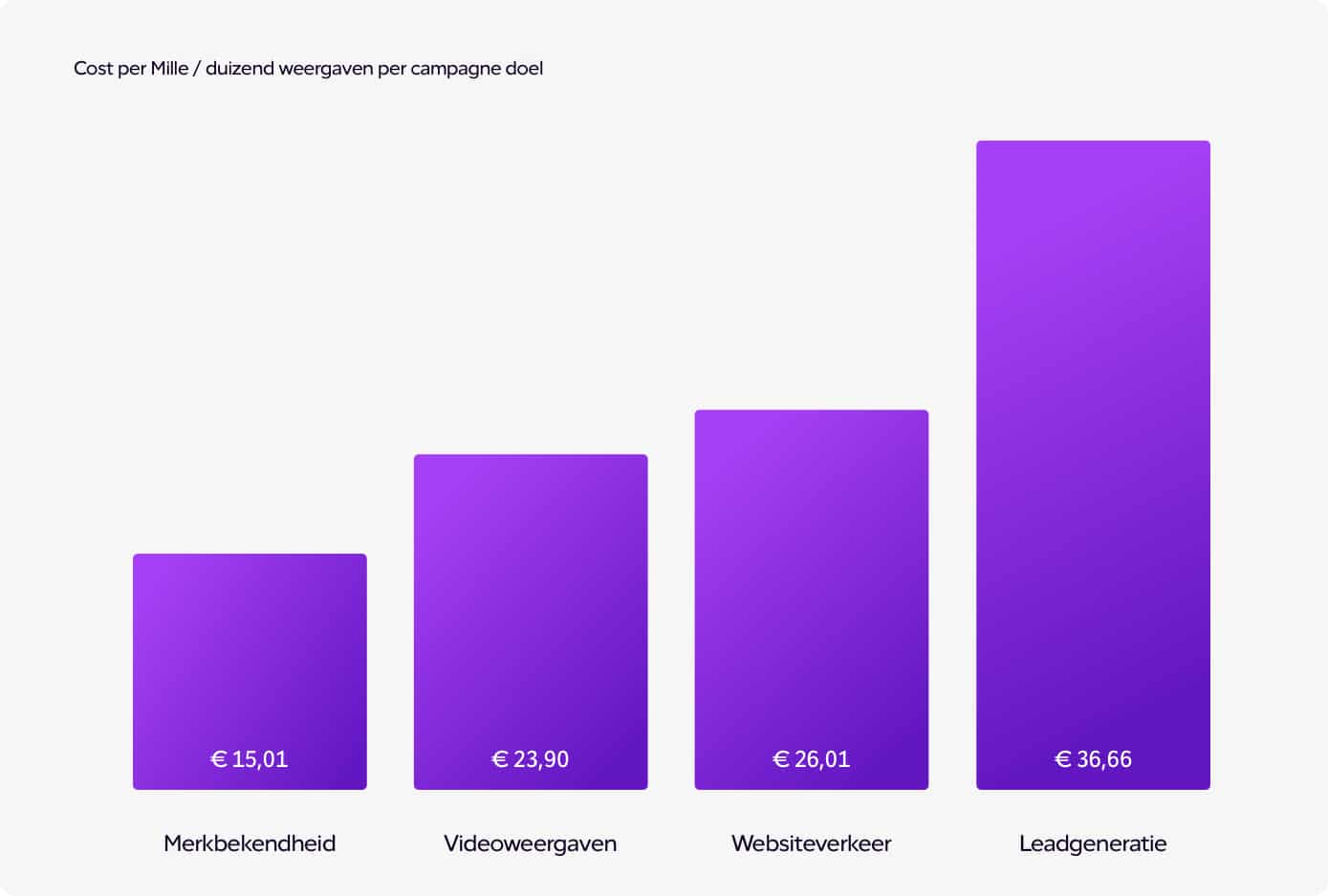
Average LinkedIn CPM per campaign objective
What can you expect from a LinkedIn CPM? We share what you can expect for several commonly used campaign objectives.
Which factors influence LinkedIn CPM?
To truly understand LinkedIn CPM, we also want to tell you which factors influence CPM. We have already mentioned audience and competition, but this is not all. These factors also influence your LinkedIn CPM:
- Seasons: we often see CPM fluctuate strongly during holiday periods, for example around summer and autumn holidays, but also around Christmas. In our experience, this comes down to two factors: your audience’s activity on LinkedIn and competition. The result varies greatly per audience and period. For example, an audience may be significantly less active during summer holidays but have a lower CPM due to less competition and still be interesting. The same audience can have a higher CPM during autumn holidays because competition is not less active. In our opinion, always worth testing!
- Bidding strategy: the options you have for bidding strategies vary per campaign and ad type, but it can make a big difference in your results and CPM. The default bidding strategy is often set to CPM and maximum results. But you can also choose a different bidding strategy, for example, a manual cost per cap or a limited CPM.
- Ad type: there is a strong difference between ad types. For example, InMails are relatively cheap but, in our experience, much less effective. Depending on your message and product or service, testing different ad formats is worthwhile. Note that you can only use one ad type per campaign. Testing multiple ad types therefore requires a higher budget.
- Campaign objective: not surprising when you think about it, but the CPM of a brand awareness campaign is much lower than when you choose lead generation.
- Ad relevance: not unique to LinkedIn but decisive for your results. How relevant is your ad? Relevant ads that the audience responds well to are rewarded by the algorithm: more impressions at lower costs.
- Quality of the ad destination: not only the ad, but also the quality of, for example, your landing page matters.
- Network and devices: where do you want to show your campaign? You can choose only the LinkedIn network or also the LinkedIn Audience Network and, of course, mobile and desktop. The choice between mobile and desktop depends on the ad type. In our experience, the LinkedIn Audience Network gives you a lower LinkedIn CPM, but we find the quality of placements and clicks from there questionable. Test and evaluate this per audience.
Tips for a lower LinkedIn CPM
Now that you understand what LinkedIn CPM is and how it works, you naturally want to know how to achieve a low LinkedIn CPM for your campaigns. The most important tip we can give you is optimize your audience. Use the unique options LinkedIn offers you and create as specific an audience as possible. Not only do you target the people most valuable to your campaign, but you can also create very specific ads. This immediately strengthens the relevance of your ad. Then it’s a matter of testing and optimizing. Think about the ad type, your bidding strategy, campaign objective, and timing of advertising.
Want to read more about LinkedIn CPM or LinkedIn possibilities? Then check out our page about LinkedIn advertising. Prefer to discuss the possibilities further? We are happy to share our knowledge and experience with LinkedIn campaigns for various B2B markets in a personal conversation.