These sellers will be obsolete within 5 years!
Are you also regularly confronted with customers who actually know more about the application of your product in their environment than you do? This is the result of the changing customer journey and the need for a new kind of salesperson. In this article, we discuss why the traditional salesperson will be obsolete within 5 years and how the salesperson 2.0 operates. Do you also think that the traditional sales profession has had its day, or do you stubbornly cling to old habits?
 Before the industrial revolution, there were already producers, salespeople, and buyers. At that time, it was common for home weavers to buy their raw materials themselves from a farmer, weave textiles, and sell door-to-door in the neighborhood. Every producer was also a salesperson. During the industrial revolution, the craft became a factory job. Farmers delivered directly to factories where weavers worked on steam-powered mechanical looms. Because production kept increasing, new markets had to be found. The factory hired people who went ‘outside’ to sell the products. The traditional salesperson was born, and their task was to track down as many potential buyers as possible. But does it still make sense in this age of digitalization and transparency to randomly knock on companies’ doors?
Customer journey in B2B drastically changed
The customer journey (purchase process or customer journey) is changing drastically. This is mainly due to the increasing availability of information through the advent of the internet and wireless (mobile) connections. Research by, for example, Forbes and McKinsey among B2B companies shows that the previously linear purchase process now looks completely different. Forbes’ research also indicates that half of all marketing expenditures have little to no influence on purchasing decisions.
Behavior of the traditional salesperson in B2B
The traditional salesperson is still focused on this linear process and behaves more like a spy than an ambassador. You don’t find them; they find you! The traditional salesperson tries to break into companies and find out what they need. They then want to supply that. Until the first conversation, the customer actually knows very little about them, their expertise, or their specialization. Combine the changing customer journey with the behavior of the traditional salesperson, what happens then?
The salesperson only starts a conversation with the customer after they have already absorbed a lot of information and knowledge. Very targeted information and knowledge, because the salesperson was unaware of any demand. In practice, a salesperson often sits opposite a customer who probably knows more about the subject than they do!
The traditional salesperson is actually always either too early or too late
Behavior of the B2B salesperson 2.0
Ladies and gentlemen who can come to a concrete solution for an important challenge in a warm and personal conversation with the customer will of course never become obsolete. But the traditional salesperson will disappear simply because they no longer fit how the customer makes their purchasing decisions. It simply no longer pays off! So how would we characterize the behavior of the salesperson 2.0?
Instead of being a spy or door-opener, the salesperson becomes an ambassador. An ambassador of certain knowledge, specialty, technology, or market information that is essential for the customer to make the right decision. This information is openly shared and is therefore findable for customers who have a question or challenge. The salesperson shows that they have ideas and can come up with practical solutions for challenges. The branding of the organization together with the personal brand of the salesperson determines whether the customer engages in conversation with them!
Traditional salesperson vs. Salesperson 2.0 in the competition matrix
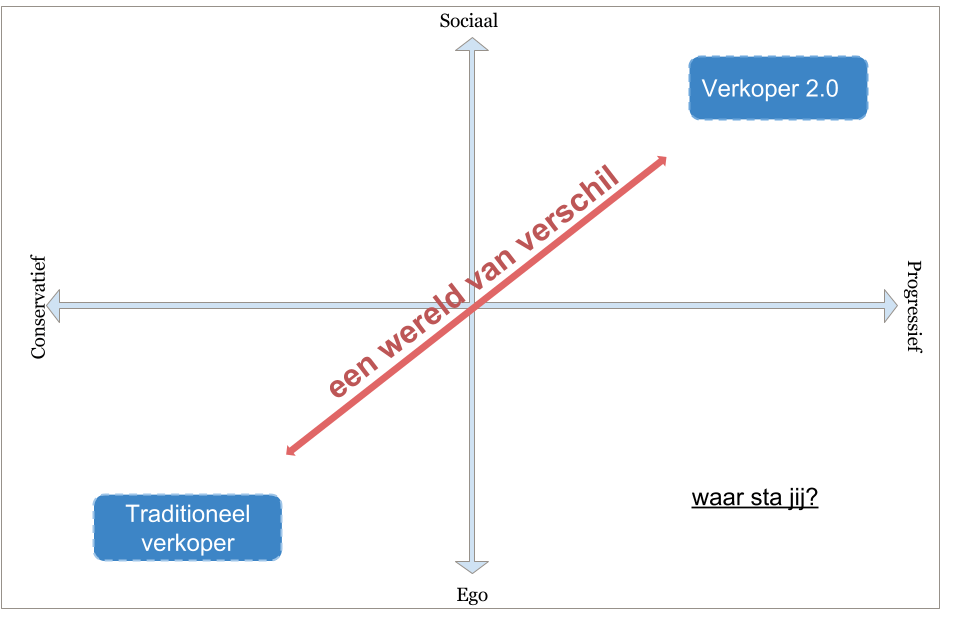
As you can see, a world of difference! What does the salesperson 2.0 do differently than the traditional salesperson? Below are the 5 main differences:
- Share, share, share!
Where the traditional salesperson protects and holds on to their knowledge as much as possible, salesperson 2.0 shares it freely. They know that giving comes before taking and that they must first prove themselves worthy as a conversation partner. - Making choices
The traditional salesperson prefers to be at home in as many markets as possible and therefore prefers not to make choices regarding specialty, market, or technology. Salesperson 2.0 knows exactly where they can add value and clearly chooses that. - Personal branding
Salesperson 2.0 knows that their personal brand is essential to make clear why they are the suitable conversation partner to discuss the challenge with. They combine personal style, traits, and expertise into a clear ‘brand’ that the customer understands. - Choosing/using channels
Salesperson 2.0 has chosen to be present on the channels the customer uses and uses these to promote their personal brand and engage in conversation with potential customers. - Being reachable
The traditional salesperson is actually not very reachable, you don’t call me, I call you! This directly follows our point about channels; salesperson 2.0 is simply always reachable if it suits the customer and via the channel the customer chooses. It will not surprise you that this channel is often an online channel (email, LinkedIn, Twitter, Facebook, etc.).
Regardless of which market you are active in, the shift to a different customer journey and thus the need for salesperson 2.0 is irreversibly underway. The only thing keeping the traditional salesperson alive now is the equally traditional customer, but how long will they remain alive in turn? Will you keep fighting a losing battle or finally make the decision now?
What do you think of salesperson 2.0? What steps have you already taken?
Need help or support? Please contact us.