Positioning Red Bull: the 5 key lessons
Do you know the ingredients of a can of Red Bull? Probably not, we think. But when you think of Red Bull, all kinds of other associations come to mind, like extreme sports, and you might even feel some energy bubbling up. This distinction is exactly what makes Red Bull so interesting for marketers—how did they manage that? The company has developed within 30 years into the most famous drink after Coca-Cola by breaking all marketing conventions. What can you learn from Red Bull’s positioning and what can you apply tomorrow?
Podcast about Red Bull positioning
Exciting developments at Red Bull now that founder Mateschitz has passed away. We discuss the potential impact on the brand in our podcast.
Origin of Red Bull
 Red Bull was founded in 1984 but it took until 1987 before the company appeared on the Austrian home market. The basic formula was found by the founders during a trip through Thailand, but they needed another year to make the drink suitable for the Western market. Due to the limited budget, the company had to spend its marketing budget smartly and therefore focused from the start on students and young professionals through very direct Viral Marketing. Within 10 years (!) the brand conquered Europe and the United States and created a completely new and unique market segment: the energy drink. We reflect on Red Bull’s positioning and marketing strategy and explain why the brand was able to conquer the world so quickly.
Red Bull Positioning

Photo by Jim Bauer
Founder Mateschitz drank a Thai energy drink to help with his jet lag, and this seems to be the basis for the ‘gives you wings’ slogan. By directly linking Red Bull to your performance, the company positions itself as the ‘boost’ you need to achieve spectacular results. The company actually doesn’t talk about the taste or effects of the drink but about the results you achieve with it! Also interesting is the limited focus on the social aspect; Red Bull doesn’t make the whole world better, but especially your world. This very progressive way of thinking has certainly paid off; the company now sells 5.5 billion cans per year and is the absolute market leader with often more than 40% market share.
Red Bull Marketing Strategy
Red Bull’s marketing strategy is to come into direct and physical contact with their target audience (men, 18 to 35) at concerts, festivals, and extreme sports events. The brand then uses their unique, high-quality content as leverage to reach a much larger audience. In this content, Red Bull sells the brand, not the product, always putting the experience and enjoyment of the target audience at the center.
Click for readable version
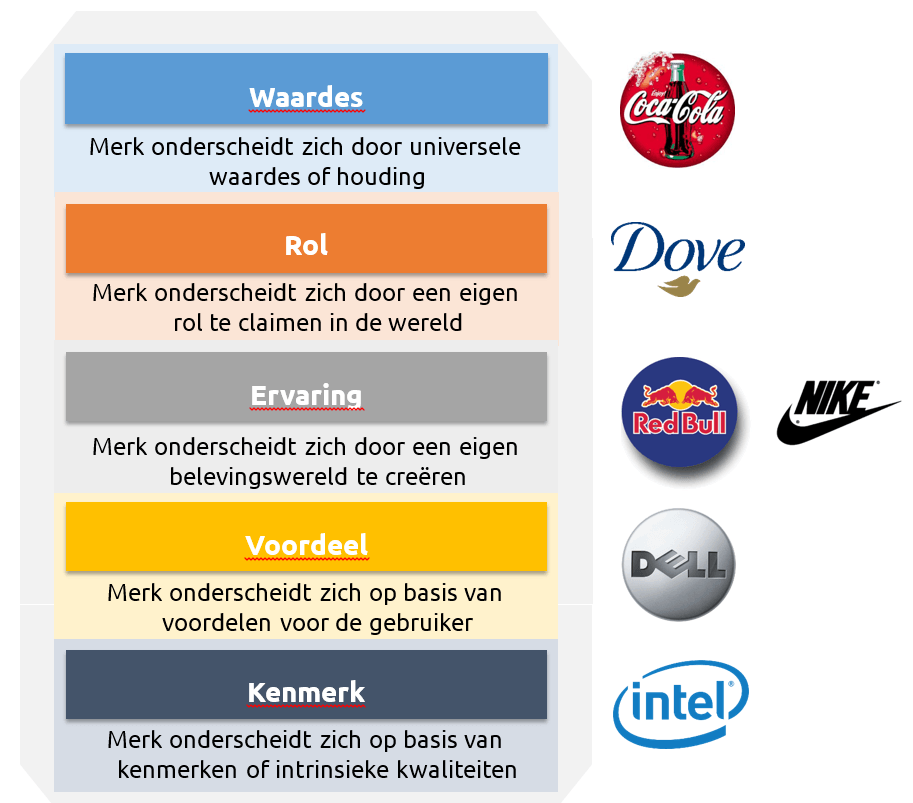
By zooming in on the communication level, it becomes crystal clear how distinctive Red Bull’s marketing strategy is. By focusing on the experience, and not the brand, Red Bull was able to create a completely unique world, a world in which Red Bull then plays a prominent role. Red Bull has thus become almost synonymous with the world of extreme sports. The company’s investments in, for example, Formula 1 only contribute to this.
In Red Bull’s world, freedom is very important and the company behaves accordingly. Each region chooses which events or sports best fit the target audience and is given a lot of freedom in this. The only limitation: the ‘tone of voice’ must remain consistent worldwide as set by Mateschitz.
Red Bull Positioning: Key Lessons
Important lessons that also apply to your company that we have learned from Red Bull’s positioning and marketing strategy:
- There is enormous benefit to be gained from deliberately breaking with the established conventions of a market. By using the competitive matrix you can map the positioning of your competitors and move yourself towards the open playing field.
- Reflect on the different communication levels. Active in a market where everyone mainly talks about features or benefits? Think of Red Bull and sketch a world where your customers are central, then explain what place your product or service has in that world.
- Consistency: use one tone of voice. Your organization or brand can have many different messages, but the way you talk to your target audience must always be the same. A very basic example is the use of formal or informal address, but you can implement and use this in many more ways. The result is recognizability and trust.
- Evaluate your tools and channels; what is the key tool to reach your target audience? Red Bull was able to reach the most valuable target group for them with little money because they first asked themselves: Where can I find and directly reach my target audience? The answer was not the usual ads or billboards but 1-on-1 sampling by mobile promotion teams.
- Walk the talk, what behavior fits your positioning? The founder of Red Bull drinks about 10 cans daily himself and the company takes giving wings so literally that employees can even get flight lessons reimbursed. The company breathes its slogan and therefore has no trouble conveying it, can you say the same?
Red Bull’s positioning is simply ‘one of the greats’. Even if you find the drink terrible, you can probably relate to their world and, so to speak, feel butterflies in your stomach when you think of Red Bull. By comparing the key lessons from Red Bull’s positioning with your own positioning, you challenge yourself and undoubtedly come to new insights.
Want to know more about positioning and how you can get started yourself? Read our page positioning and find there, besides in-depth articles, also dozens of examples and models for every possible positioning challenge.