Positioning Rabobank, a neglected backyard?

Photo by Philip Henzler
The Rabobank “on all continents but especially in its own backyard” was the slogan of the campaign back in 2010. But that very backyard seems to be somewhat neglected. The number of cooperative branches has dropped from 547 to 129 in 10 years, and the headquarters in Utrecht is increasingly taking a dominant role and now largely determines the entire course.
Nowadays, we see flashy world cities on screen when Rabobank is convincing us of its knowledge and expertise, cities like Hong Kong and New York, cities that absolutely do not resemble my backyard. What remains of the statement by then president-commissioner Lense Koopmans who in 2011 still called the cooperative a ‘superior form of enterprise’ and who ‘always wanted to be able to see the church tower of the village’?
In terms of positioning, Rabobank finds itself in a vacuum: are they the major international player or the local cooperative bank for “money and good advice”? A position that cannot be aspired to because as we always say, “if you don’t dare to choose, a place will be assigned to you.” A customer always wants to understand why they choose a specific bank, but now that is too difficult. What does the customer see: Rabobank is becoming a bank like all the others but clings desperately to the positioning that always set it apart. Who still feels at home with both faces of the bank?
Rabobank positioning dilemma visible in our positioning matrix
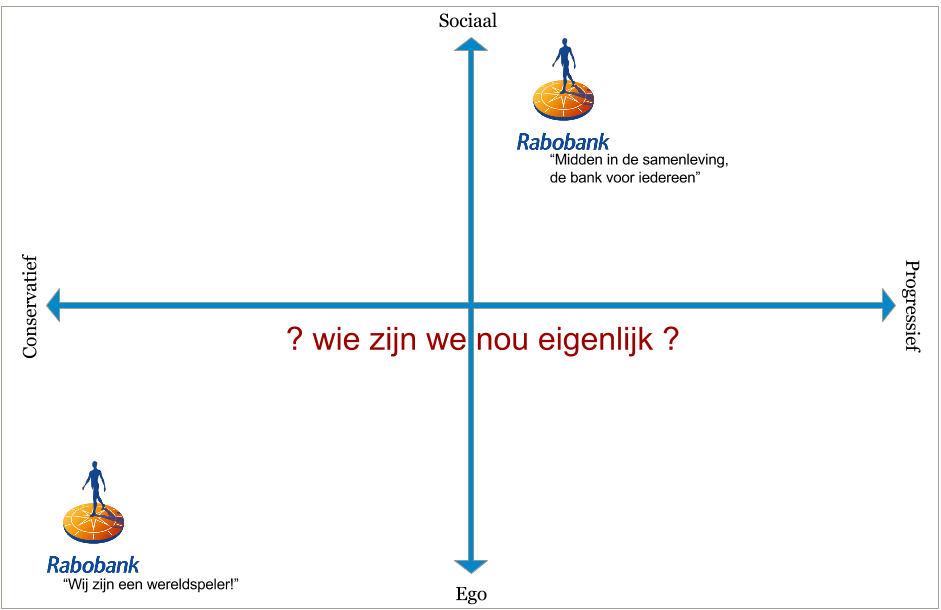
Development of Rabobank positioning in 3 commercials
Of course, we do not advocate that you should always stick to the ‘old familiar’; Rabobank is clearly heading in a certain direction. We simply state that the company must choose and formulate and implement a positioning that fits this choice. Will they choose again for the neat backyards of their members, or for the green grass in faraway destinations?
Want to know more about positioning and how you can get started yourself? Read our page positioning and find there, besides in-depth articles, also dozens of examples and models for every possible positioning challenge.