Positioning Netflix: market leader in a fast, turbulent market
How do you continue to successfully position yourself in a changing market where competition is rapidly increasing? Netflix has become a household name in our society, in our culture, and that is why we look at the positioning of the streaming service. Founded as an online DVD rental service in 1997, it has now become the leading online streaming platform with over 200 million subscribers. We explore how Netflix has built its brand and successfully positioned itself in a highly competitive and fast-changing market.
 Who doesn’t know Netflix? The streaming service is no longer a newcomer, has secured a strong position, and we also think it’s a cool brand. The streaming service became famous thanks to major original productions such as House of Cards, Stranger Things, Squid Game, Bridgerton, and Lupin.
The Netflix brand is even so strong that;
- ‘Netflixing’ has become a verb,
- ‘Netflix and chill’ has become a saying for several generations,
- Ben & Jerry’s now sells Netflix & Chilll’d, and
- for many people, “tu-dum” is a sound forever associated with Netflix.
The opening jingle is so characteristic of the brand that Netflix recently organized a unique online party for fans: Tudum. During this online event, the stars of the biggest Netflix hits gave a preview of the newest seasons. We and many others think Netflix is a cool brand, and we are happy to explain why, which of course has a lot to do with the positioning and marketing expressions.
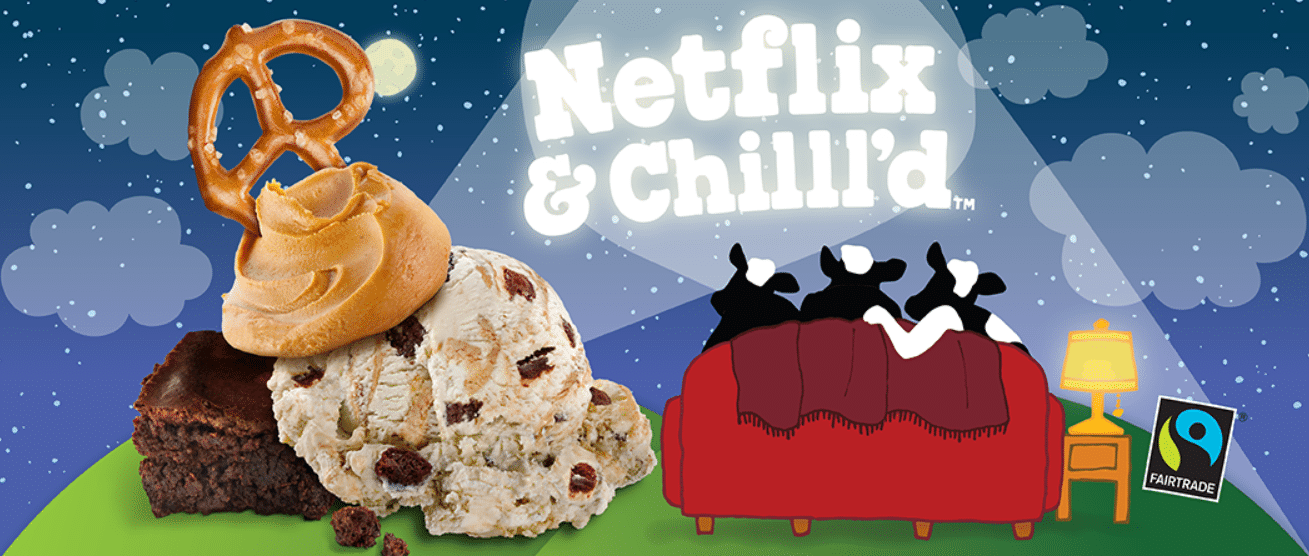
Netflix & Chilll’d, the Ben & Jerry’s flavor specially developed for the perfect Netflix night.
Netflix: always an innovative concept?
Was Netflix always innovative? If you place the online DVD rental in the right zeitgeist, the answer is probably yes. But even if we dive deeper into history, we quickly encounter innovative concepts. We go back to the year 2000: the year The Sims, Windows 2000, and the Worldonline stock were introduced. It is the year Netflix drastically changed its revenue model to a subscription form. Customers could no longer rent one DVD but had to take out a Netflix subscription that allowed unlimited DVD rentals for a month. In 2021, subscriptions for services are very normal, but twenty years ago, a subscription was a groundbreaking concept.
Thanks to this groundbreaking concept and the rapidly growing popularity of the DVD, Netflix grew quickly. In 2000, the company had 300,000 subscribers and 57 million dollars in debt. But the tide quickly turned for the DVD, partly due to the arrival of streaming platforms and video-on-demand services. The first streaming platform, YouTube, was launched in 2005. Followed by Amazon Prime (2006), Hulu (2007), and Netflix (2007). So, both in 2000 and 2007, Netflix made major, innovative changes to its concept. Meanwhile, Netflix is the largest streaming platform worldwide.
Positioning in a rapidly changing market
In the past twenty years, the way we watch movies and series has completely changed. How do you as a brand deal with that rapidly changing demand? Netflix has managed to use these changes to its advantage with the result: in 2020, the company had 203.6 million subscribers and made 2.7 billion in profit. In this article, we therefore answer the question: how has Netflix successfully positioned itself in a highly competitive and fast-changing market?
Netflix mission and vision
Netflix has a very clear vision of entertainment: streaming will replace linear television. People love television and movies, but not the experience of linear TV watching because they are bound to a limited offer with a specific viewing time that they cannot watch everywhere. Streaming, on the other hand, offers a more personal offer and is available wherever and whenever the viewer wants. Streaming services make it possible to rewatch and binge television and movies. We can say that Netflix’s vision perfectly aligns with the changing viewing behavior of their target audience.
Netflix has formulated the following mission:
At Netflix, we want to entertain the world. Whatever your taste, and no matter where you live, we give you access to best-in-class TV shows, movies and documentaries. Our members control what they want to watch, when they want it, with no ads, in one simple subscription.
Netflix: a “focus passion brand”
Netflix’s goal is to entertain, wherever and whenever its users want. For this, the company sets two core values:
- Content people love
- Focus passion brand
Content people love
Content is the core of Netflix and is determined as much as possible by the customer. From continuously improving the platform based on data and offering the right content at the right time based on personal preferences to creating new series and movies or personalizing the promotion of new content.
Focus passion brand
Netflix calls itself a “focus passion brand.” A Netflix subscription is simple: for a fixed monthly fee, you can watch unlimited series and movies online wherever and whenever you want, without ads. It is also easy to cancel monthly. Netflix offers its customers the freedom, flexibility, and pleasure of “bingeing” wherever and whenever they want.
Additionally, the platform has one specific focus: entertainment in the form of television and film. This means subscribers will not find sports, news, music, or user-generated content on the platform. For a long time, games were also not an option, but Netflix has reversed that. At the end of 2021, Netflix announced it will soon offer games based on its most famous series and movies on the platform. With this change, Netflix hopes to reach younger generations, CEO Reed Hastings previously indicated that Netflix is increasingly losing younger users to games like Fortnite.
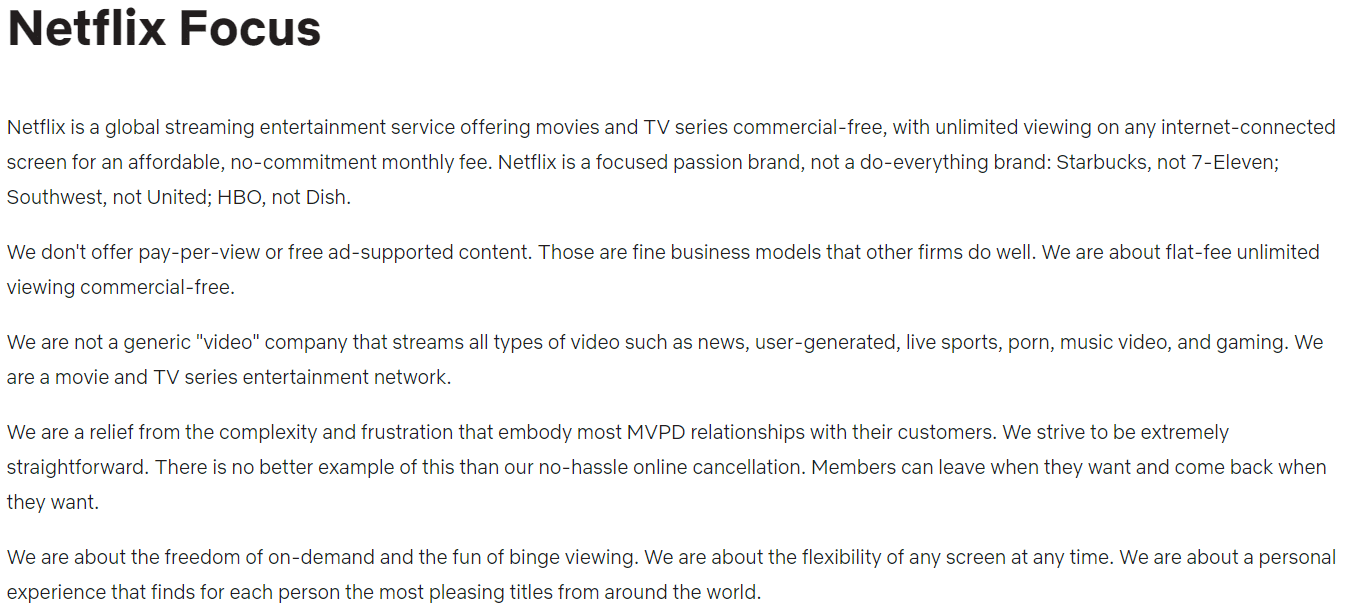
Netflix focus: freedom, flexibility, fun, and the personal experience of bingeing.
Netflix brand archetype: Jester
Netflix is convinced that they improve the offering of entertainment such as movies and series. They have challenged the status quo for over twenty years. First, they challenged the brick-and-mortar video store by sending DVDs home with a subscription. Today, Netflix does this with its streaming platform, convinced that linear TV watching and commercials are things of the past.
This rebellious attitude goes hand in hand with a passion for content and humor. Humor is a great asset in Netflix’s communication. From social media posts and strategies to create online engagement with the target audience, to announcing new content: it must tease, often be funny, and regularly poke fun at situations. We therefore assign Netflix the Jester brand archetype. Like the Jester, Netflix is playful, cheerful, and critical. Fun and humor come first, but there is certainly a serious vision behind it.
Take, for example, the introduction of Narcos Mexico in Thailand; a heavily censored country where the mostly naked, violent scenes full of alcohol, drugs, sex, and crime were not allowed to be promoted. What do you do as Netflix? You poke fun at Thai censorship. With an adapted trailer, in which the forbidden parts are not visible but you can tell what it’s about even with little imagination. Support this campaign with billboards that directly address the censorship and clearly state when the uncensored version will premiere on Netflix. It was the ultimate tease and criticism of the Thai authorities for Netflix.
No surprise that under the slogan ‘Netflix is a joke’ the brand announced its Comedy branch with unique specials from world-famous comedians.
Social media and content strategy support positioning
Essential to Netflix’s success is how they use social media. Of course, new series and movies are announced on various social platforms, but precisely by using these platforms as a communication tool with fans, it fits perfectly with their brand. The content and communication are full of humor and often a two-way interaction with fans, which creates a lot of engagement.
Engagement is increasingly the leading factor in organic visibility on social media platforms, and Netflix knows how to make optimal use of this. Netflix is many times larger on social media than competitors such as Amazon Prime, Disney+, HBO Max, and Hulu. The result is a very large fan base that introduces the newest Netflix offerings with relatively little effort.
For example, the campaign for the second season of Narcos was inspired by the striking online reactions of fans. The first season was extremely popular and was often mentioned on Twitter as the way to learn Spanish. So Netflix launched “Spanish lessons with Narcos” ahead of the second season. The campaign was an immediate hit and generated a lot of organic visibility for Narcos and the Netflix brand.
But, as befits a Jester, Netflix also knows how to deliver an appropriate message to its audience about more serious topics. For example, the second season of the popular series 13 Reasons Why was introduced with a campaign around awareness and prevention of youth suicide: “13 reasons why not.”
Netflix positions itself as the platform for entertainment
A positioning focused on entertainment with a major role for communication via social media may seem quite logical and not so innovative for an online streaming platform. But it is. To support this judgment, we compared Netflix with its main competitors.
Hulu
Hulu’s mission is: “to empower everyone to discover, share and celebrate the stories that connect us.” Hulu’s vision centers on creating new and familiar experiences, challenging creators to push the boundaries of storytelling and thus lead the future of streaming. Hulu launched a unique concept during the COVID-19 pandemic: Hulu Watch Party. With this service, subscribers from different locations can stream Hulu content together; the stream is synchronized and includes a private chat.
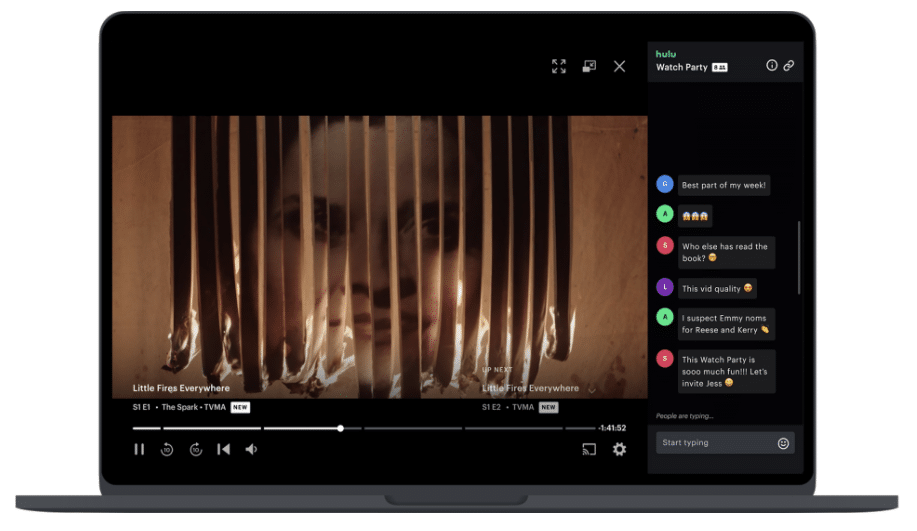
Hulu Watch Party: streaming together
Hulu’s offering consists of its own documentaries, series, and movies, supplemented with series and movies from other producers. This offering is available at a reduced rate with ads and at a higher rate ad-free. A big contrast with Netflix is that binge-watching is hardly possible: on Hulu, episodes come online one by one. Hulu is now 100 percent owned by The Walt Disney Company and collaborates with Disney+ and ESPN to offer customers a complete entertainment package, such as live sports events and children’s movies.
Amazon Prime
Amazon Prime is part of Amazon, the company that strives “to be earth’s most customer-centric company, where customers can find and discover anything they might want to buy online.” The biggest difference between Amazon and Netflix is the availability of content. Amazon wants to always serve its customers and therefore chooses a hybrid content model, in which some content is released all at once on the platform but some, for example movies, can be rented for a premium price before the release date. This way, Amazon subscribers can enjoy the newest movies relatively soon after their cinema release.
Additionally, Amazon’s offering, like Netflix’s, consists of original and purchased productions. A big difference is that you can take an Amazon Prime Video subscription, but you can also choose an Amazon Prime subscription that also gives you access to e-books, music, and free shipping for everything you buy on Amazon.
HBO Max
The biggest difference between HBO Max and the other platforms is that HBO Max is part of one of the largest TV broadcasters in the United States, HBO. This gives the platform exclusive rights to many successful series such as Game of Thrones, Chernobyl, and The Wire. In 2021, HBO Max also collaborates to release all Warner Bros. and DC Movies immediately after their cinema release.
Compared to the other streaming platforms, HBO Max might be the odd one out regarding its mission and vision; big brother HBO has formulated the following: “At the heart of HBO is our passion of making a difference, and every day we are using our platform to educate, inspire thoughtful action and help make the world a better place.” How HBO Max fits into this is not yet entirely clear to us, but maybe that will become clear when HBO Max is also available in the Netherlands from 2022.
What does Netflix’s positioning yield?
Netflix is by far the largest online streaming service worldwide in terms of subscribers. Besides the three other streaming services we discussed in this article, there are countless other global and local streaming services; thanks to its strong positioning, this is not a threat to Netflix. It has led to Netflix becoming a household name, inseparably linked to streaming services and entertainment.
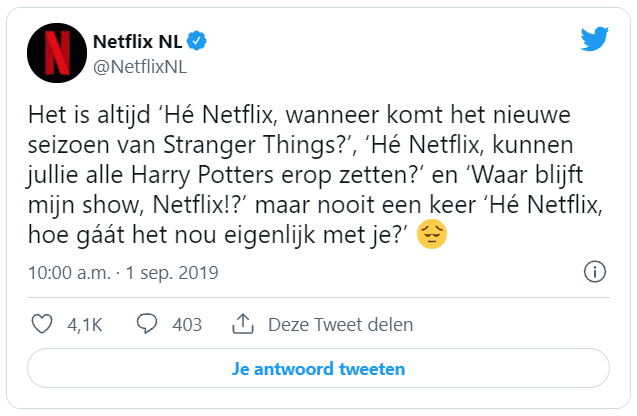 Compared to its competitors, it has not only led to a very clear, strong position but also to a unique online presence that we do not see with any of the other platforms. None of its competitors are praised for cool campaigns or how they communicate with their subscribers, not even Amazon, where the customer is central.
Besides brand value and a large number of subscribers, another valuable result of its high-quality positioning is a certain invulnerability among the target audience. As a result, the Netflix brand suffers little damage from price increases and controversies surrounding celebrities linked to Netflix, which is a very valuable result in a time when ‘cancel culture’ quickly claims victims.
Want to know more about positioning and how you can get started yourself? Read our page Positioning and find there, besides in-depth articles, dozens of examples and models for every possible positioning challenge.