Is LEGO’s brand and positioning strong enough to withstand parasites?
The LEGO brand is undoubtedly one of the few toy brands that consistently manages to claim a high-quality positioning. For years, LEGO was the sole provider of the famous bricks, and the question “Who didn’t grow up with it?” is entirely justified. However, recently alternatives to the well-known bricks have emerged. One of these alternatives is the brand Sluban (www.sluban.nl). This alternative seems to offer a similar product at a significantly lower price. LEGO has, of course, made legal attempts to ban this “copycat” product. Apparently, these attempts have failed.
Our fascination with the LEGO brand led us to feature this wonderful brand at the center of our podcast:
LEGO Positioning
The brand name LEGO comes from the Danish leg godt (“play well”) and was started in 1932 by Ole Kirk Christiansen. He developed the product based on a patent for “Automatic Binding Bricks” (read the original patent) from England. It was only in 1958 that they succeeded in translating their vision of a system for creative toys into a patent. Father and son Christiansen built the company around one statement: ‘the best is never too good,’ and quality remains one of the company’s pillars. The blocks from the company’s early years are still compatible with the current blocks.
The products from China-based Sluban are part of a series of copycat products that emerged after the last LEGO patent expired and are built to the exact dimensions of LEGO bricks. The different systems therefore all fit together, although Sluban appears to be of significantly lower quality. (Source 1 & Source 2) Marketing-wise, Sluban also bases itself on LEGO; the similarities between the websites are quite evident. A clear example is that they repeatedly speak of “bricks that fit the well-known building blocks.”
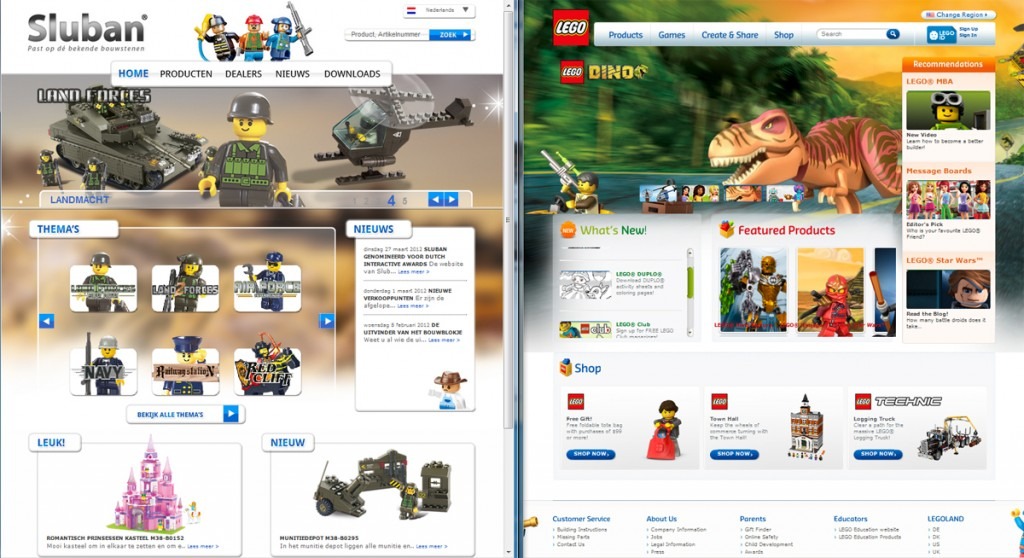
Comparison between the Sluban and LEGO websites
Just as the remora fish lives in large numbers at the expense of the humpback whale, a number of parasites have gathered around the LEGO brand. In nature, it is always a ‘higher’ organism that is parasitized by a ‘lower’ organism, and that seems to be the case here as well. But what makes LEGO the higher organism in this story?
LEGO’s Brand and Positioning
LEGO speaks of its brand as a responsibility. They feel responsible for the expectations people have of their products. LEGO’s core values have remained consistent over the years and are: imagination, creativity, fun, learning, caring, and quality. They want to make a positive difference; for example, the theme of ‘war’ is taboo at LEGO, and they prefer adventure. It is this combination, linking the organization’s identity with behavior, that LEGO can use to maintain and expand its position.
That we call Sluban a parasite, and not even a penguin which we often use, has no moral basis. But the fact that Sluban cannot sustainably distinguish itself from its ‘host’ LEGO means it cannot take a distinctive position in the market. This symbiosis with LEGO is also finite, as undoubtedly a stronger parasite will come. The English proverb teaches us: “There’s always a bigger fish,” but fortunately for LEGO, like the humpback whale, they remain the biggest for the foreseeable future.
Want to learn more about positioning and how you can get started yourself? Read our page positioning and find, besides in-depth articles, dozens of examples and models for every possible positioning challenge.