Implement your positioning in 9 steps
Generate more leads and sales? Implementing your positioning according to these 9 steps ensures it truly shines.
Determining a unique, remarkable positioning is often quite a challenge, and a team breathes a sigh of relief once it’s done. But then the real work begins. Implementation is where the success of the positioning stands or falls. It deserves full attention. That’s why in this article we discuss the 9 steps for implementing your positioning.
Implementing positioning: 9 steps
 Create customer profile
- Map the customer journey
- Develop proposition
- Formulate objective
- Determine KPIs
- Align organizational behavior
- Determine resources and channels
- Track results
- Evaluate and adjust annually
Of course, we are happy to discuss the individual steps in detail.
1. Create customer profile (buyer persona)
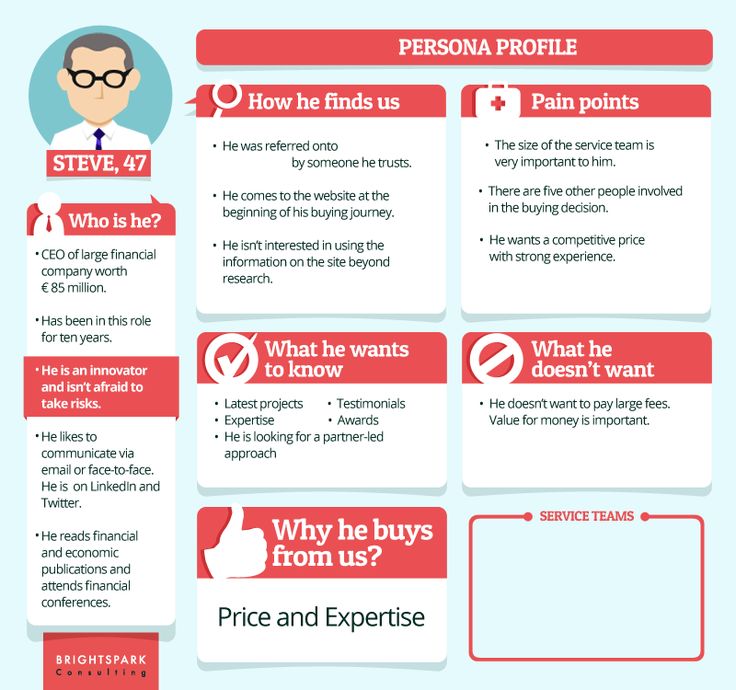
Example customer profile (buyer persona) Source
When creating positioning, we speak of a target group, a segment within which the majority of our (potential) customers fall. But for implementing the positioning, this is too general. Therefore, the first step in implementing positioning is creating customer profiles.
Creating a customer profile or buyer persona gives a real ‘face’ to your ideal customers. You use all the knowledge you have to describe who this person is and how they think. What occupies her daily, what attitude does she have towards your product, what criteria does she use to make a decision? The answer to these and many more questions should emerge from the customer profile you create.
2. Map the customer journey
For each customer profile, you then map the customer journey. The customer journey is the collection of phases a customer goes through in their purchasing process and interaction with a company. Your research into the customer profile has probably already given you much insight into the contact moments, but it’s worthwhile to really reflect on this and visualize the result.
Next, you place the customer profile(s) alongside the result and indicate the most important contact moments. These are called ‘Moments of Truth’:
Moment of Truth: The moment when a potential customer interacts with a brand, product, or service and forms or changes an opinion about it.
Google distinguishes an additional step, the ‘Zero Moment of Truth’. Read all about it here.
Keep in mind that the most important contact moments often differ per customer profile. It’s therefore worthwhile to determine these per profile.
3. Develop proposition(s)
A proposition is the transaction-oriented statement that briefly summarizes why a customer should prefer a specific product or service over all competitors and alternatives. A well-known example is ‘melts in your mouth, not in your hand’ from M&M’s.
Determine the primary proposition per customer profile. You can use various structures, some examples:
- We help X with Y so that Z.
- For {customers} who have {problem or question} there is {product or service} that ensures {result}.
- What, how, why
- {Huge problem}. {Offered solution} that {why it’s different} and {share proof/track record}.
We wrote extensively about the difference between proposition and positioning.
The ultimate step is to determine the best fitting proposition per Moment of Truth (important contact moment). That sounds like overkill, but what convinces someone strongly depends on the phase of the sales process they are in. Your conversion is probably much higher with specific propositions. By the way, you can also implement this later as part of the annual evaluation and adjustment.
4. Formulate objective(s)
What do you want to achieve with your marketing efforts? Probably to attract more customers or leads, but you understand that this objective is far too vague. I won’t bore you with the explanation of SMART (Google it yourself) because it should be self-evident.
Another pitfall is not choosing one or a few objectives but a whole list. So greater brand awareness, more leads, larger market share, and better customer retention. Even if your objectives are very SMART, having too many objectives makes it harder to make choices.
Noah Kagan, now known from SumoMe but started as employee #30 at Facebook, says the following about his work at Facebook:
“In every meeting, I had new ideas for Mark (Zuckerberg) to make money. He would look at me and ask: ‘But how does that get more users?’ If I couldn’t answer that, the action didn’t proceed. Mark had only one objective: get more users. The rest came later. And this is the basis of Mark and Facebook’s success. When I started SumoMe, I also stuck to a single objective, and it works!”
The best objective(s) are dominoes; when these fall, the rest naturally follows.
5. Determine KPIs
It says KPIs, but ideally it’s just one: which variable best embodies to what extent you meet the objective(s)? I’ll give you a concrete example:
The first few years of Merkelijkheid, within our online-only strategy, we mainly focused on attracting visitors, increasing our reach. We wrote weekly articles on various topics, some focused on SEO and others on social media. Our objective was to establish and increase our brand awareness. Our KPI was the number of unique visitors visiting our site per month.
After a few years, we had a respectable number of visitors, about 6,000 unique visitors per month at that time. We occasionally received calls, but it wasn’t booming yet. During our evaluation, we decided to shift our focus; we wanted to get in touch with new potential customers, which means collecting name, address, and contact details. The overarching KPI was conversion; the % of visitors leaving contact details.
Unfortunately, the goal is not always so straightforward to capture, but I would advise you to keep the number of KPIs as small as possible. It makes evaluation much simpler, and KPIs are important tools for determining both behavior and resources and channels.
6. Align organizational behavior with positioning
Your organization’s behavior must be aligned with the positioning:
CoolBlue (service with a smile) has managed to embed its positioning into the very core of the organization. That means the helpdesk employee already looks up your details based on the phone number you call from. She then immediately has a good idea of what your question is about and can take action based on three questions. So fast and decisive that you are amazed. If at the end of your conversation you still hear ‘Enjoy vacuuming!’ you can’t help but smile.
Unfortunately, we are much more often confronted with the opposite. A company that does everything to win you as a customer but then leaves you out in the cold. This is perhaps where the risk of damage to a new positioning is greatest; if the organization does not make the positioning its own.
Describe, based on the customer journey and the most important contact moments with your brand, what behavior fits and give it concrete form. Describe mainly ‘do’s’ and as few ‘don’ts’ as possible. You want your colleagues to quickly feel confident in how to act instead of memorizing a list of rules.
7. Determine resources and channels
Should we make a brochure, and should it then be printed or used digitally? Should our brand be found on Instagram or only on LinkedIn? Which trade shows are crucial, or can we better spend that budget elsewhere?
One or more of these questions probably remind you of difficult internal discussions. These are hot topics for many brands because what worked in the past meets the future. The big advantage is that now, armed with the first six steps, you can make a clear statement about this.
Customer profile + customer journey = essential channels and resources
You know what your objective is, which customer groups you want to address, and what the most important contact moments/moments of truth are. At the intersection of these factors, you find the most important resources and channels for your brand. Marketing is often accused of being mostly guesswork, but by bringing these three factors together, you use the available resources much more efficiently.
Still struggling to make the decision? Launch a test in which you compare the old resources and channels against the new ones. Make sure to clearly agree on what determines the winner (what success looks like).
8. Track results and continuously improve/adjust where needed
The measurability of marketing has only increased, reinforced by the customer journey thinking we discussed in step two. The results should naturally be reflected directly in the KPIs, but you can also go one step deeper.
Think or calculate back what influenced the KPI:
For example; five new leads via the websites led to 2 inquiries, of which one placed an order. Cost per lead €100. That means the order cost you €500. Will you therefore invest more or less time in generating leads via the website?
The above example is of course simplistic but very close to reality for many companies. Often, looking at marketing results this way opens the eyes of the most stubborn colleagues.
9. Evaluate annually and adjust decisively
Set a firm deadline for the evaluation in which you carefully review all previous steps.
Questions for (semi)annual positioning evaluation
- Are our customer profiles still accurate, are these really our customers?
- Have any steps in the customer journey been overlooked and what does that mean for our activities?
- Does our proposition convince or does another work better?
- What has become of our objective?
- Do the KPIs cover the scope?
- Has the organization been able to embrace the positioning? Why or why not? What can be improved?
- Are we using the right resources and channels?
Positioning is a learning process
Systematically tackling and working with positioning is a learning process. No one has the right answers from the start, but following these steps you come well prepared. The last step determines whether you keep growing or stand still. If you are in a rapidly changing market, evaluate semi-annually but keep in mind that change takes time. Before you see the first results of an online strategy, you are quickly half a year further, a shame to stop before that.
Want to know more about positioning and how you can get started yourself? Read our page positioning and find, besides in-depth articles, also dozens of examples and models for every possible positioning challenge.