Gamma Positioning: successful positioning or top of mind through distinctive campaigns?
Hardware store Gamma celebrates its fiftieth anniversary this year, a perfect moment to take a closer look at its positioning. How has Gamma developed from the first real hardware store into the market leader in the Benelux? To answer that question, we look at the origin of the chain, its positioning, and several striking marketing examples over the years. Finally, we place Gamma and its biggest competitors in the positioning matrix, make a statement about Gamma’s brand archetype, and assess its positioning.
 In 1971, Gamma introduced the first wholesale store for small contractors, inspired by the American model, when it opened its doors in Breda. It soon became clear that the store was especially popular with ‘regular’ customers. Gamma then decided to rename the store as a retail outlet: the first self-service store for DIY enthusiasts. In the 1970s, the number of Gamma branches grew rapidly, partly thanks to the franchise organizational model also adopted from the US.
While the growth of the DIY market stagnated in the 1980s and 1990s, Gamma pursued acquisitions, broadened its assortment, and focused on centralizing operations such as distribution. At the beginning of the 21st century, the DIY market still struggled, but Gamma gained market share and introduced a customer card across its various formulas, including Karwei and Bouwmaat by that time. In 2013, Gamma also opened its doors online, followed a year later by the webshops of Karwei and Gamma Belgium. In recent years, Gamma and Karwei have been repositioned to sharpen the distinction between the two brands, an investment of over 100 million euros according to then CEO Harm Jan Stoter.
Gamma Positioning
But what exactly is Gamma’s positioning? According to itself, Gamma is the DIY store of the Netherlands where customers find all the products they need to get the job done. Furthermore, Gamma states:
“GAMMA wants everyone to really feel motivated to get started. With their own hands. Or with help. GAMMA makes everyone handy. Because when you’re in control yourself, when it’s exactly what you want, you enjoy it even more. I can do it. GAMMA.”
The company also speaks of Gamma’s three pillars:
- Gamma helps you tackle the job the right way
- Gamma helps you make the right choice
- For custom work and special products, Gamma is also the right place
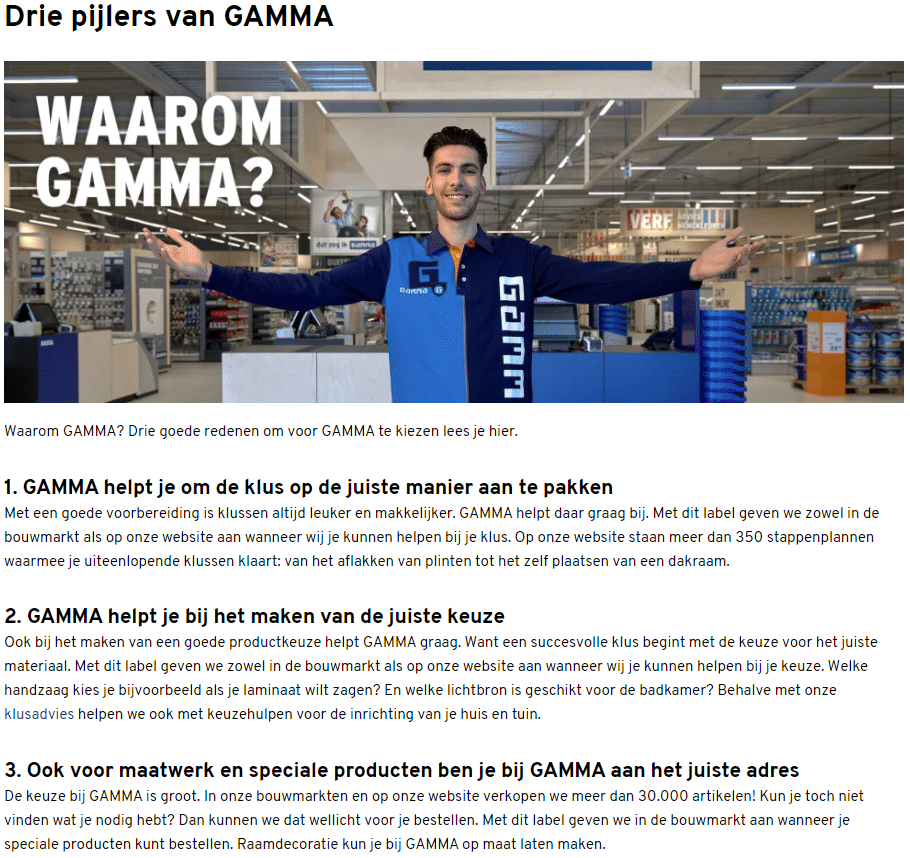
These three pillars align with ‘making everyone handy’ and finding all the products for the job. With step-by-step plans for various tasks, choice assistance, DIY advice, and a selection of products that can be specially ordered or custom-made, Gamma gives substance to these three pillars. Gamma thus takes a supportive role with very practical expressions. This is not new for Gamma; the company already offered DIY instructions on videotape 20 years ago. Yet the emphasis is really on Gamma, because you can do it thanks to Gamma.
Gamma Marketing
“That’s what I say, Gamma.” This is the slogan the hardware store has used since the 1990s, supported by various advertising campaigns, including the very successful series featuring neighbors Sjaak and Free-Willem that ran for ten years. These two characters are emblematic of the no-nonsense attitude and humor for which Gamma was known for many years. A few years before the repositioning, the campaign had to make way for a different direction, but Gamma still regularly uses variations on “That’s what I say, Gamma,” such as “That’s what I recycle” and “That’s what I save.” Since its repositioning, Gamma has focused more on families, doing DIY together, and the emotion of DIY with the fitting slogan “I can do it – Gamma.”
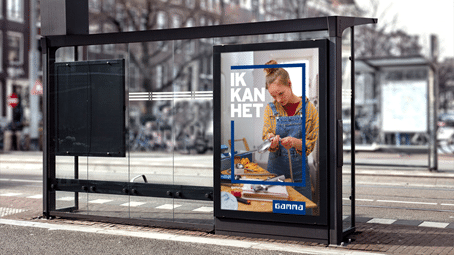
50 Years of Gamma: Quirky Ways of DIY Central in New Campaign
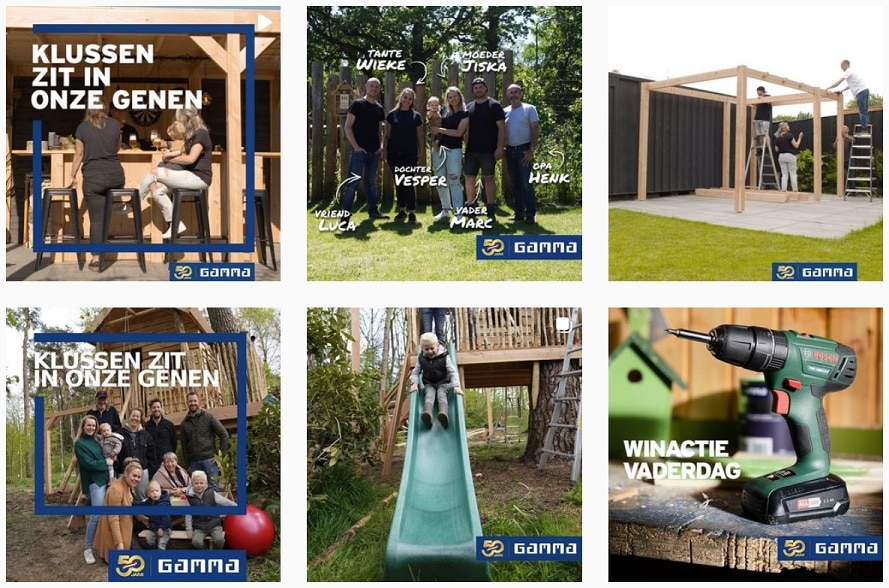
In 2021, Gamma celebrates its fiftieth anniversary with a new campaign: DIY is in our genes. This campaign also centers on DIY and families; according to Gamma, it is an ode to the quirky ways of DIY passed down from generation to generation. In addition to campaign materials on radio, TV, and in public spaces, Gamma runs a social media campaign focusing on families and friends doing DIY together.
Karwei Positioning
 Before we pass judgment on Gamma’s positioning, we put it into perspective by analyzing the positioning of its main competitors. We start with the little sister, Karwei: the hardware store with taste. Like Gamma, Karwei is part of Intergamma and has been repositioned in recent years. The most important result is perhaps that Karwei is one of the few hardware stores that does not focus on major jobs but rather on finishing touches. Karwei speaks of trends and curtains, wallpaper, furniture, and home accessories in tasteful combinations.
The emphasis is on home inspiration, style tips, and attention to small DIY projects to make your home cozier. This positioning around taste is reinforced by projects outside the (online) store, such as the collaboration with VT Wonen and online series.
Since 2014, Karwei has collaborated with VT Wonen, an online platform by DPG Media about living and styling. Besides the online platform, there are several VT Wonen TV programs that also highlight products made and sold together by Karwei and VT Wonen. The stylish hardware store also produces various online makeover series, such as “De Smaakbus.”
Praxis Positioning
“For the makers,” says Praxis, bringing the brand close to Gamma: serious jobs and everything you need for them. Whether it’s materials, a step-by-step plan, or an instructional video, Praxis ensures its customers can do it themselves. Praxis offers hours of online DIY advice, just like competitor Gamma. The big difference is that Praxis gets straight to the point with tips and handy overviews, while Gamma allows more room for humor and first explains why you should do something.
Characteristic of Praxis’s supportive role is also the new “Phygital” concept: offline shopping as you do online. Or as Praxis describes it:
“An integrated Praxis customer experience focused on convenience and experience. You physically experience the online convenience of an extensive assortment and inspiration. There are assortments in the store where some products – such as large garden furniture sets or lighting – are only displayed as show models, and a QR code directs you to the webshop for actual purchase.”
 With this new hybrid store, Praxis aims to accommodate customers who increasingly shop online but still need a physical store for certain questions or products. This innovative way of meeting customer needs is also seen in the Augmented Reality calculator Praxis launched in 2021. With this tool, customers can easily and accurately measure floor surfaces with their smartphone. Praxis plans to expand this to measuring terraces and wall surfaces so customers visit the store less often:
“We see in practice that customers encounter problems. They buy too much or too little, causing them to return often.”
The messages from Gamma and Praxis are quite similar, but Praxis truly manages to put the customer at the center.
Hornbach Positioning
There is only one hardware store that searches for the best DIYer in the Netherlands: Hornbach. For years, Hornbach has been characterized by humorous, tough yet intimate commercials where the feeling, not the job, is central. In Hornbach’s typical commercials, the bond with your tools, mating insects in your garden, and the beauty behind imperfect jobs are central. The Hornbach brand seems to constantly balance between the primitive power of muscle and self-building and the beauty of love, nature, and craftsmanship.
https://www.youtube.com/watch?v=9T5scnnHfjI
Hornbach’s marketing is clearly different, because which other hardware store puts Third DIY Day front and center? Like its competitors, Hornbach offers DIY advice, but besides marketing campaigns, there are also some notable differences, as Hornbach itself states:
“HORNBACH is for the real go-getter. For people who, with pure willpower, passion, and their own hands, create something new. Or want to renovate the old. Painting, screwing, drilling, and sawing until it’s right. It’s our passion to support you in that. That’s why thousands of employees are ready every day.”
 Not only the message, but the assortment is also slightly different. At Hornbach, you find a much larger garden assortment, saunas, whirlpools, and a large assortment for fish, dogs, cats, rodents, birds, and reptiles. Hornbach also has a clear vision on corporate social responsibility, expressed in various ways:
- A collaboration with the UWV to help re-entrants get back to work
- Healthy meals and a biennial free and anonymous health check for employees
- Only FSC-certified wood and waste reduction in all branches
- New branches are built from materials that are 90% reusable at the end of their lifecycle
- Minimal artificial lighting in stores
It is clear that Hornbach is about people, feeling, and passion, giving a very different message than its competitors.
Hubo Positioning
Hubo’s pillars are personal, expert, informative, and professional. Notably, there is an emphasis on custom work such as screens, cabinets, security, and (outdoor) sunshades, where Hubo comes to your home for measurements or advice and even performs the job. While Gamma and Praxis focus on the job itself and Hornbach puts people in the spotlight, Hubo chooses to put the solution first.
https://www.youtube.com/watch?v=YP5tWNEJGbs
The communication in word and image is strikingly contradictory. In commercials, we see a Hubo that takes care of everything for its customers and helps ducks cross the road and children retrieve their ball from the ditch outside the store. On the website, a different message appears: “Hubo has been a household name for years and has the most experience,” “Hubo is one of the largest and most reliable chains,” and “every Hubo excels in craftsmanship, customer friendliness, and expertise.”
Gamma Positioning in Positioning Matrix
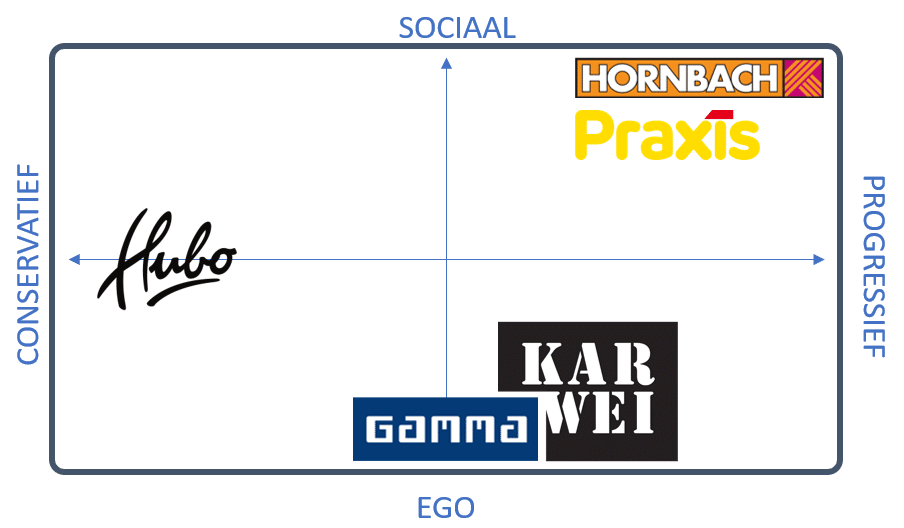
We compare Gamma and its four competitors in the positioning matrix, allowing us to interpret the market at a glance.
Gamma Brand Archetype
Gamma’s positioning has revolved around Gamma itself for years, which is why the brand is positioned completely at the bottom in the positioning matrix. At first glance, Gamma seems like an Ally brand archetype, with terms like “I can do it” and the DIY tips. But if you look further, it’s really about the Gamma brand; it enables you to do it. Therefore, we see Gamma primarily as the Hero brand archetype, where Gamma is the hero.
Gamma Positioning: Our Final Verdict
Although Gamma certainly makes efforts to keep renewing the brand, we find it mostly very conservative. Gamma is a brand we all have known for years and, thanks to memorable advertising campaigns, is top of mind for many Dutch people. The current marketing efforts seem aimed at maintaining that.
Notably, sister company Karwei actually projects exactly the same image but focuses more on styling your home than on drills, screws, and wood. Yet, if you walk past the first three aisles at Karwei, you also find bolts, doors, and hardware. So what really is the difference between Gamma and Karwei, besides a different look? We certainly don’t see the 100 million euros spent in recent years on differentiating the two positionings reflected.
Biggest competitor Praxis seems very similar to Gamma in many respects, and both organizations have managed to launch funny but rather meaningless campaigns. So what is the difference between the two hardware stores, and who will win the long-term battle? Praxis truly manages to be the Ally that puts its customer first. The brand is more to-the-point when it comes to DIY advice and tries to help its customers so well that they visit the store less often. In recent years, it succeeded in opening ten successful Praxis City branches, while Gamma Compact remains stuck at two branches. Based on everything we now know about the different brands, we wonder: why wouldn’t you choose Praxis? Based on brand and marketing, we bet on Praxis and Hornbach for the long term, as both have a much clearer proposition and deliver on it.
Unfortunately, Gamma’s biggest asset has nothing to do with marketing but with store density, and as long as it legally fights new Praxis and other competitor branches, its stores will not disappear from the streets anytime soon.
Want to learn more about positioning and how to get started yourself? Read our page Positioning and find, besides in-depth articles, dozens of examples and models for every possible positioning challenge.