Customer journey as the basis for communication and sales process
How many contact moments do you have with customers before they make a purchase? According to Dr. Jeffrey Lant, the ‘Rule of 7’ states that you need to have contact at least seven times within 18 months before a purchase follows. This claim seems completely unfounded and far-fetched but of course contains a kernel of truth. Especially in B2B, many contact moments are more the rule than the exception. The customer journey naturally differs per product, company, customer group, and industry.
Therefore, we prefer to think in terms of customer journeys rather than contact moments. It is about the circular path the customer takes from introduction to purchase and not to forget aftercare and evaluation. In this article, we delve deeper into that customer journey. We discuss the definition and meaning, give examples, explain models, and gladly tell you how to actually implement the customer journey in your organization.
Customer Journey Example from Hell
Imagine you are standing in Albert Heijn in front of the dairy fridge choosing a pack of yogurt. After a minute and a half, you decide: full-fat yogurt from the house brand. You walk to the checkout and pay.
The next morning you walk into a Starbucks for a coffee and who comes out from behind the counter? A salesperson from Albert Heijn: “Would you like to buy this pack of full-fat yogurt?” Surprised, you indicate that you already have a pack of full-fat yogurt. The salesperson says: “Okay” and walks away. Half an hour later you are in Hema for some household items, and the same Albert Heijn salesperson suddenly approaches you again pushily: “Would you like to buy this pack of yogurt!?”.
In such a situation, you really start to wonder if they all have their act together, don’t you?
Sounds pretty bizarre, right? Yet this is exactly the customer journey as we often experience it online.
If your vacuum cleaner breaks, you read some reviews online and check various suppliers until after an hour of research you make up your mind and order a vacuum cleaner. The next day it is delivered, exactly what you wanted. But the days and weeks after, you are chased by all three suppliers, including the one where you actually bought the vacuum cleaner! You can’t read an article on nu.nl without getting bombarded with 5 vacuum cleaners, it’s maddening!
How does this affect your buying experience and perception of these brands?
Customer Journey as the Intersection of Marketing and Sales
Even in a B2B environment, this phenomenon is commonplace. All contacts are lumped together in one file and receive the same mailings and invitations. Even the long-standing customers! The prospect you met for the first time two months ago at a trade fair receives the same message as the customer who has been buying your product for 10 years. What goes wrong here?
- The prospect is at a very different stage in their customer journey than the existing customer. They are still exploring and don’t really know how they will make their choice. They would appreciate a demonstration, whitepaper, or presentation.
- The long-standing customer already knows all the ins and outs of your product, they could even teach your engineers something! They benefit more from new tips and tricks from other customers or an invitation to a relationship day.
Your communication does not sufficiently align with the stage of the customer journey each customer is in. The big danger is that this causes them to drop out or look for another supplier who does have this in order. You prevent this by mapping the customer journey of your company and aligning all communication accordingly. For that, we start at the beginning.
Customer Journey Definition and Meaning
The definition of customer journey to start with:
The customer journey is the collection of phases a customer goes through in their interaction with a company.
A customer journey thus represents all contact a customer has with your company. This quickly becomes a complex model that touches all departments of the organization. In the past, and this still applies to many companies, the customer journey was a reflection of the structure of the selling company:
- Marketing
The first contact with a company at, for example, an event or webinar and the subsequent mailings and possible contact - Sales
The relationship becomes more serious, the potential customer considers a purchase - Production
Delivery, installation, or realization of the purchase - Customer Service
Aftercare and help with using the product - Relationship Management
Keeping the built customer relationship ‘warm’, possibly leading to a new Marketing & Sales cycle
But is this also how the customer thinks about their contact with your company?
Probably not, and that is the challenge. It often goes wrong, as in our earlier example, at the transition between different phases. Sales can do their job very well, but if this does not align with marketing efforts, you are 1-0 behind. The customer journey therefore works from the customer’s perspective: how do they make their choices? By responding to this, you increase the return on the efforts of the various departments. Roughly speaking: you sell more.
But what does your customer journey look like? There are various models you can use as a basis.
Customer Journey Model: Make Your Choice
In fact, every customer journey is unique. One person looks online for weeks before making contact, another calls immediately. Your customer journey must precisely cover both. You map the different phases your target group goes through and then determine what is needed during that phase. You probably already have a pretty good idea of this.
But to arrive at a complete customer journey, it is probably useful to work based on an existing model. This way you are sure not to skip phases and every department always knows what is expected of them. There are many models; we mention four here. Take a moment to consider each model and think about whether it fits your company well.
KOPAN
Stands for Kennismaken (Getting to know), Opsporen behoefte (Identifying needs), Presenteren (Presenting), Afsluiten (Closing), Nazorg (Aftercare). This is a traditionally less well-known sales model but can be applied to the contemporary process without much imagination. For example, if you fail to get to know well, it becomes very difficult to identify the need.
AIDA Customer Journey Model (wikipedia)
Stands for Attention, Interest, Desire, Action. The traditional sales and marketing model that states the potential customer must first have attention before interest can be aroused and so on. Why is this model somewhat outdated? Because it does not consider everything after the Action, while nowadays aftercare and reputation are essential.
McKinsey Customer Journey Model
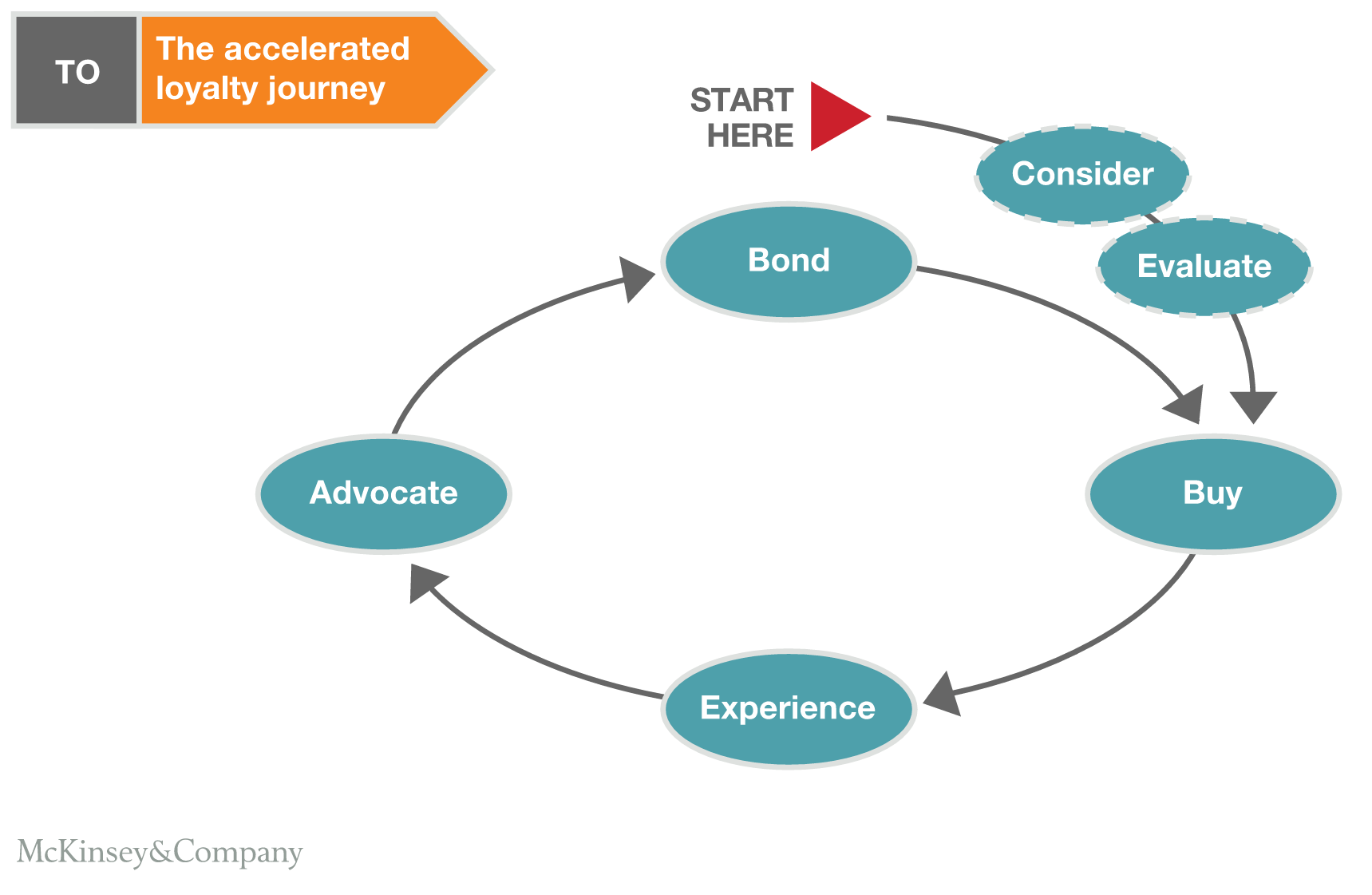 McKinsey states that companies can no longer simply react to the (changing) customer but must play an active role in shaping and steering it. McKinsey clearly states the circular nature of a customer journey and the different phases within it. Consider and Evaluate are the lead-up processes; within the circular customer journey, they limit themselves to Purchase, Experience, Advocate, and Bonding.
Babcock Jenkins Customer Journey Model
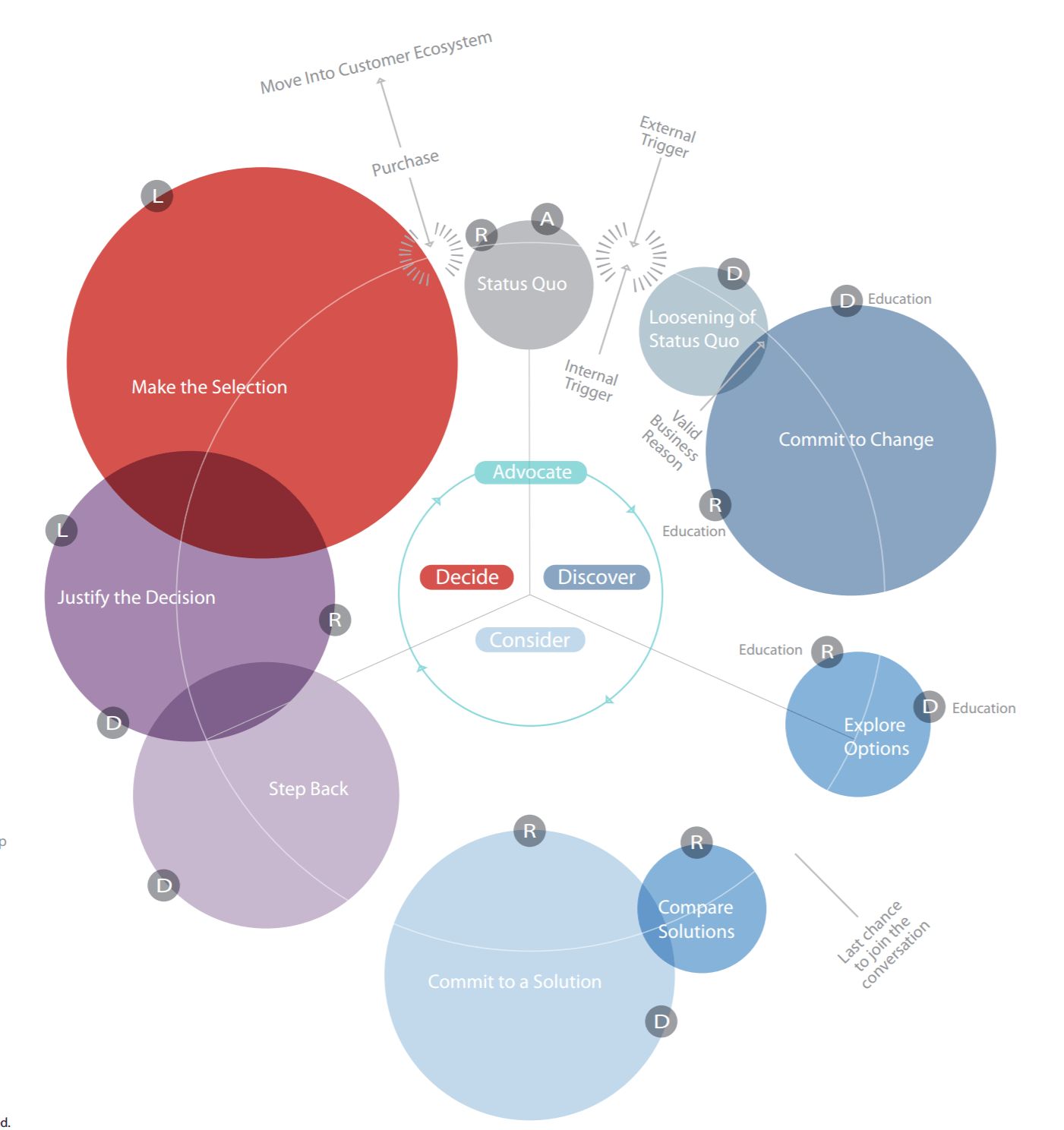 Babcock Jenkins presents a very complete customer journey model in (download in pdf) and distinguishes 3 core phases; Discover, Consider, Decide around which Advocate revolves as a continuous process. The three core phases are further divided into 11 decision moments that determine whether the next phase in the customer journey is reached.
This model is our preference, mainly because it is very customer question-oriented and easy to apply to different companies. First step in using this model? Answer the questions on the right side of the pdf for your company.
Customer Journey: Role of Website and Content
The further you develop the customer journey model for your organization, the more you discover the answers your customers seek in each phase. You use your website to answer as many questions as possible with the goal of moving the customer to the next phase. Ideally, of course, a sale.
Website as a Source for Leads
But the opposite also applies. By analyzing the use of your website, you determine in which phase of the customer journey a particular customer is. For example:
Jan de Vries visits your website on Monday. He requests a whitepaper about using your product in a specific market and leaves his name and email address. You now know he is mapping possible solutions but not yet what problem he has. The following week you send him (possibly automatically) a follow-up email with 3 articles about specific problems your product solves. If he reads one of these articles, that is an excellent basis for conversation. Maybe it’s time to hand this lead over to sales?
Customer Journey: Consequences for the Sales Process
Thinking from the customer journey, also called the customer-centric approach or ‘Customer Central’, naturally places very different demands on salespeople. Previously, the salesperson was a ‘spy’ or a ‘door-opener’; nowadays, the salesperson’s role is more that of an ambassador. We call this Salesperson 2.0 and wrote a whole article about it called These Salespeople Will Be Obsolete Within 5 Years!
Applying this to the customer journey places the following demands on the salesperson or sales department:
- Fully informed about the pre-sales process
A customer may have already had about 3 contacts with your organization and expects you to get straight to the point. So make sure sales is aware of where the customer is in the journey and what information or knowledge you already have. But above all; make sure you know what the next step is and what is needed to take it. - Possess in-depth and relevant knowledge
If Jan de Vries from the earlier example is called, make sure he speaks with a specialist who has experience with his specific problem. - Authority
The potential customer has probably already done their homework and is now an expert. How does he know you are too? Does the person he speaks with have authority, has the customer come across their name during research? - Being reachable
And that goes beyond answering the phone. Being reachable means answering a question within a timeframe that benefits the customer. Being reachable also means the customer can reach you via channels they prefer. Why shouldn’t you be able to ask a question on Twitter?
We elaborate on this in our article about Salesperson 2.0.
Customer Journey Example from Practice
The customer journey example below from Rail Europe clearly shows how a customer journey can be practically applied.
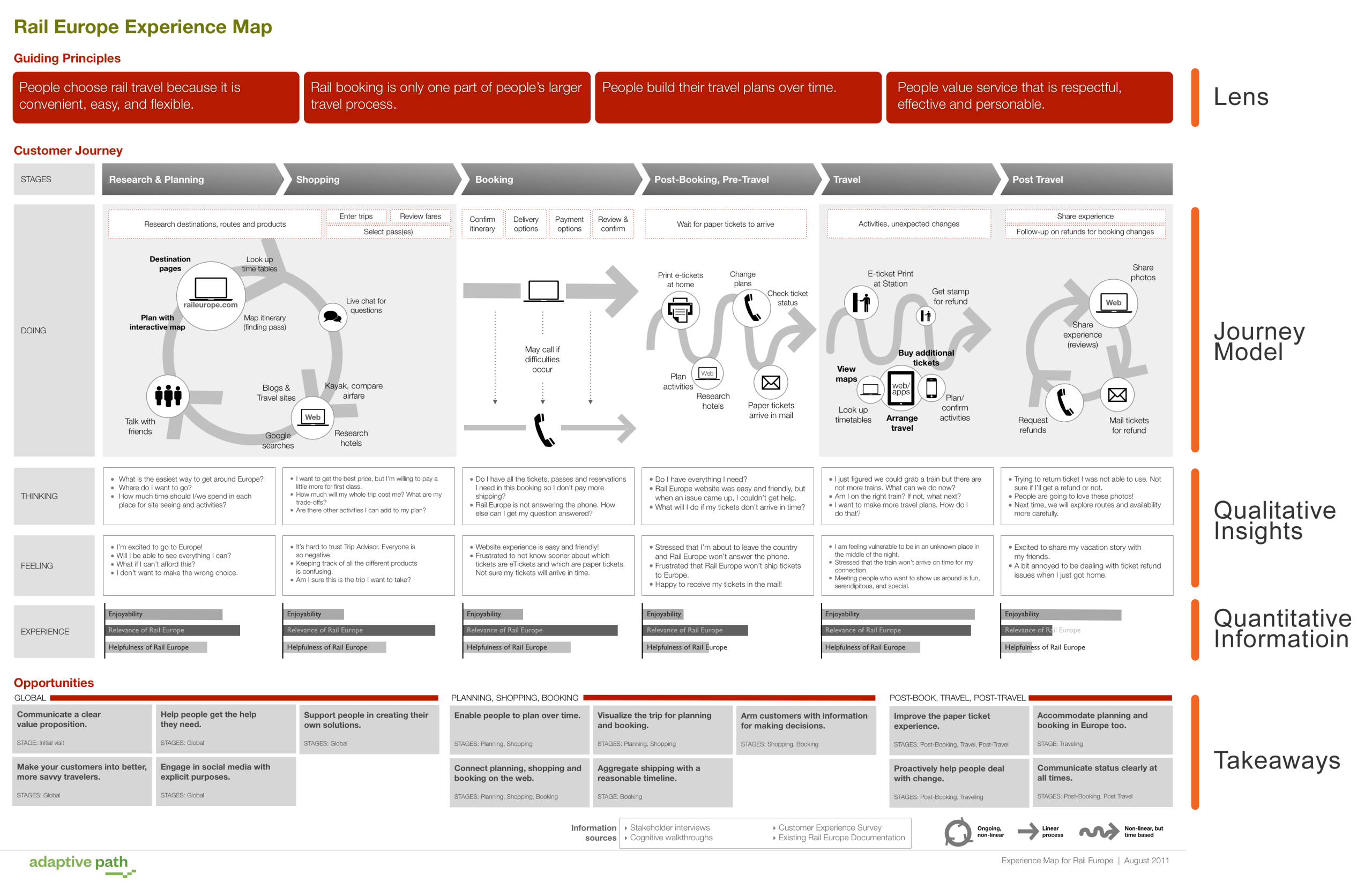
Customer journey developed by Adaptive Path
Getting Started with Your Customer Journey
What is the first step to mapping the customer journey that fits your company? Here are some you can consider:
- Talk with sales. Take the time to talk with your sales colleagues and map the phases in their sales process. What questions do their customers ask, what objections do they raise, which decision factors are decisive, etc.
- Analyze the website. What information is currently searched for and found on the website, when do visitors drop off, how do visitors find you? Essential input for the first phase of the customer journey.
- Interview customers. Because this is what it’s all about, they will surely tell you in detail how they come to a (purchase) decision. Note, there is often a difference between how we think we make a decision and how we actually come to a decision!
Other information sources are of course customer service, production, field service, etc., but we limit ourselves to the marketing/sales part of the customer journey.
So far our view on the customer journey, have we missed an aspect or do you have a specific question? Let us know.