Competition matrix; the strategic view on marketing and positioning
Our Merkelijkheid Competitive Matrix allows organizations to instantly compare their own positioning and marketing against those of their competitors. By placing relevant market players in the matrix based on both message and behavior, it becomes possible to directly and objectively assess how distinctive your positioning and communication are. Besides actual usage, we also discuss the origin of the matrix and the thinking behind the axes. After reading this piece, you will be able to use the competitive matrix to determine your own strategy.
Our positioning matrix addresses the effectiveness of marketing efforts by exploring the tension between identity and perception through the question: “Do you succeed in remarkably communicating your organization’s distinctive positioning to the market?” Read more about positioning.
In practice, few organizations can answer this satisfactorily; but what should happen next? This important question is where the competitive matrix originates; should you adjust your positioning, or should you communicate differently?
Origin of the Competitive Matrix
To make this assessment, we work within the Competitive Matrix with the terms message and behavior. The message concerns what you say, and behavior how you say it, but another way to look at both aspects is content versus form. To provide insight into this trade-off, we have linked each of these terms to its own axis. Both axes represent extreme opposites, making it possible to compare positionings without subjectively judging quality. Keep in mind that we have examples of successful organizations in every part of the matrix and that a -5 position on both axes is not a value judgment and therefore does not say anything about an organization’s success. We explain both axes individually:
Behavior: Conservative vs. Progressive | The behavior axis places brands based on their forward-thinking approach in conveying the message. Do they prefer to follow well-trodden paths, or are they open to a unique approach? How innovative or distinctive is the approach? This can also mean, for example, reviving a forgotten channel. Possible considerations:
- Are various means used? (e.g., events, video, guerrilla actions, or sponsorship) Or is it mainly advertising in traditional media?
- What about the use of new or social media?
- Conservative statement: we have been doing it this way for years and it works fine.
- Progressive statement: we are always curious how we can stay ahead of developments.
Message: Ego vs. Social | From our experience, the ego vs. social trade-off is particularly suitable for objectively comparing brand messages. A more ego-oriented brand has a take-it-or-leave-it attitude, while a more social brand primarily focuses on the needs and wishes of its customers. Possible considerations:
- Is the brand in conversation with its customers, or does it only broadcast?
- Does the brand encourage co-ownership/co-creation, or is it focused on maintaining brand control and ownership?
- Do customers have influence on product, communication, or marketing?
Using the Competitive Matrix
To determine the zero line of both axes, it is necessary to establish as objectively as possible what is common in the market. Then competing brands are placed relative to that average. The position of your competitors in the matrix is determined solely by how they are perceived by the market, as you have only (very) limited insight into your competitors’ desired positioning. Optionally, you can use a third value (e.g., market share, marketing budget, or quality) to determine the size of the different competitors. This way, your main competitors are displayed more prominently.
Next, you place your own organization twice in the matrix:
- the position that follows from your positioning
- the position that corresponds with the market’s perception of your brand
As you can see, using the Competitive Matrix results in a clear market overview that provides insight into how your behavior and/or message can best be adjusted to distinguish your brand more clearly from the competition.
We would like to illustrate this with an example:
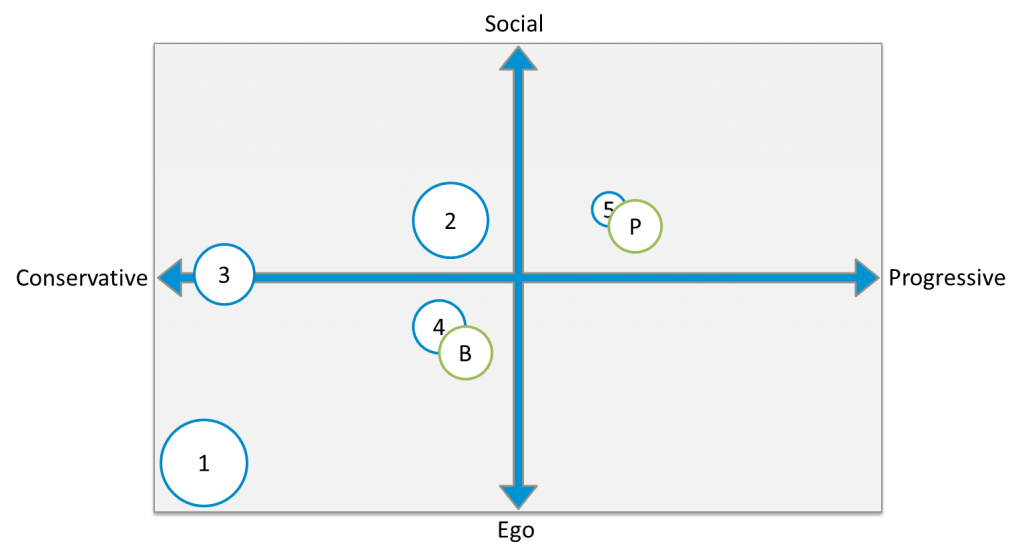
The above situation is comparable to many industrial and other established markets. Market leader no. 1 prefers to keep everything as it is and relies on its own (considerable) status and reputation to maintain its market share. No. 2 realizes that differentiation is necessary but fears alienating the traditional market too much, while no. 3 tries (in vain) to copy the behavior of no. 1. No. 4 is actually quite satisfied and simply focuses on serving existing (long-term) customers. No. 5 is a relatively new player seizing every opportunity to stand out.
The client (green) is best compared to no. 4 – and the perception (G) of the organization’s behavior reflects this – but realized they were on a dead-end path. The new positioning (P) must distinguish them more clearly from the (established) competition. Although there are multiple ways to achieve a distinctive result, you must realize that a brand’s perception by the market can only change gradually. Therefore, it is wise to use openings in the market to grow toward a new positioning.
In this case, a distinctive direction would be to adopt a more progressive attitude while the message changes only to a limited extent. Only once employees are familiar with the new expected behavior can you decide to gradually communicate a different message. This prevents two major course changes from happening at once and maintains calm within the organization.
To give you a more intuitive idea of what the Competitive Matrix entails, we have filled it with several well-known car brands:
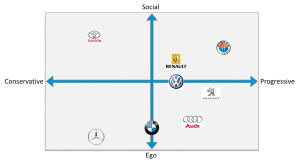
We are aware that the methodology as described above still involves a high degree of subjectivity. This can be greatly reduced by linking fixed values to certain considerations when placing brands in the matrix. For example, in the market from the earlier example, no social media is used besides LinkedIn; a +2 characteristic of progressiveness could be the use of Facebook and Twitter. Or a -2 characteristic of ego is a ‘take it or leave it’ proposition.
But for many organizations, the exercise of categorizing the market along these two axes is already more than enlightening. You and your organization are better informed about the market situation than anyone else. This matrix simply enables you to look at the market with as little judgment as possible and to view your choices in that perspective.
We are certainly very curious about your findings and would love to hear what results you have achieved with the Merkelijkheid Competitive Matrix.