Brand Archetype Innocent: the promise of simplicity and happiness
Is your brand like a true optimist searching for the perfect world? The Innocent offers customers a simple choice for a better world. It strives, just like its customers, for happiness and harmony. A motto of the Innocent could be ‘improve the world, start with yourself’. With honest, pure products that contribute to a better world, the Innocent binds customers based on shared ideals. Curious if this brand archetype fits your brand? Discover it in this article!
Brand archetype Innocent: contributing to the ideal world

Toyota is the Innocent among car brands
The Innocent, the Idealist, the Optimist. We know several names for this brand archetype, but what does it really mean? The Innocent archetype searches for an ideal world and finds it in simplicity. Innocent brands act as a guide for customers towards the ideal life: they point in the right direction and make clear that a choice contributing to the ideal world is within reach. The Innocent offers its customers simple solutions for often complex (societal) problems. However, the choice remains with the customer; an Innocent will not be intrusive or aggressive. A typical Innocent brand is pure, innocent, sincere, and honest.
For the Innocent, the glass is always half full. With a positive attitude and innocent view of the world, it assumes the best in people and society. Innocent customers seek a harmonious life and look for brands that contribute to this with relatively simple solutions. They choose products that contribute to the world they want to live in. Based on shared norms and values, they feel connected to and loyal to a brand.
Brand archetype Innocent: Dove
Think, for example, of Dove, simple products like soap, body lotion, and deodorant. But behind these products lies an idealistic message: true beauty has nothing to do with age, color, or body shape but is a source of inspiration and self-confidence. Dove expresses this in campaigns featuring real women of different sizes and backgrounds as models. With this, the brand centers real beauty and counters stereotypes. With these campaigns, Dove addresses a problem but in a positive way. Since 2005, Dove has also run the ‘Dove Self-Esteem Project’. Through this project, Dove encourages young people to build a healthy relationship with their body and self-confidence through various articles, workshops, and lesson packages.

Image from Dove Self-Esteem Project website
Another consumer brand where the ideological background is truly part of the product is Spa. A pure, naturally pure product that depends on nature and therefore has an ideological story. Spa has managed a nature reserve in the Belgian Ardennes for over 125 years, covering an area the size of 26,000 football fields, from which Spa draws its water. Management and protection of the nature reserve is an important part of the company.
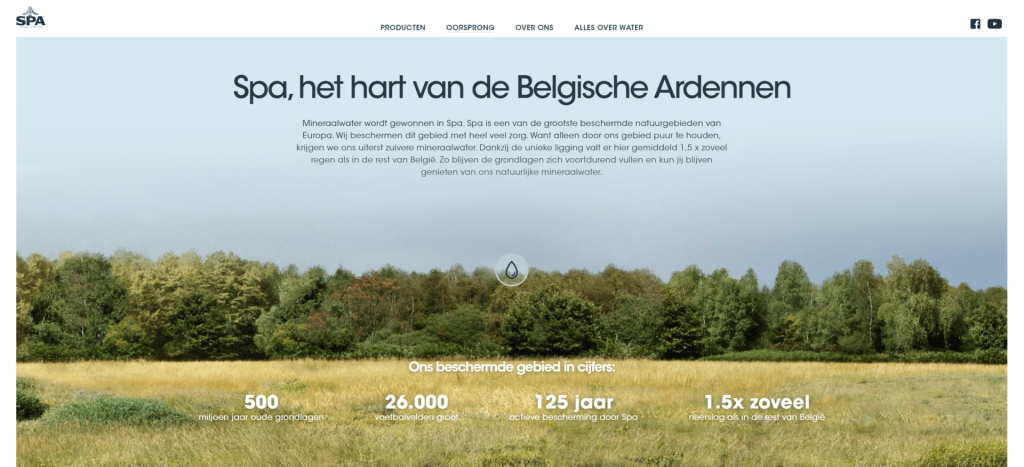
Screenshot from Spa website: source of their water
In its communication, Spa mainly focuses on nature, as pure and clean as their product. There is also, for example, an information center about the nature reserve, and at the end of 2014, Spa launched the campaign ‘pass on nature’ together with the Nature Conservation Association. The design is, like Dove’s, simple with mainly primary colors.
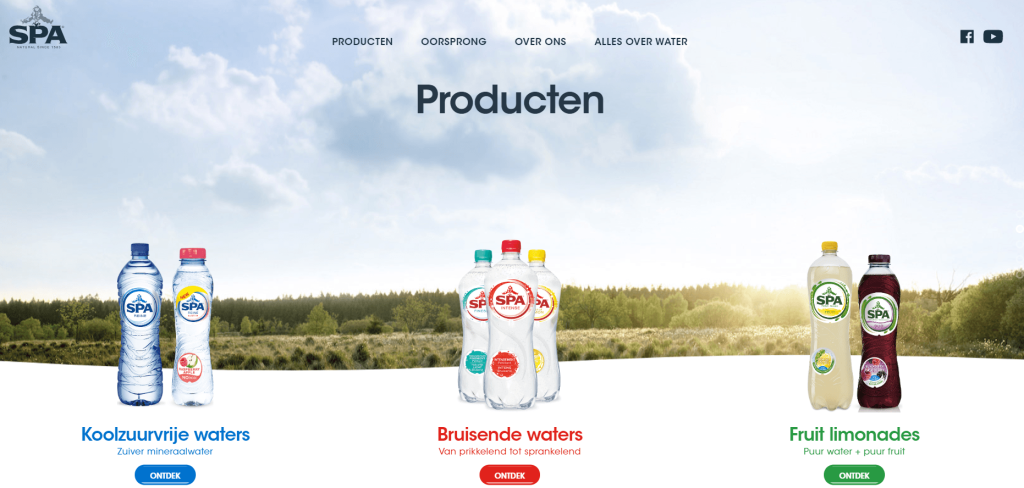
Spa: A simple product, simply presented
Dove and Spa are both consumer brands for whom the Innocent brand archetype is tailor-made. Curious how business service providers or industrial companies handle this brand archetype? We answer that question with 2 examples, ASN Bank and FrieslandCampina.
Example brand archetype Innocent business services: ASN Bank
What is more Innocent brand archetype than a squirrel?
ASN Bank is the prime example of an Innocent brand archetype in business services. Since its founding in 1960, the bank has strived for a sustainable, just society. ASN promises its customers returns from sustainable and transparent investments, contributing to a sustainable world. Investments are therefore assessed on ASN’s 3 pillars: Climate, biodiversity, and human rights. ASN offers its customers transparency in the form of explanations about investments on its website and in the annual report.
ASN Bank’s strategy fits perfectly with the Innocent brand archetype: working on the ideal world through ‘good behavior’. But how do we see this reflected in communication? The shared norms and values of an Innocent brand and its customers must ultimately lead to happiness and simplicity. In imagery, Innocent brands often choose simple images that radiate calm and well-being, such as a smile, a child, or an image or shape from nature. At ASN Bank, this is reflected in the logo, a squirrel, and the website where elements from nature frequently appear in the simple lines of the design. In wording, ASN Bank also refers to happiness and the future, with slogans like ‘this is how money makes you happy’ and ‘hope for the future’.
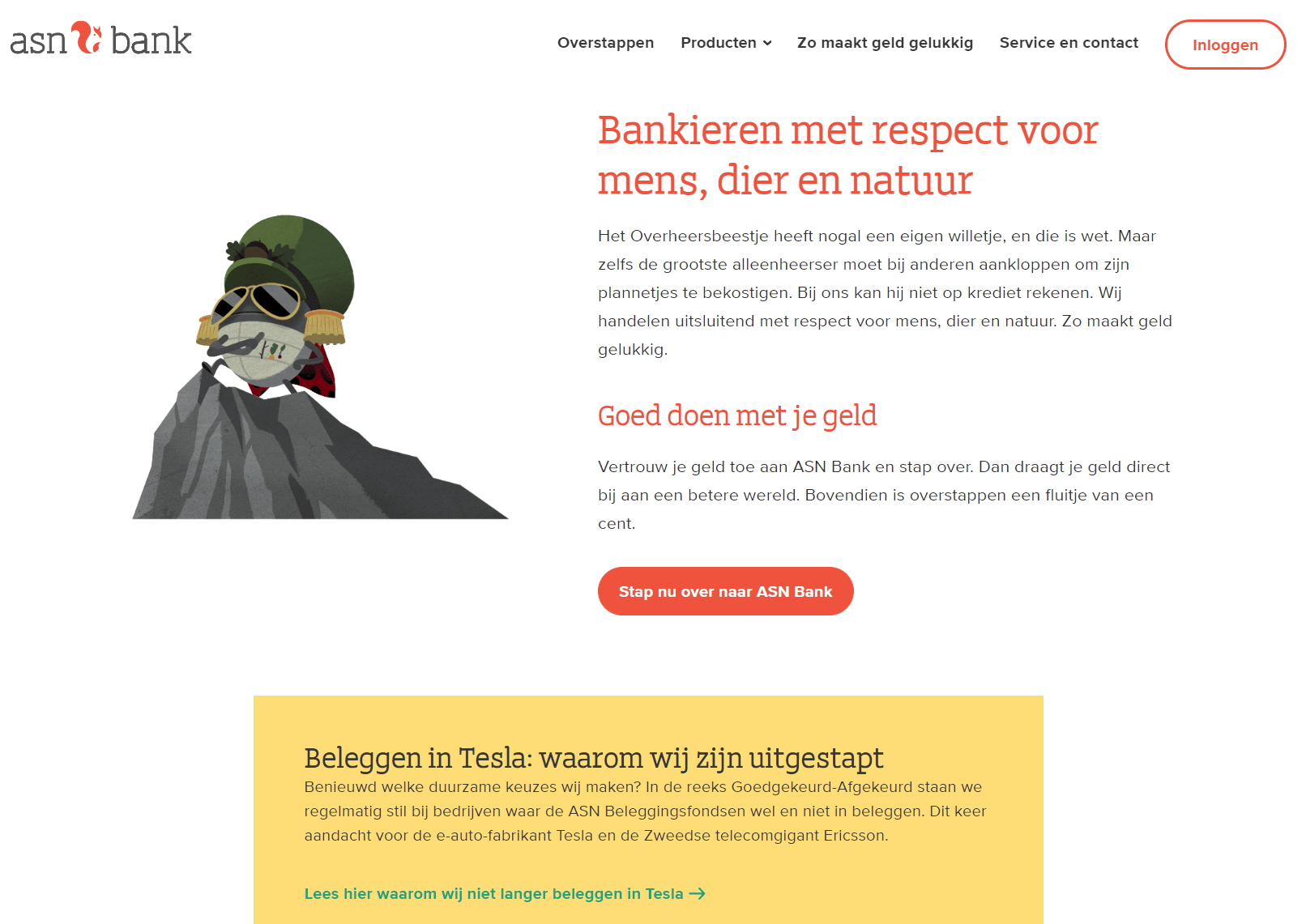
ASN Bank, the typical Innocent in business services
Additionally, ASN Bank makes it easy to contribute to a better world now with concrete tips on its website. ASN Bank combines simple imagery and positive texts in the perfect illustration of a marketing campaign for Innocent brands, the fable campaign.
Fable campaign: marketing campaign of an Innocent brand archetype
In early 2017, ASN Bank launched the fable campaign, a series of fables each featuring a different animal in the lead role telling ASN’s sustainable story. The campaign kicked off with the Habit Animal. With this, ASN illustrated how most people do business with the same bank for years, while that bank’s investments are bad for the climate. The message? Switching to ASN is very simple and thereby contributes to a better world.
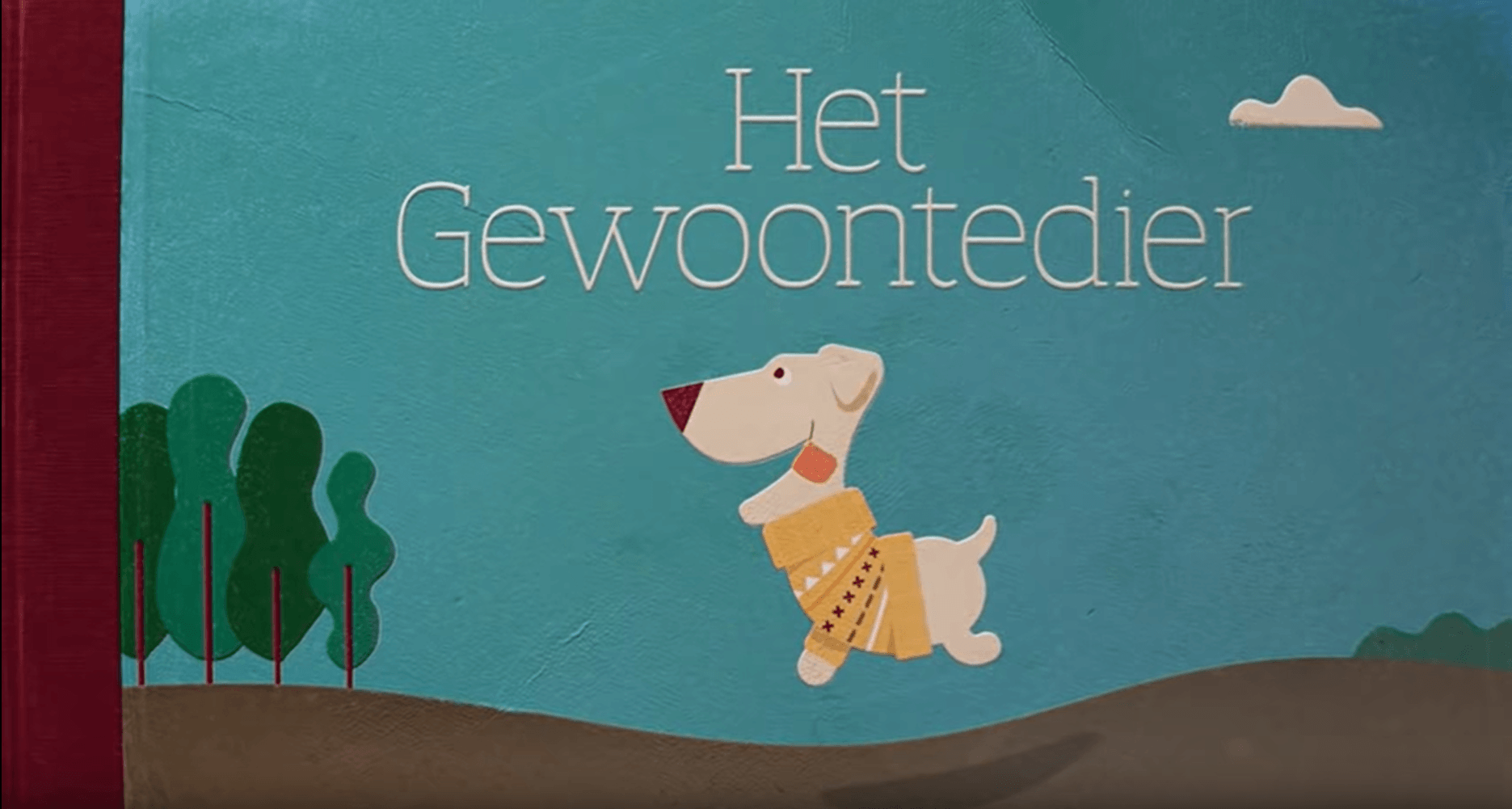
The Fable campaign perfectly illustrates the simplicity and ideology of ASN Bank
With the fable campaign, ASN Bank illustrates more of these typical behavior patterns regarding banking and the sustainable alternative the bank offers. For example, the ‘Data Beast’ calculates how much CO2 emissions customers reduce with an ASN Bank account, and the PVC Horse and the Not-So-Picky show how ASN Bank contributes to a cleaner world. With the Mayfly, the bank focuses on ideology; banking with ASN makes a difference for tomorrow. And does ASN play with the Youngster on the climate awareness of younger generations? The campaign fits seamlessly with an Innocent brand archetype because it expresses ASN’s norms and values without being confrontational. ASN paints a picture and offers its customers the opportunity to live in a better world right now, without preaching or pointing fingers. This attracts like-minded people who, as ASN customers, work together to realize the perfect world.
Example brand archetype Innocent industry: FrieslandCampina
Friendly, colorful style fits an Innocent brand
Who hasn’t grown up with milk? A quintessentially Dutch product that FrieslandCampina’s farmers have been working on since 1871. FrieslandCampina is now one of the six largest dairy companies in the world. The mission of this cooperative is: better nutrition for the world, good income for our farmers, now and in the future. This still closely aligns with the story of the first farmers who joined forces in 1871 to strengthen their market position. Many years later, this led to the merger of Friesland Foods and Campina at the end of 2008. But what exactly makes the brand, besides their mission, an Innocent brand?
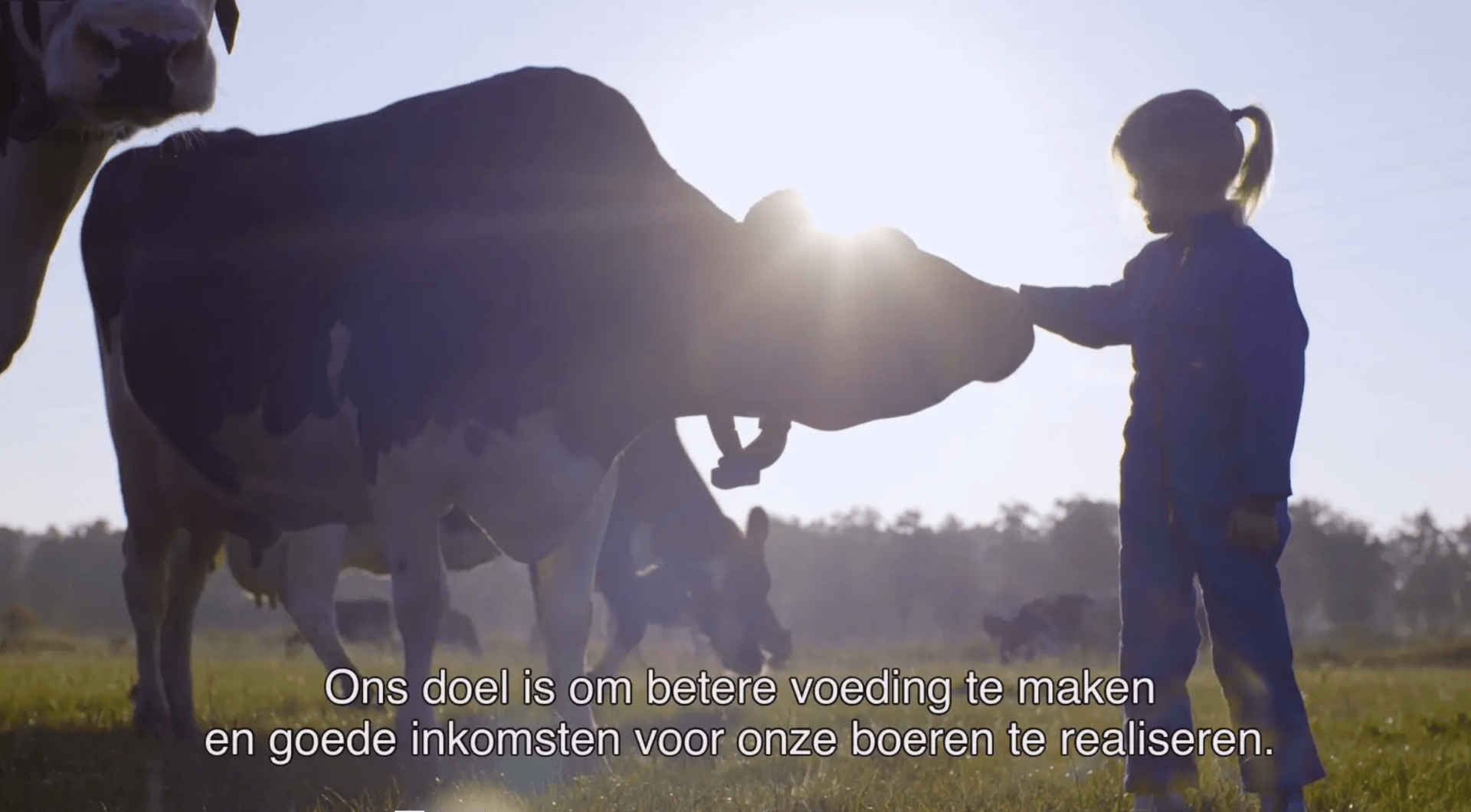
FrieslandCampina’s goal is typical for an Innocent brand archetype
FrieslandCampina offers a pure, natural, and simple product with an ideological story around it. Not the customer’s story, but the producer’s, with better nutrition for the customer as the result. How? The 12,104 member dairy farms and 18,261 member dairy farmers in the Netherlands, Germany, and Belgium are united in the FrieslandCampina Dairy Cooperative and thus 100% owners of the company. This way, the farmers work together on milk quality, continuity for multiple generations of dairy farmers, and the highest possible milk price for farmers.
With the first part of the mission, better nutrition, FrieslandCampina addresses the global food problem. FrieslandCampina aims to contribute to the growing food demand with its dairy products. The focus is on improving recipes and keeping dairy products affordable for all income groups. FrieslandCampina’s nutrition policy is based on the United Nations’ ‘WHO Global Action Plan’. This also links to the last part of the mission, now and in the future. ‘Doing good’ applies not only to the farmer and the consumer but also to animals and the climate. FrieslandCampina works on climate-neutral growth of dairy farming, preservation of grazing, continuous improvement of animal health and welfare, and preservation of biodiversity.
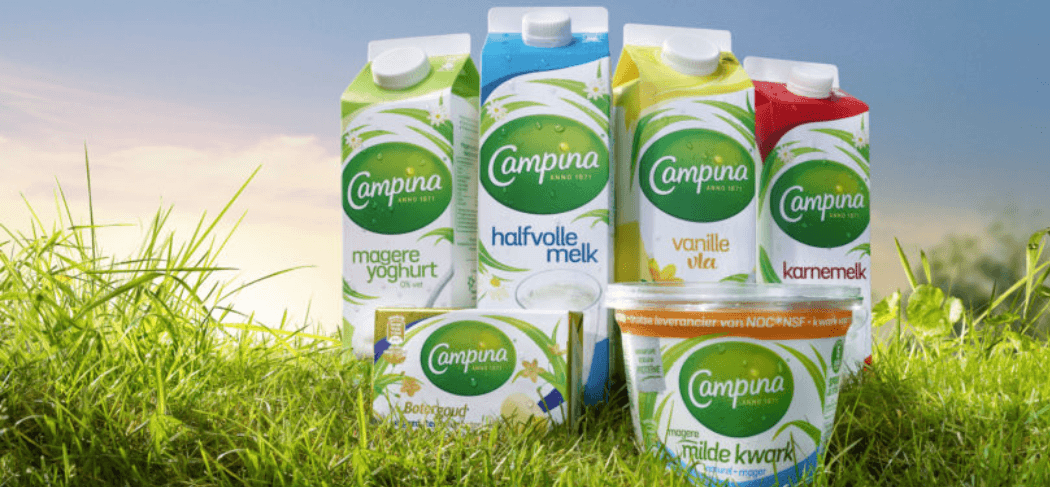
FrieslandCampina emphasizes in imagery the relationship between its products and nature
In communication, we see the Innocent brand archetype reflected in terms like ‘from grass to glass’ and campaigns emphasizing the healthiness of dairy products. This is combined with lots of green images of grass, nature, and farms. The company offers insight into farm life by working with its farmers on Open Farm Days and a series of vlogs featuring sustainable farms in the Netherlands. In its communication, FrieslandCampina illustrates what customers choose: healthy food, but also where this food comes from: the farm and nature. This binds customers who are consciously engaged with nutrition and its impact on the world, typical for an Innocent brand customer.
Advantages of the Innocent brand archetype
The Innocent brand archetype connects customers with your brand based on the same norms and values, creating a loyal customer base. This target group seeks a reliable brand and is very willing to deviate from the dominant brand for that. The Innocent brand archetype thus offers an opportunity to compete in the long term with a strong brand, such as a Ruler or a Hero. ASN is a good example of a bank that, with a well-articulated story and ideals, has secured a strong position in a world dominated by large banks like ABN Amro and ING. Customers of the Innocent are generally very loyal; with the right strategy, you can bind a fixed group of customers as an Innocent brand.
More broadly, the Innocent brand archetype is very suitable for reaching Generation Z, also known as the ‘purpose-driven generation’. This generation will participate in the economy in the coming years and feels strongly connected to various societal issues. They will look for brands that fit their values and worldview. As a result, brands with certain brand archetypes, such as the Outlaw, the Explorer, and the Innocent, will be very attractive to this target group.
Pitfalls of the Innocent brand archetype
Besides advantages, every brand archetype also has downsides. The Innocent may not want to hear this in all its optimism. And that is precisely where the pitfall for the Innocent brand archetype lies. As an optimist at heart, it can fall into denial or be naive. Does the Innocent brand archetype fit your brand well? Then be aware that a reality check is sometimes necessary to be successful. If you don’t do this, you risk underestimating threats or developments and missing opportunities.

Does the Innocent brand archetype fit your Brand?
Do you recognize your brand in one or more of the descriptions below? Then the Innocent brand archetype could be a good fit for your brand.
- Customers associate your brand with integrity, simplicity, nostalgia, childlike innocence, or good morals.
- Your product or service offers customers a simple solution to a recognizable problem.
- Your brand provides customers with clean, healthy, and honest products or services, which are very suitable for repeat purchases.
- The price of your products or services is low to moderate.
- You want to distinguish your brand from a brand with a tarnished image.
- Your brand has strong core values; it is honest, reliable, and straightforward.
Not so innocent after all?
Are you unsure whether the Innocent brand archetype fits your brand? The Caregiver, Explorer, or Ruler might be closer to your brand.
Like the Innocent, the Explorer seeks the ideal life. However, both brand archetypes think they can achieve this paradisiacal life in very different ways. The Innocent guides customers with simplicity to happiness in the here and now. The Explorer does exactly the opposite and goes off the beaten path in search of paradise. Always looking for new paths to happiness, it offers its customers self-development, adventure, and self-expression.
The Caregiver shares the same associations as an Innocent, but the underlying motivation is very different. While the Innocent seeks a harmonious life, the Caregiver is driven by helping others. The motivation and thus the actions of a Caregiver brand archetype are much more influenced by social factors.
The Ruler may seem far from the Innocent, but in fact, both seek a form of order. For the Innocent, norms and values lead this order; the Ruler simply wants to be the ruler. While an Innocent acts as a guide showing customers another way, in the eyes of a Ruler, there is only one way: their way. The Ruler will therefore be more forceful and strict compared to the Innocent.
So if you are still unsure about the best brand archetype for your brand, read our articles about the Explorer, Caregiver, or Ruler. Or take a look at our page about brand archetypes.