Positioning in your market: how does it work?
Positioning. In practice, we repeatedly find that everyone has a different idea of the word. This is especially challenging when you try to persuade the organization to overhaul your brand’s positioning but ‘they’ don’t see the need for it. Therefore, in this article, we will explore the general picture around the question: Positioning in the market, how does it actually work? Additionally, we will focus on how to get your colleagues’s or management moving.
The Origin of Positioning
 The verb positioning actually only came into use since the 1970s. Jack Trout wrote an article for the trade magazine ‘Industrial Marketing’ titled “Positioning” is a game people play in today’s me-too market place”. In it, he writes that consumers are overwhelmed with advertising messages and simply ignore them unless they immediately find an easy (and free) spot in their mind. He developed this thinking about finding an easy and free spot together with Al Ries into the book “Positioning: The Battle for Your Mind” in 1981.
The concept of positioning continued to evolve and today we define it as follows:
“Connecting a product [or service] with such a collection of features and attributes that it acquires its own place relative to competing products [or services] in the mind of the customer.”
A positioning consists of three factors; the perception of the brand by the target audience or customer, the identity of the brand, and the desired positioning. What makes positioning so interesting is the influence these three elements exert on each other and on the positioning itself. This is easiest to explain with an example.
Practical Example: Positioning in the Industrial Market
We start from a completely fictional market and players but in a situation we often encounter in practice:
Alpha Industrial has existed for 40 years and supplies heating elements to installers/contractors. The company supplies exclusively through wholesalers and has been market leader for years with a 40% market share. Its slogan is: “Certainty and top quality” and it exhibits at two trade fairs and occasionally places an advertisement in a trade magazine. Competitors Beta Heating and Gamma Warmth have 25% and 15% market share respectively. The remaining 20% is divided among several smaller players. Both Beta and Gamma use a me-too marketing strategy and essentially imitate Alpha’s marketing.
Two years ago, a new player entered the market: Omega Production. In a short time, market challenger Omega managed to gain 20% market share partly due to the slogan: “Good and cheaper”. Omega produces in China much cheaper, which is reflected in the selling price. It also invests heavily in marketing; the target audience cannot ignore them. Alpha is now at a loss; in 2 years, it saw 10% market share evaporate and margins have dropped significantly due to increased price pressure. While the decline in the first year could be blamed on ‘the market,’ in the second year everything was done to turn the tide. In vain.
The Positioning Problem
The above situation may have many similarities with your market. It is a situation we encounter all too often. Based on the factors perception, identity, and desired positioning, we clarify where things went wrong.
Perception – The target audience had already made its choice years ago and because the three brands remained the same, they never really had to choose. Most chose Alpha and were happy to pay a little more for a safe feeling, while others chose the slightly more likeable number two or three. Now Omega appears with a product that is 40% cheaper and of a quality that is perfectly adequate; finally, the target audience has something to choose from and they do.
Identity – Alpha’s identity hinges on only one thing, market leadership. Beta and Gamma follow Alpha’s themes and talk about quality and reliability. If you asked them, none of the three could tell you what exactly distinguishes them from the rest. The problem is that they also do not make the right decisions because of this. Omega? They want to be ‘Cheaper and practically just as good’ and therefore invest in efficiency assuming that being cheaper leads to more market share.
Desired Positioning – I think this is clear by now. Alpha wants to keep things as they are, maybe gain a bit more prestige and market share but otherwise is fine. Beta and Gamma simply want to snatch market share from each other and Alpha and possibly take over the lead. None of the three is thinking about taking a different approach because: “That’s just how the market works.” Omega conquers 20% and panic sets in while none of the three has a positioning to hold on to.
The Positioning Matrix
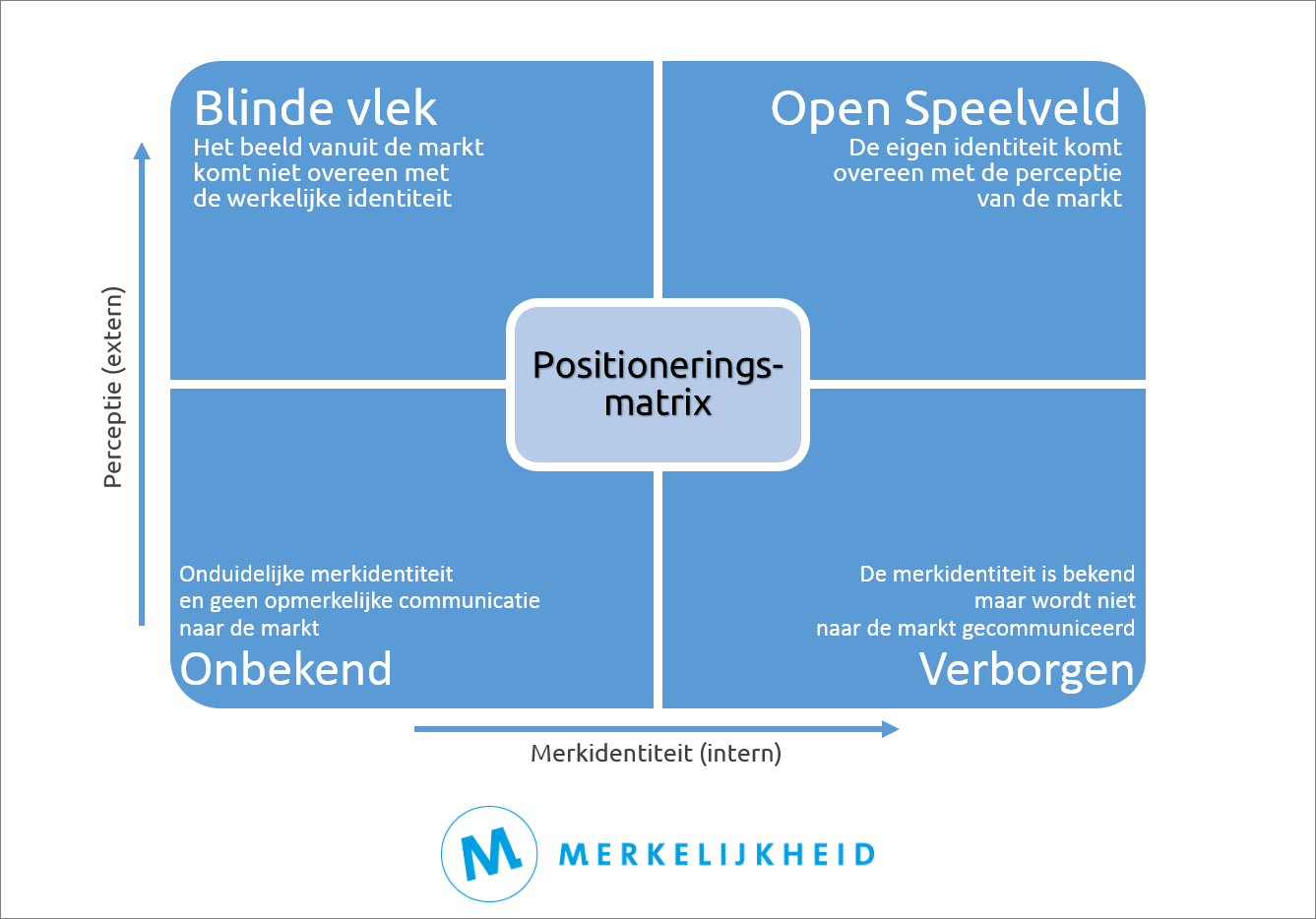 Such issues occurred so often that we developed a model for it: the positioning matrix. In the positioning matrix, you compare perception and identity to determine what the challenge is or if you fall into the ‘open playing field.’ The open playing field is a situation in which you know exactly what your identity is while the market (re)cognizes it and values it, in other words, you are distinguishable from the competition. In the other three quadrants, you face a challenge:
- Blind spot: The brand has ‘its eyes closed’ and lacks any feeling with the market while the market can distinguish the brand from the rest.
- Hidden: The brand knows exactly what distinguishes it but is unable to communicate this to the market.
- Unknown: Both market and brand actually have no idea and the brand is literally a ‘gray mouse’.
By using this model to clarify the challenge a brand faces, we get to the heart of the matter in practice: positioning.
Positioning in the Market: How Does It Work?
For a brand that wants to position itself more distinctively in the market, this is usually not an end in itself. It is often a building block for achieving a business objective such as gaining a larger market share, higher profitability, or increasing competitive strength. Why is this relevant? Because this business objective strongly determines which positioning you ultimately choose.
By mapping both brand and market and keeping the objectives in mind, you can use the positioning matrix to ensure your team knows exactly where your challenge lies. This gives you the perspective to optimally position the brand in the market and make the right choices. There are various models you can use for the next steps; we cover quite a few in Positioning Models: Which Model to Use.
If you take one thing away from this article, let it be that positioning does not happen in a vacuum. Your positioning is partly determined and influenced by, for example, market conditions, target audience, and competition. Instead of resisting this, it’s time to embrace this fact and use it to your advantage. Develop a positioning framework in which you map all factors and influences important to your market and use this to develop the optimal positioning for your brand. Then use this same framework in your evaluation of all efforts and you will see that you can respond much faster and more adequately to circumstances.
Make sure that when your ‘Omega’ appears, you don’t have to spend 2 years consulting before you can take action. Want to know more about positioning and how you can get started yourself? Read our page positioning and find there, besides in-depth articles, dozens of examples and models for every possible positioning challenge.