Online marketing starts with Google keyword research and analysis
Which keywords does your customer use? Knowing what your customer is searching for is essential when setting up a targeted and effective Online Marketing campaign. We explain how a Google keyword research process works and how it helps build your online marketing campaigns. We focus on Search Engine Advertising (SEA) and Search Engine Optimization (SEO) and how these two disciplines come together.
Keyword Research and Online Marketing
Online Marketing touches almost the entire customer journey or sales funnel. Regardless of the model you use – such as the well-known AIDA model –, Online Marketing impacts every phase. How you deploy Online Marketing is therefore determined by the phase you focus on. Do you mainly want to generate brand awareness or ensure you get to submit a quote? This choice determines which tools and channels are most suitable to achieve your goals.

At least 80% of all buyers start with an online search (source)
The basis of Online Marketing is search engine marketing. This works both paid, Search Engine Advertising (SEA), and unpaid, Search Engine Optimization (SEO). In both cases, the so-called keywords, the words people use in their search query, are essential. With a clear picture of the keywords around your topic, you know:
- Which keywords your target audience uses
- What the search intent is (what the searcher wants to find)
- Which phase of the buying process a keyword belongs to
- What a keyword is worth (for you)
This allows an SEO or SEA campaign to be deployed effectively right away to achieve your goals.
Merkelijkheid works closely with its clients in the field of Online Marketing. Together we set goals and KPIs and then deploy the right tools and channels. In practice, this ranges from increasing brand awareness or positioning relative to competitors to generating conversions. By that, we mean that you create leads, sales, or contact moments. SEO or SEA are often an important component in this, but to deploy this effectively, good keyword research is crucial.
Online Marketer Emma Stroosma on Google Keyword Research
Within Merkelijkheid, online marketer Emma Stroosma is the expert in keyword research. She has conducted keyword research for numerous clients. We ask her about the importance of thorough keyword research and how to conduct keyword research. She explains our approach in 6 steps:
1. Competition is the Basis of Keyword Research
Thorough keyword research always starts with an analysis of the online playing field in which the client operates. Together with the client, we determine who the main competitors are. This competition can be a direct, local competitor for one client and a large international one for another. Of course, this competition determines the region, language, and scope of the keyword research. We analyze the websites of the competitors and the client. Based on this, we formulate a list of sometimes hundreds of keywords to focus on.
“I have conducted keyword research for both small, more local clients and large international parties. Think, for example, of a local agency active in debt counseling or a large international machine builder. Parties with enormous competition to a market with only a few providers worldwide.”
2. Determining Keyword Volume
We now have often hundreds of keywords. We categorize these by volume (number of searches per month), a step that already gives the client a lot of insight. Often a client thinks that ‘the market’ uses certain keywords but there is hardly any search traffic on them. By ranking the keywords based on volume, we get a good insight into the total search traffic and a first impression of possible long-tail keywords.
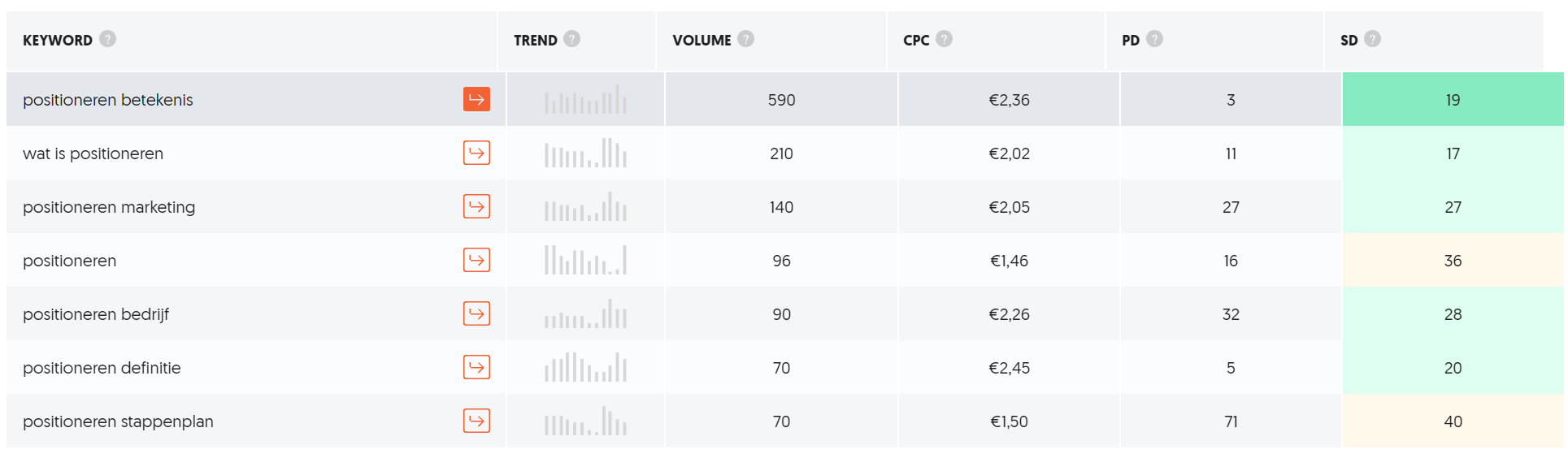
Search traffic around the word ‘positioning’
Words with the most search traffic are often the most logical or direct. For example, when searching for an ‘online marketing agency’. This keyword is then relatively expensive (SEA) or harder to be found organically (SEO) due to high competition. But there are also many, more specific, keywords with significantly lower search volume, can we do nothing with those?
3. Finding Longtail Keywords
The ‘sweet spot’ is often found with so-called longtail keywords with just a bit less traffic than the large general terms. Longtail is a term derived from the characteristic hockey stick curve showing there is a huge ‘tail’ in demand for almost every topic. For every 20 searches on common terms like online marketing, there are 80 searches for more specific, in-depth search terms. But those could be 40 different terms.
Often this involves a combination of keywords. For online marketing services, this could be “online marketing support Amstelveen” where the focus is on geographic aspects or “online marketing for wedding photographers” where a selection is made based on a target group. The better you arrange this, taking into account that there must be some search traffic, the better the alignment with your website visitor.
4. Keyword Research: Search Intent

Search intent is becoming increasingly important as more people search by voice via Smart Speakers. Google provides one result based on the expected search intent
Finding and selecting the right keywords is closely linked to search intent. What is the visitor’s goal when entering this term in Google? If they enter ‘online marketing agency’, do they want to become a client or apply for a job? Or if someone searches for ‘keyword research google’, does this person need information or services? By categorizing keywords based on search intent, it is possible to tailor the campaign even more to the client’s goals.
For example, we can focus on a longtail keyword like ‘online marketing support Amstelveen’ while ignoring the more general ‘online marketing’. Your competition then pays the maximum for the generic visitor while we purposefully attract the relevant visitor to our landing page.
From the keyword research for a client, it appeared that the search intent around their main keyword had nothing to do with their product. The company is active in machine building but the search intent revolved around a medical procedure. Expensive keywords that will yield nothing, so we put a stop to that.
5. Costs of Search Engine Advertising (SEA)
We now have an extensive list of keywords. By simply bidding more than our competition, the traffic immediately comes our way. But that quickly becomes expensive and ultimately only benefits Google. By focusing on keywords with the desired search intent AND sufficient volume, we can deploy the budget as effectively as possible.
An additional advantage is that we clearly indicate in advance the expected costs AND results of your SEA campaign. Of course, we continuously optimize the campaign; in the weeks and months after launch, we sometimes reduce the average cost per click by up to 20%.
6. Developing SEA Ads or Writing SEO Content
We now know exactly what we want and can be found for. Based on this, we develop content. In the case of SEA, this involves ads and landing pages; in the case of SEO, these are so-called SEO articles. We write and build both around the right keywords, especially considering the user’s search intent. This ensures maximum value from every visitor.
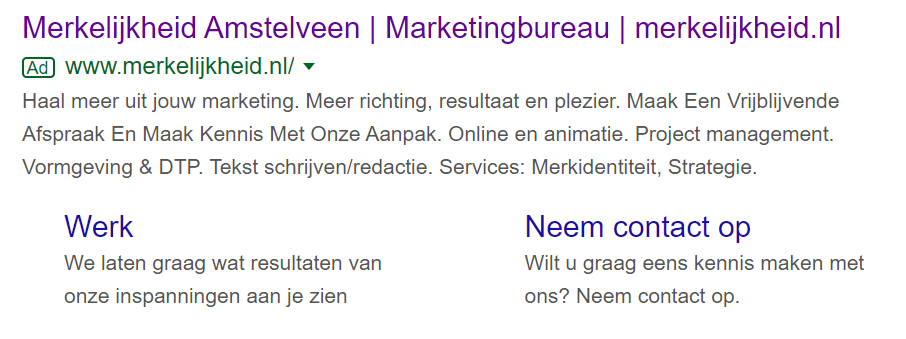
Present an ad aligned with the search intent of your potential customer
Following these steps results in a tailor-made campaign for every client. As much as we would like to offer a standard solution, your product, market, and objectives require a unique approach. We always immerse ourselves in the client and now know more than almost anyone about planetary gearboxes, fraud investigation, intercom systems, and many more topics. This ensures that we often work with clients for years and can set sharper goals together each time.
In this article, we provide a small insight into our way of working and the importance of thorough keyword research. We use various paid and unpaid platforms such as MOZ, Ubersuggest, and of course Google Adwords and Google Analytics to achieve as much as possible for our clients. Of course, we are a Google Certified Partner in areas such as Google Ads. Curious what we can do for your online marketing? Read more about our online marketing services.