Creating a content strategy in 4 steps
Content marketing is indispensable. Yet, many companies are still not actively creating and distributing valuable content to reach their target audience. Are you ready to get started with content marketing? We’ll show you in 4 simple steps how to develop a content strategy. After reading this blog, you can immediately start working on your content strategy and content marketing!
Content marketing is the foundation of your SEO strategy
‘Being easily found on Google’ is a goal for many organizations. And rightly so! Online is becoming increasingly important, and this trend – partly due to the rise of ‘Voice Search’ – is unlikely to diminish anytime soon. But how do you achieve this? With a solid SEO strategy and content strategy.
What is a content strategy?
Content marketing is a strategic marketing approach focused on creating and distributing valuable and relevant content with the ultimate goal of attracting or retaining a clearly defined target audience.
A strategic approach therefore requires a content marketing strategy. Your strategy becomes the common thread in your content marketing, so you don’t have to rethink what’s needed every week or month. How do you develop this strategy? First, decide what content you will create, for what purpose, for whom, and how you will distribute it. These four elements together form your content marketing strategy.
A successful content strategy in 4 steps
Content marketing comes in many different forms and flavors; you can make it as simple or complex as you want. But as with many other things, we recommend starting with a basic content strategy. In these 4 steps, you develop a content marketing strategy:
- The goal of content marketing and KPIs
- Determining the target audience and their content needs
- Content ideas and topics
- Content distribution: the distribution of content
We guide you through this process and explain at each step how to define your content marketing strategy. Finally, we also give you a tip for your content calendar and content production.
The goal of content marketing and KPIs
Step 1 of a successful content strategy is defining your goal. What do you want to achieve? This can be very broad because your content strategy can serve various goals. Ask yourself what the highest achievable online goal is for your organization. Is it an online sale? Or generating a lead? Work backwards to practical and, above all, measurable goals from that point.
For Merkelijkheid, our primary goals are, for example:
- Consultation: a potential client has a question and wants to schedule a consultation
- Appointment request: a potential client wants to schedule an introductory meeting
- Conversion: subscription to our newsletter
Then consider which data could serve as good KPIs. Also think about other online goals and how they contribute to the main goal. For example, goals like website visitors, social media followers, newsletter sign-ups, or sample requests.
If you’re just starting with content marketing or online marketing in general, this can be challenging. You tend to focus mainly on the customer journey and how to convert the target audience into customers. This might cause you to pay too much attention to the final steps in the process, limiting the number of opportunities.
Fortunately, this becomes easier over time because online marketing teaches you a lot about your customers and target audience, giving you a good sense of cause and effect. For example, you learn that more visitors lead to more inquiries, and the percentage that becomes a customer remains the same. You can then make a well-informed choice between attracting more visitors and increasing the conversion rate.
You now know what the most important online goals are and which smaller KPIs support them. Now make truly measurable, realistic goals! How many leads do you want to generate in the first three months and in the first year? Do you want to double or quadruple your website traffic? Formulate clear goals and link the right KPIs to them.
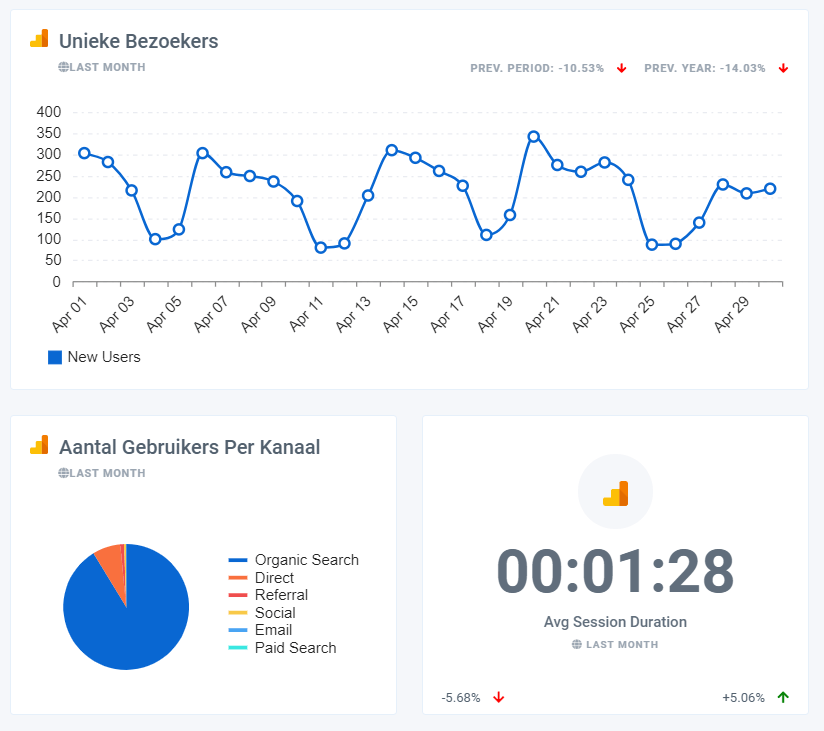
Part of Merkelijkheid’s monthly report.
Some examples of KPIs for content marketing are:
- The number of unique visitors to your website
- The number of visitors from search engines
- Your bounce rate
- The number of followers on social media
- The click-through rate of your social media posts
- The number of new newsletter sign-ups
- And of course, the number of leads
Determining the target audience and their content needs
Do you know who your target audience is? A successful content marketing strategy aligns with the needs of your target audience, so it’s essential to know who they are! The more you know about your target audience, the greater the chance of success. So don’t just think about who you want to reach, but also what they want to know and what their needs are.
You can make this as difficult or easy as you want. In any case – always – conduct keyword research! Not only will you immediately learn a lot about the search terms your target audience uses and what you want to be found for, but you’ll also learn a lot about the information they are looking for. Also look at the content you (unconsciously) already offer. Which pages on your website are viewed most often and which social media posts generate the most interaction with the target audience?

A small selection from the recent keyword research for Merkelijkheid in the field of Online Marketing.
Also, have conversations with colleagues who have a lot of contact with the target audience, such as sales or customer service. What questions and themes are relevant to the target audience and the market? Want even more insight into your target audience? Information directly from the source is invaluable! Consider a short conversation with a number of (recent) customers about their experiences and customer journey.
The goal is to clearly understand for whom you are creating content and what content they need.
Content ideas and topics
Now that you know where the target audience’s needs lie, you can start brainstorming topics and ideas. Use all the information you have gathered to come up with many different topics and content formats. If you want to share information about new regulations as a service provider, a blog might be the best format. Or do you want to dive deeper and share a whitepaper? Also, think back to your target audience’s customer journey and try to offer multiple types of content on the same topic for different moments and preferences during the customer journey.

Start with a brainstorm and then create a short, clear list of content you want to produce in the next 3 months.
Determine which topics have priority and which different types of content you want to create for them. Our tip? Keep it manageable. A list of 10 blogs for the first 3 months is much easier to execute than a multi-year plan with an endless list of topics and content ideas. Actually creating content is often underestimated; small steps make the strategy feasible.
Content distribution: distributing your content
How do you ensure that your content actually reaches your target audience?
With a well-functioning website and a successful SEO strategy, there’s a good chance your content will be found by your target audience. But in the beginning, that’s certainly not always the case, for example when you’re exploring a new topic or new target audience. After all your hard work, you want your content to reach (potential) customers.

Also distribute your content through other channels, such as various social media platforms.
How do you ensure your blog, whitepaper, or video reaches the target audience? The answer is content distribution, and that goes beyond just publishing your content online. For example, take a blog about beach towels. You’ve written a series of fantastic blogs about different materials, sizes, and designs. You post the blogs on your website. And then? Think about other channels, opportunities, and moments to share the blogs. For example, different social media channels, your newsletter, or a social media ad. And why not share blogs again when the beach season starts again a year later?
Content calendar and content creation
Congratulations, you have developed a content marketing strategy! Now it’s time to create content. A content calendar helps you keep an overview of content production and monitor deadlines. In a content calendar, you plan which content you want to publish and share when, when the deadline is, and who will create the content.
There are various ways to create a content calendar, and the internet is full of templates and tools. Are you just starting with content and working with a small team? Then a simple Excel overview might be enough. If you work with a larger team on content, it might be worth looking into online tools.
Now finally the core of the story: content creation. Get started. You have decided which content to create, for whom, with what goal, and when. All the ingredients are there, now the product! Start with a clear list of content you will produce and begin. Schedule regular time to work on your content and ensure the planning is feasible. You will soon see that the strategy you developed is workable and that you keep your content production efficient and enjoyable.
Are you looking for more information about online marketing? On our online marketing page, we gather all our knowledge and tips.