8 reasons to use social media in business-to-business marketing
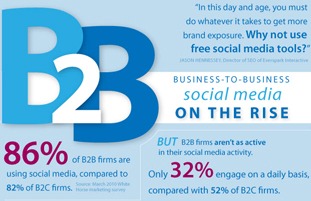
In consumer marketing, the use of social media is undisputed. But in the markets where we are mainly active – business services and industry – this tool is still rarely fully utilized. For many industrial (B2B) organizations, online marketing is the little brother of sales, it is rarely something close to management, and it is difficult for marketers to demonstrate the results of their efforts.
The choice of whether to use a tool or channel depends on the specific organization, identity, positioning, target audience, and budget, to name just a few variables. We leave the choice to you. This article simply provides some arguments for using social media in your business marketing.
Social media in B2B marketing
- Leverage – Where in traditional marketing you pay for every contact or impression, with social media you can use your own personal network, or that of the organization, as leverage. By informing or reaching 100 contacts with a relevant message, you enable them to share this message with people in their own network. The viral effect that a message thus gets results in a huge multiplier, making a well-thought-out but relatively small effort have great consequences.
- Affinity – Social media focuses on building relationships, contacts, and authority. The big difference between business and consumer marketing stands in stark contrast to the fact that social media is already fully embedded in consumer marketing. Especially in the business market, where years of intensive interpersonal relationships are responsible for a large part of the turnover, social media should have been adopted the fastest.
- Measurable – The saying “half of our marketing is wasted, we just don’t know which half” sounds familiar to many and is accepted as fact in traditional marketing. With social media, all efforts are fully measurable through a large number of (free) tools.
- Feedback – It is in the nature of social media that you receive direct feedback from your most important target group, the buyers of your product or service. Because in social media the traditional relationship between sender and receiver has disappeared, you gather valuable information directly from your customers. This ensures that the desired and necessary dialogue between you and your target group arises.
- Findability – In the internet world, it is a fact that ‘social results’ will prominently appear in all search results in a very short time. This is also proven by the recent announcement of the world’s largest search engine Google, that from now on information from its own Google+ network is decisive for search results. This concretely means that if people share your message on social media, it will rank higher in the search results.
- Expand target audience or market – You have been active in your market for years and know your target audience like the back of your hand, but the use of social media opens the door to new contacts that do not fit within your own market definition. Maybe you find a completely different industry where there is huge demand for your product, or part of it. Or a consumer comes up with an application for your product that you and your engineers never thought of.
- Track record – The internet forgets nothing, and for many companies this is a reason to stay far away. But where a company used to be as good as its last job, your performance is now permanently visible, even without your participation. By building a solid online track record or portfolio, you ensure that customers, now and in the future, get the right impression of your company.
- Customers demand presence – Just as years ago the fax was imposed on you – you simply couldn’t avoid it – we now see the same movement happening with social media. Also in your market, there are people who are already actively using social media, and they expect to find you there as well. Your customers demand to be in contact with your organization in the way that suits them best. Perhaps social media is currently only relevant for 1 in 10, but we can say with certainty that this number will increase, and then you better be ready.
Hopefully, these are sufficient arguments to justify the choice to use social media within your organization. Of course, many questions remain, but email was not fully integrated into your company within six months either. At least consider the following issues:
- When is it a success / What do I want to achieve?
- Which tools do I use?
- Which social media channels do I use?
- How do I determine the result or ROI?
- How do I evaluate our results?