Understanding the value of your online marketing – revenue growth and ROI
What is a website visitor worth? What is the Return On Investment of your online marketing? Unlike many marketing tools, it is possible to quantify the value of a website or online marketing. Even without annoying cookie notifications and costly tools, you can explain what your website or online marketing delivers. In this article, we discuss more than just the technical basics and setting up analytics programs. After reading this article, you will work 100% result-oriented with online marketing. And you will also be able to explain or justify it to any layperson.

Steering online marketing results with a simple dashboard
In the first part of the article, we discuss why you should assign value to the behavior of your website visitors, and in the second part, we explain how to do that. The end result is a fully automated – and simple! – system that assigns a value to each visitor you can manage.
Return on Investment of your website and online marketing

What is it worth if someone clicks ‘Get Acquainted’ here?
What does one euro invested in your website and online marketing yield? Surely more than one euro, but a clear answer often remains elusive. And that’s not surprising because many companies cannot or do not want to sell their product online. The highest achievable result is often a completed quote form or the contact details of a lead.
This makes it difficult in many cases to say: this is what our website or online marketing has delivered.
But it becomes even more difficult when you have to choose between two actions: ‘Should I spend €1,000 on LinkedIn or on Google Ads?’ How do you make this choice? When ordering a machine, you probably consider the payback period, revenue and profit potential, and ROI. Why is it different with online marketing?
Conscious and targeted investment in online marketing or website
Your website is the foundation of your online marketing. Primarily because you control what a visitor sees here. This way, you can guide potential customers in their purchasing process (towards your product or service). Other channels will always charge (high) costs for this. Additionally, you can assign a value to the behavior of each visitor. With that value, you can determine the ROI of a specific campaign, action, or advertisement. If the behavior of the X purchased visitors has a value of Y, calculating the ROI should no longer be difficult.
But you do need to know which behavior should be measured and what value it has.
Determining desirable behavior
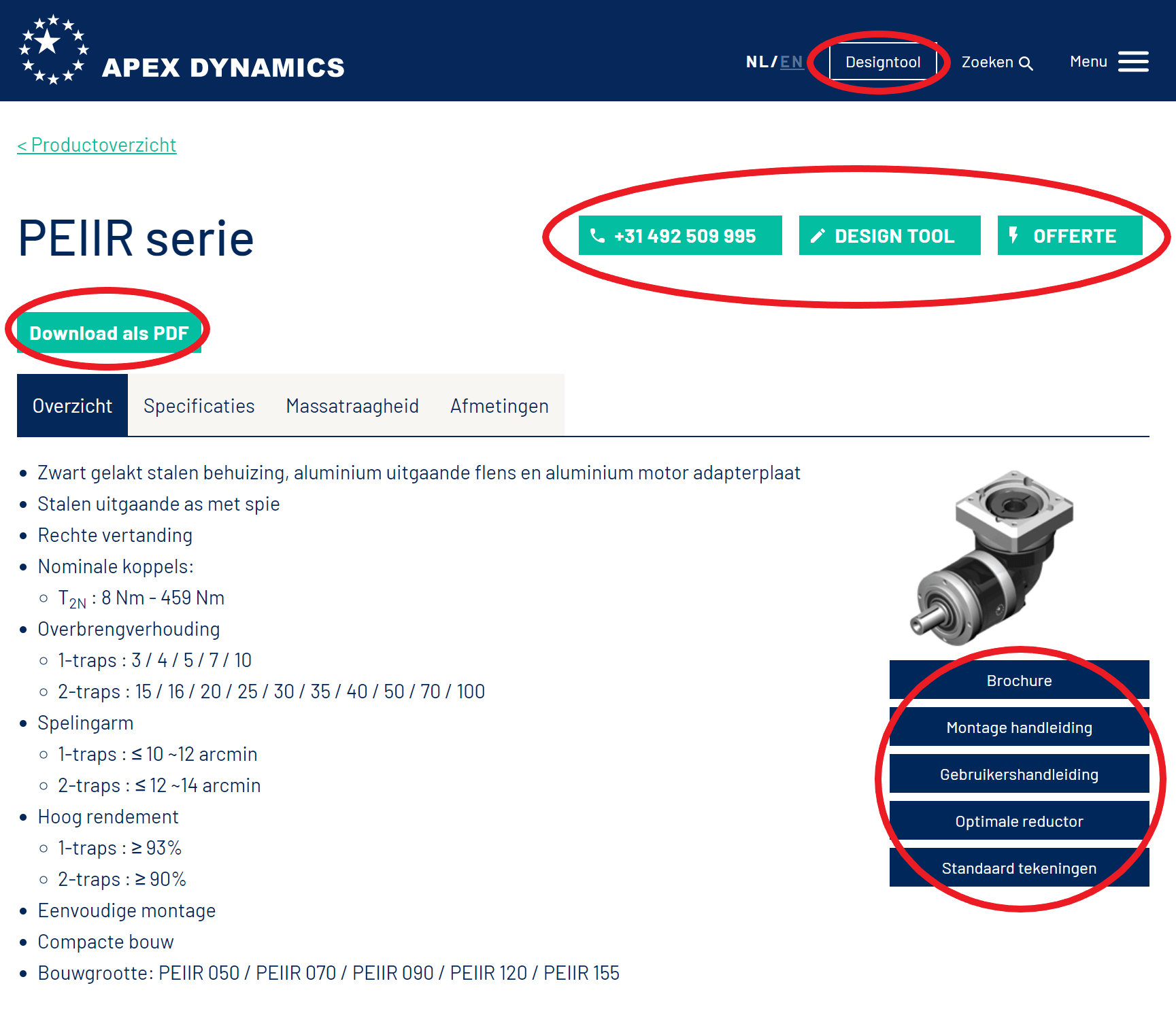
Sometimes 8 desirable actions appear on one page (source)
The activities you want the website visitor to perform, i.e., the desirable behavior, are what it’s all about. Here are some examples of desirable behavior:
- Clicking on an icon linking to your company’s Facebook page
- Clicking on the phone number to make contact
- Downloading a PDF file
- Submitting a fully completed contact form
- Selling and directly checking out your product
If there are no or few valuable actions, that is naturally the first step to take: what can your website deliver?
What constitutes a valuable action naturally differs per company or website. Therefore, you must determine this specifically for your website. Make a list of all possible actions to which you could assign a value.
Assigning value to visitor actions
Once you have listed all possible and valuable actions on your website, it is important to assign a value to them. This is easy with the sale of a standardized product, but what is downloading a brochure worth? By value, we mean the number that best represents the economic value of a particular action:
Actions further from a sale; such as a Facebook visit, a phone call, or a newsletter subscription, are harder to interpret. Often we start with a lower number and adjust it as we learn. How do you learn the value of a particular action? In the case of a phone call, several possibilities come to mind:
- Special phone numbers on the website. Using the same area code but not your ‘standard’ number, you direct people to certain numbers for specific actions. Monthly or weekly, you then receive a report with the number of calls made to each number. Also useful for a one-time promotional campaign.
- Have receptionists tally who calls for what. Have the employee ask: “How did you find us?” Involve employees in the search for value and the origin of new customers.
- A special call-us module, where people must choose the purpose of their call before seeing a number.
Once you know why people call, it is easier to assign an average or specific value to a phone call.
Calculating the value of a website visitor
The next step is simple: addition. By adding up the values of all actions of a particular visitor, you calculate the value of that website visitor.
Managing based on ROI of a channel, campaign, or action
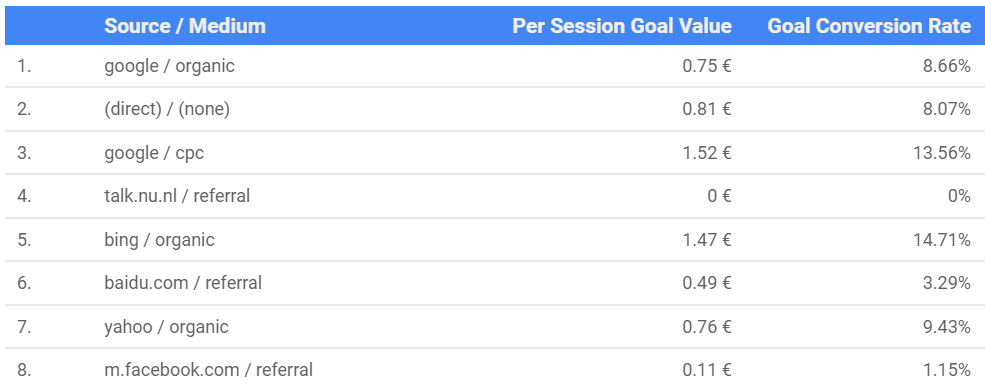
For example, the average value or conversion rate of a visitor is visible per channel or campaign
You then determine the Return on Investment of a channel, campaign, or action by adding up the value of all visitors who came to your site via that action and comparing it to the costs. Make sure you can clearly distinguish different campaigns – for example, by giving each a unique identifier – and that you can actually compare them.
Returning to the brochure example, where a brochure has a value of €100.00:
- You have developed a landing page for your product with the main Call to Action being a request form for the brochure.
- Via LinkedIn, you sent a total of 100 visitors to this landing page for €350; 5 request a brochure and visitors perform €50 worth of other actions, mainly newsletter sign-ups.
- Via Google Ads, you sent a total of 380 visitors to the same landing page for the same €350; 4 request a brochure and €90 worth of other actions are performed.
- The result of the LinkedIn campaign is much higher than that of the Google Ads campaign. Purely based on ROI, the LinkedIn campaign would therefore be preferred.

How many leads are needed to make this campaign worthwhile?
If you manage purely based on the value of actions, you leave out more abstract aspects. Brand awareness or visibility of your brand or the market’s familiarity with your product, for example. In the example, 280 more people came to the page via Google and thus (partially) got to know your brand and product. That also has value and deserves a place in the ROI calculation.
But in any case, we hope it is clear that calculating the value of a visitor provides more insight into the quality of certain channels or the success of an action. And that you can also communicate this to colleagues or other stakeholders. The only question left is implementation: how do you achieve this?
Technical implementation: what you need to do
Most people use Google Analytics to monitor their website traffic. It is a program from Google, the main search engine, and it’s free. You can already see quite a lot in Google Analytics, but it is not designed to register every action on every website. You need another system for that, and Google realized this too: they developed Google Tag Manager for this purpose.
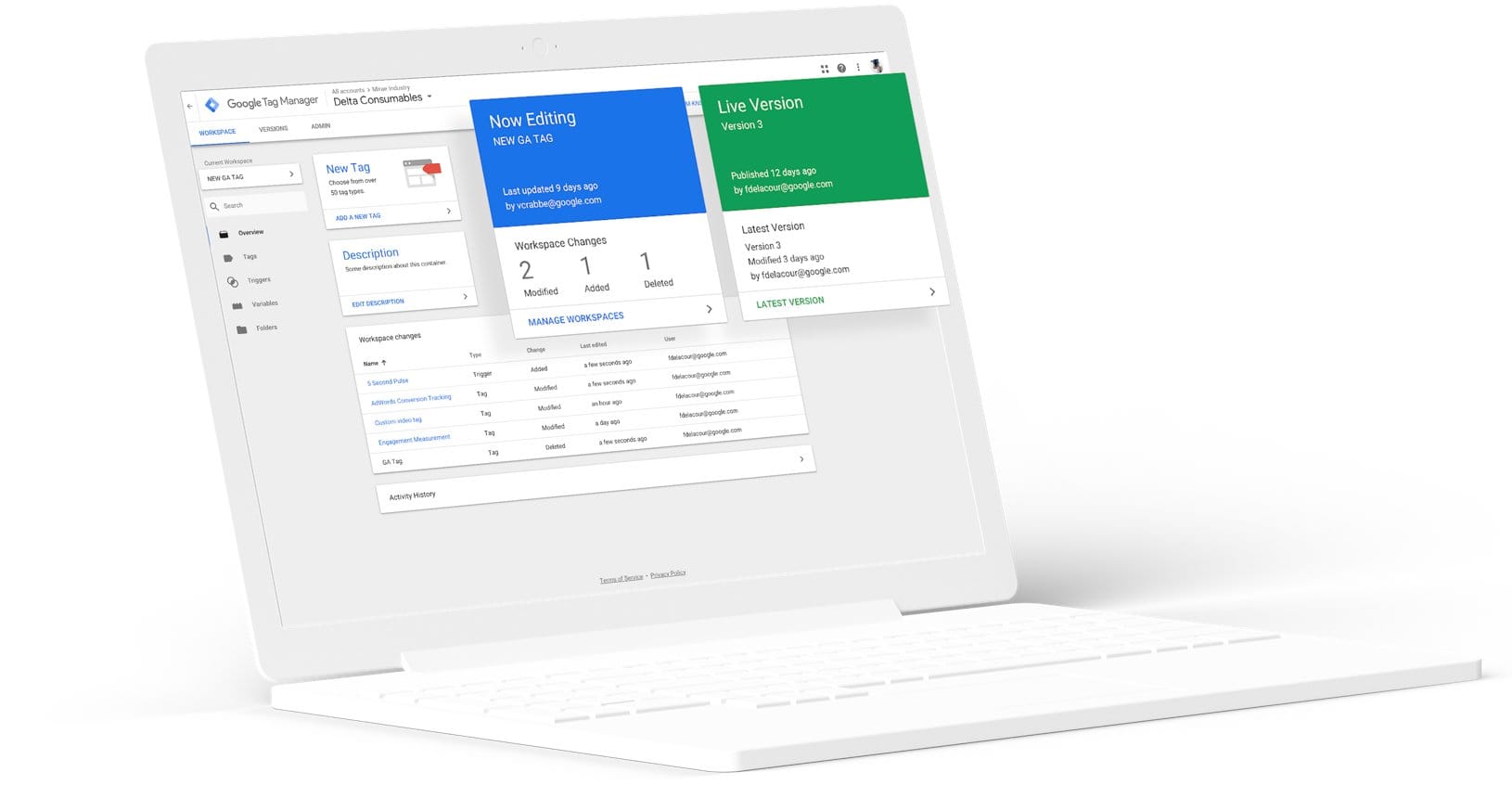
Once Tag Manager is set up, it saves a lot of work (source)
With Google Tag Manager, you identify a unique user and assign a ‘trigger’ to each action. Through ‘tags,’ you send those actions to other tools such as Google Analytics but also to Facebook, LinkedIn, or Google Ads. You use these programs to analyze all actions and user behavior.
Setting up Google Tag Manager
You set up Google Tag Manager so that;
- Programs like Google Analytics can analyze the behavior of your visitors (anonymously if desired),
- Each action is linked to a so-called trigger,
- The correct value is assigned to each trigger, preventing mistakes and distorted views when comparing multiple channels,
- Tags are added to ensure every action is recorded in the program you use for analysis (Google Analytics)
The second step requires technical (programming) knowledge; for optimal implementation, you cannot avoid making adjustments in your website’s code. An experienced developer should not take more than a day for a normal B2B site, depending on the number of triggers.
Next step: Categorizing tags and goals
Even with a simple website, there is a chance you quickly lose the forest for the trees. There are 5 social media actions, 12 brochure downloads, a newsletter subscription, various contact forms, and so on. How do you make this manageable?
To avoid an overwhelming list of different tags, our advice is to categorize them. This can also be done in Google Tag Manager and has several clear advantages.
Advantages of categorization through Google Tag Manager
- Every list of categorized tags is usable in every tool, ensuring uniformity across various tools.
- A category can serve as a goal, one practical KPI for your site
- No long list of different tags, but a clear list per category
- Useful for universal and clear reporting & analysis of website results.
Our 5 categories in Google Tag Manager
We divide all goals into five categories, which are:
- Referral
- Contact
- Downloads
- Conversion
- Sale
The fundamental idea is to have as few categories as possible, and that they are both complete and as logical as possible for the layperson. This classification is based on the customer journey concept; from acquaintance to purchase and everything in between:
Referral – When someone clicks on a link, in any form, for example to your Facebook page or the source of an article. But sharing an article via social media also falls under this; after all, you click on a Facebook link to share the article.
Contact – Any action that can be the basis of a contact moment with your brand or organization. Clicking on an email link, phone number, WhatsApp button, chat, and so on. Each of these actions has in common that you do not necessarily get the other party’s contact details. These belong to conversions.
Downloads – Speaks for itself, just a download without sharing contact or personal data. For example, offering a brochure, manual, or installation guide for download.
Conversion – An important step in the sales process is when the visitor provides their personal or contact details. With this, you can take action yourself, provided it complies with GDPR, and guide the customer to a sale. A job application would also fall under this.
Sale – An action with which you realize a sale, no more and no less. In practice, many B2B companies do not have this option; it is more common in B2C environments where the average sales value is lower.
In practice: Google Analytics
A fully implemented setup of triggers and tags into categories and then implemented as goals in Google Analytics looks very simple in practice but has quite some depth. For our own site, it looked like this at one point:
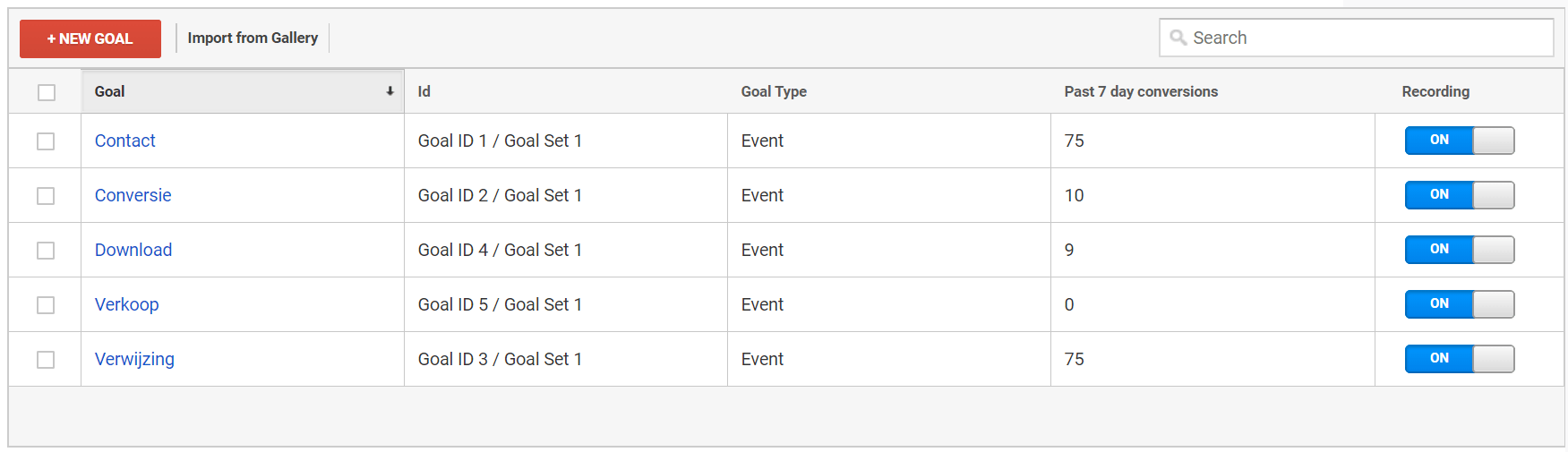
Image 3 Example from Google Analytics
As you can see, our highest achievable goal is a conversion. Often this is an introductory appointment or a concrete request via email. Like many B2B companies, we do not realize a sale.
Insight into the value of a website visitor: the result
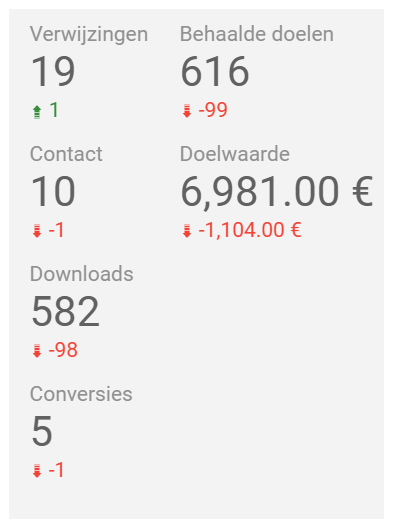
Clearly visualizing the ROI of your online marketing
The first gain is gaining insight into all possible website actions and their value. This step forces you and your team to be concrete about what you want to achieve and how you will do it. Even if you don’t yet know the answer to many questions – what is a brochure request worth – it is important to assign a value here. Learning by doing – once the first lead places an order via the brochure request, the value increases – and it makes you alert to the follow-up of all website results. After a month or quarter, you will be able to determine the value much more accurately. With this approach, adjusting the value is naturally a breeze.
The second gain is that you can suddenly compare website efforts with other marketing efforts such as a trade fair. What are the costs per lead from the trade fair? But more importantly, how do you value the brand or name recognition that this trade fair generates? How do you determine that? For both a trade fair and a website, the value of brand or name recognition is quite intangible but in both cases an essential part of the ROI.
The last gain we discuss here is, of course, optimization and insight. If a LinkedIn campaign has a Return on Investment of 57%, why not run two? And what is the difference between traffic from Google and Facebook?
By assigning as concrete and realistic a value as possible to your website visitor, you can approach not only the ROI of a campaign but of the entire website. Essential in a time when the importance of online marketing is growing, the website is the central instrument, and more attention is paid to the value of marketing. This way, you come well prepared and have the insight and hard numbers that enable you to make and justify the right investment in online marketing.