Starbucks positioning: trendy coffee brand or ditch water?
Starbucks positioning hits the mark worldwide, but what exactly does the positioning entail? The brand has large numbers of loyal fans and ambassadors but at the same time also many opponents. The same picture is reflected in the media where a positive article alternates with accusations of tax evasion. The brand has tens of thousands of Dutch fans but ‘real’ coffee lovers are still rather not seen there. In short, the brand stirs up a lot of emotions. Reason for us to take a closer look at Starbucks’ positioning and history.
 Starbucks was founded in 1971 but only gained momentum when former employee Howard Schultz (now still/again CEO) took over the 6 locations in 1987 and rebranded his own coffee shops as Starbucks as well. Two years later, the company had 46 locations and when it went public in 1992, already 140. That IPO was necessary to open even more locations and this remained the company’s main goal until 2007. An interesting fact is that Starbucks opened an average of 2 locations per day during that time.
Starbucks in trouble
2007 is the year Starbucks’ explosive growth was temporarily halted. In a leaked memo to the Starbucks Board of Directors, Schultz writes that the ‘Starbucks experience’ has diluted and that growth is therefore stagnating the company. The memo was made public (not by Schultz) and led to the dismissal of then CEO Jim Donald and Schultz’s return as CEO. The company returned to its old course and started an extensive repositioning. In 2009, Schultz closed more than 600 locations and laid off 1/3 of the employees at headquarters as a last step to turn the tide.
It largely dates back to this period that the ‘real’ coffee lover is not found at Starbucks. In the pursuit of higher operating efficiency, the company replaced coffee machines with fully automatic machines after Donald took office, and the design of Starbucks locations became increasingly uniform. Coffee lovers increasingly ignored Starbucks and employees also rang the alarm in vain. The aspects of design and the craftsmanship of the coffee received Schultz’s full attention in 2007, and the brand then focused heavily on innovation.
The big difference with Jim Donald is that Howard Schultz has had a vision of ‘the coffee shop’ from the start and wants to do everything possible to achieve it.
Update: Here’s the Thing host Alec Baldwin interviews Howard Schultz about the origin and future of Starbucks. He talks about global ambitions and his own coffee consumption. Listen to the interview here.
Starbucks positioning: ‘a welcome third place’
CEO Schultz developed his vision of the best positioning for Starbucks in the 8 years after the IPO. The positioning team wanted to position Starbucks as the fixed ‘third place’ for people, the first two being home and work. They thought of the third place that appeared in many different cultures throughout our history, think for example of Roman forums, English pubs, Japanese teahouses, and German beer gardens. Starbucks must do everything to be that third place and connect its brand to the deeper history around it.
That’s why Starbucks has comfortable chairs, free Wifi, and you can stay as long as you want, something many young people gratefully use. And this positioning was a huge success. In his 2015 letter to shareholders, Schultz writes: “The Third Place concept [is] no longer novel, it’s a way of life”.
It is important to note that the ‘third place’ means something different in every culture and that this has relatively strong consequences for the design of Starbucks locations. The success of international expansion, with now more than half of Starbucks locations outside the US, shows that Starbucks takes this sufficiently into account.
Kunal Vora explains Starbucks’ success on Quora in a simpler way:
“A smiling guy handing you a great product in a warm and friendly environment – what more can the consumer ask for?”
Want to know more about the process by which Starbucks managed to position itself so distinctively? Read the article ‘5 things I learned building the Starbucks Brand’.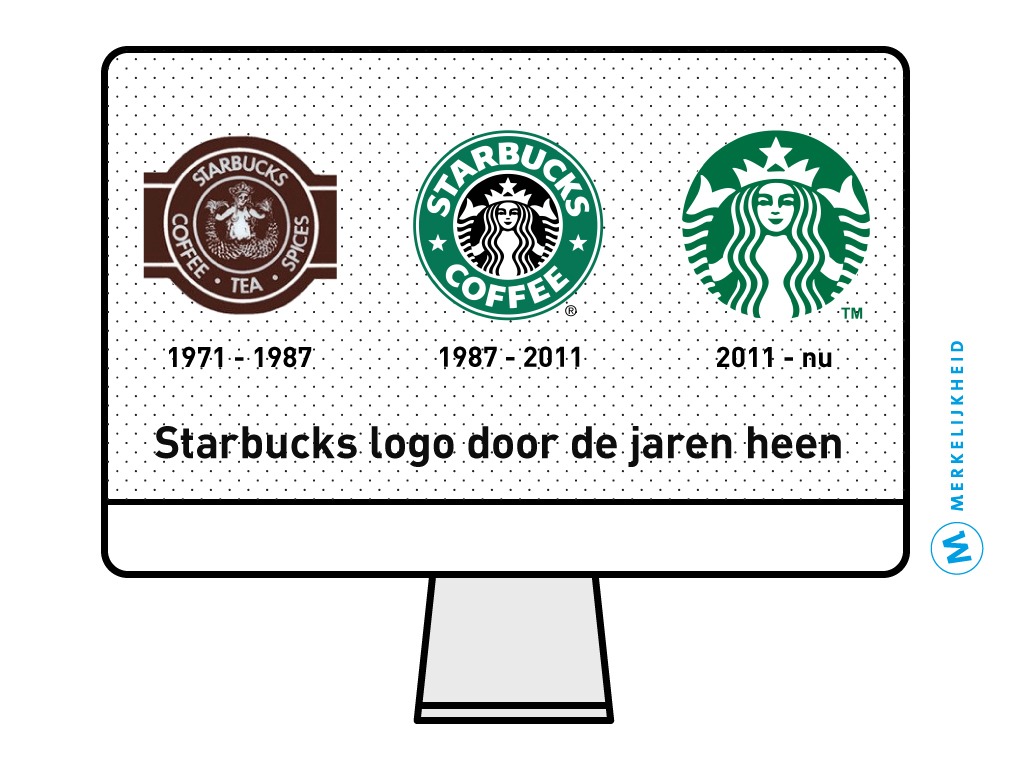
Starbucks logo and positioning
The mermaid that is central in the Starbucks logo has also changed enormously in the 40 years the company has existed. As you can see in the comparative image above, Starbucks has gradually removed more and more elements over the years and moved more towards the ‘core’ of its logo. As Starbucks grows and gains recognition worldwide, this will likely continue, just like with Shell and Nike, for example.
Starbucks positioning in the Netherlands
Screenshot Quartz.com
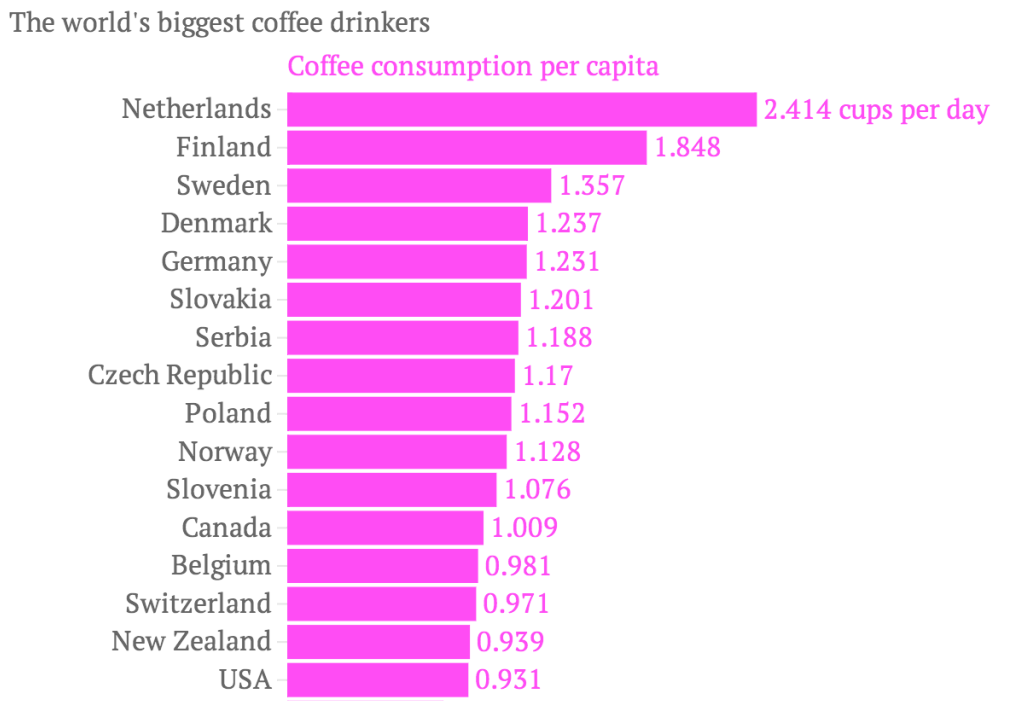
Starbucks fans have been clamoring for years for Starbucks to come to the Netherlands. The Netherlands is the world’s biggest coffee drinker, as you can see on the Quartz chart, and although we have long since moved away from the cup of joe, it is not Starbucks that caused that.
The Coffee Company is partly responsible for that, at least in the capital. In response to questions from NRC about Starbucks’ place in the Dutch market, Jasper Uhlenbusch of The Coffee Company states that they are not worried and do not think the literal place Starbucks has taken is great:
“Our biggest successes are neighborhood coffee shops, with regular customers, where people stay longer. At stations you deal much more with passersby.”
But Starbucks is there, and meanwhile with about 50 locations larger than the 37 The Coffee Company mentions. However, according to the Starbucks 2015 Annual Report, there are only 10 own locations in and around Amsterdam, the rest are opened under license at NS stations and Shell gas stations.
The ‘third place’ positioning of Starbucks is expected to have little impact in the Netherlands. The friendly environment has been successfully established by other chains and independent coffee shops, and they have already won the hearts of Dutch coffee lovers. We do not see them moving to Starbucks anytime soon. On the other hand, there is the enormous amount of brand equity the company has with tourists and young people. With more than 36 million likes on Facebook, the company is better than anyone else able to get its message out to the world. Research by Capgemini even shows that 94% of all Facebook users are either a Starbucks fan or friends with a Starbucks fan!
The globally recognizable brand also has a good image here. Although local chains and coffee shops certainly have a place, we think they should indeed be afraid of Starbucks and its marketing power.
The future of the Starbucks brand
Although we think Starbucks will not conquer the Netherlands with its positioning, the rest of the world is a very different story. The company does the most business in China after the US locations and expects to open about 900 locations in Asia alone in 2016. The vast majority of growth must come from those regions and expansion of the product range with, for example, tea. How does Starbucks do that? The brand builds its position based on the following pillars:
Starbucks marketing strategy
The data and insights below are based on/distilled from the past 3 annual reports and letters to Starbucks shareholders. These can be found on their website.
- Everything is about social – The company places integrity and making a contribution to the world at the center of its strategy. Many brands do that, but few pay as much attention to it as Starbucks. In the 2015 annual report you read:
We also believe our Starbucks Global Responsibility strategy, commitments related to ethically sourcing high-quality coffee and contributing positively to the communities we do business in, and being an employer of choice are contributors to our objective.
A variant of this can also be found in the 2014 annual report.
And except for the accusation of tax evasion, the company seems to be doing everything to actually make progress here. The company pays for training for thousands of employees and now sources 99% of its coffee ‘ethically’. Whether it is really such a social company is beyond the scope of this article, but from a marketing perspective, story, message, and proof are well put together.
- Customer satisfaction and ‘personal’ first – American friendliness and service really drip from Starbucks. The barista asks your name, you can make your coffee as crazy as you want, and they always serve it with a smile. This certainty is in our opinion one of the strongest brand attributes and Starbucks does everything to keep its employees service-oriented.
- Leverage social, digital and mobile applications – Because our country is of little importance to Starbucks, except for a huge coffee roastery in Amsterdam, we notice little of this here, but Starbucks has hugely successful platforms and applications. Mobile pay accounted for about 21% of revenue in the US in 2015, a 10% growth compared to 2014, and the company continues to focus on further growth. Online it is one of the most successful brands, the aforementioned 36 million Facebook likes and success on other social platforms is a driver of growth and something the company is very aware of.
The core of the success is the focus on permission marketing as conceived by Seth Godin. Starbucks collects permission from its target audience in the form of likes, app installs, loyalty programs, and participation in promotional actions. It then uses this permission to ‘cost-free’ promote its products and brand.
Due to the company’s problems in 2006-2009, the ‘innovate or die’ mentality was hammered in hard. Where some companies struggle with change, Starbucks sometimes seems to have too much confidence in it, think for example of the huge fuss when they didn’t print Christmas trees on the holiday cups. (What are we even talking about 😉
- Localized store design
The big challenge for Starbucks is to maintain the Starbucks experience Schultz always talks about, while people still feel like they are in ‘their’ Starbucks. The brand therefore wants to integrate local culture and customs with its own brand experience. To see that in practice, you have to travel to a city like New Orleans or Tokyo where the brand combines its distinctive style with a strong local flavor. I was recently in New Orleans and only realized while writing this article how different the Starbucks there was.
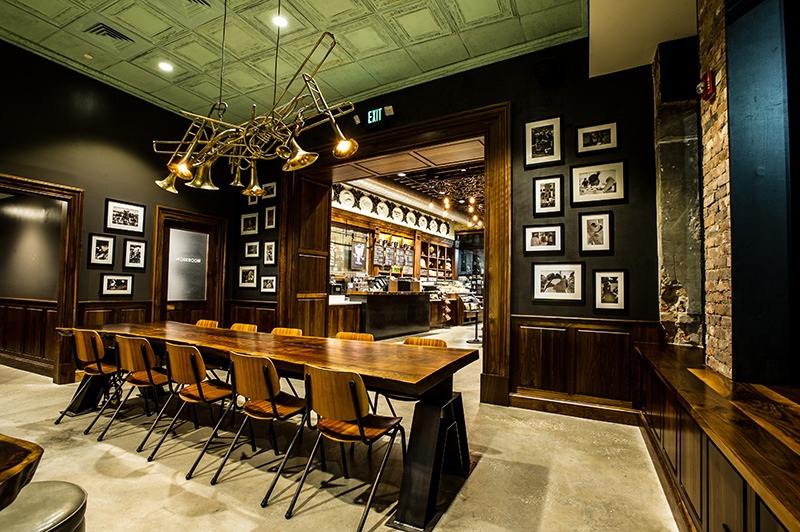
Starbucks Canal Street, New Orleans – Source: Matthew Glac for Starbucks
Conclusion: the Starbucks positioning
The ‘third place’ positioning, which is central to Starbucks’ positioning, we find fantastic. It is a solid foundation for the organization and at the same time offers enough flexibility to deal with changing circumstances and new markets. We highly recommend the article about how the basis for this positioning was laid. Furthermore, we admire how closely the brand sticks to the positioning, for example through the acquisition of tea brand Teavana or the expansion of its food offering to remain relevant as a ‘third place’.
You can say little about Starbucks in terms of marketing. Their use of crowdsourcing platforms and embracing various applications pays off, but they are fully committed. And that is a sign that they understand their target audience well.
Personally, or if we only look at the Dutch market, we are neither warm nor cold about Starbucks. Where I live, I can name 5 nicer, better, or cozier coffee shops. But what if I am in a new, unfamiliar environment? Then I know what I get there: good service and a fine coffee, exactly how I want it.
Want to know more about positioning and how you can get started yourself? Read our page positioning and find there, besides in-depth articles, also dozens of examples and models for every possible positioning challenge.
Sources:
- http://www.seattletimes.com/seattle-news/tempest-in-a-coffee-cup-illuminates-power-of-starbucks-brand/
- http://qz.com/166983/where-the-worlds-biggest-coffee-drinkers-live/
- http://www.businessinsider.com/howard-schultz-turned-starbucks-around-2011-6?op=1&IR=T
- http://www.seattletimes.com/business/starbucks-must-find-lost-soul-schultz-says/
- Howard Schultz’s Starbucks memo
- 5 Things I Learned Building The Starbucks Brand
- http://www.econtentmag.com/Articles/Editorial/Commentary/Starbucks-and-Social-Media-Its-About-More-than-Just-Coffee-103823.htm
- http://vorige.nrc.nl/economie/article1956223.ece/Starbucks_late_nieuwkomer_op_Nederlandse_koffiemarkt
- Starbucks Fiscal 2015 Form 10-K
- Starbucks Fiscal 2014 Form 10-K
- Wikipedia https://en.wikipedia.org/wiki/Starbucks
- Photo of woman with coffee: Pexels