Brand Archetype Sage: knowledge creates a better world
Can you prove the quality of your brand beyond doubt? The Brand Archetype Sage can bring calm and confidence in the fleeting world of ‘fake news’ and clickbait. The Sage believes that knowledge will help us create a better world. The Sage knows no higher good than knowledge and truth and wants to make you think. Curious if this brand suits you? In this article, we list the characteristics of the Brand Archetype Sage, discuss examples from business services and industry, and share the main pitfalls.
The motto of the sage is:
The truth will set you free
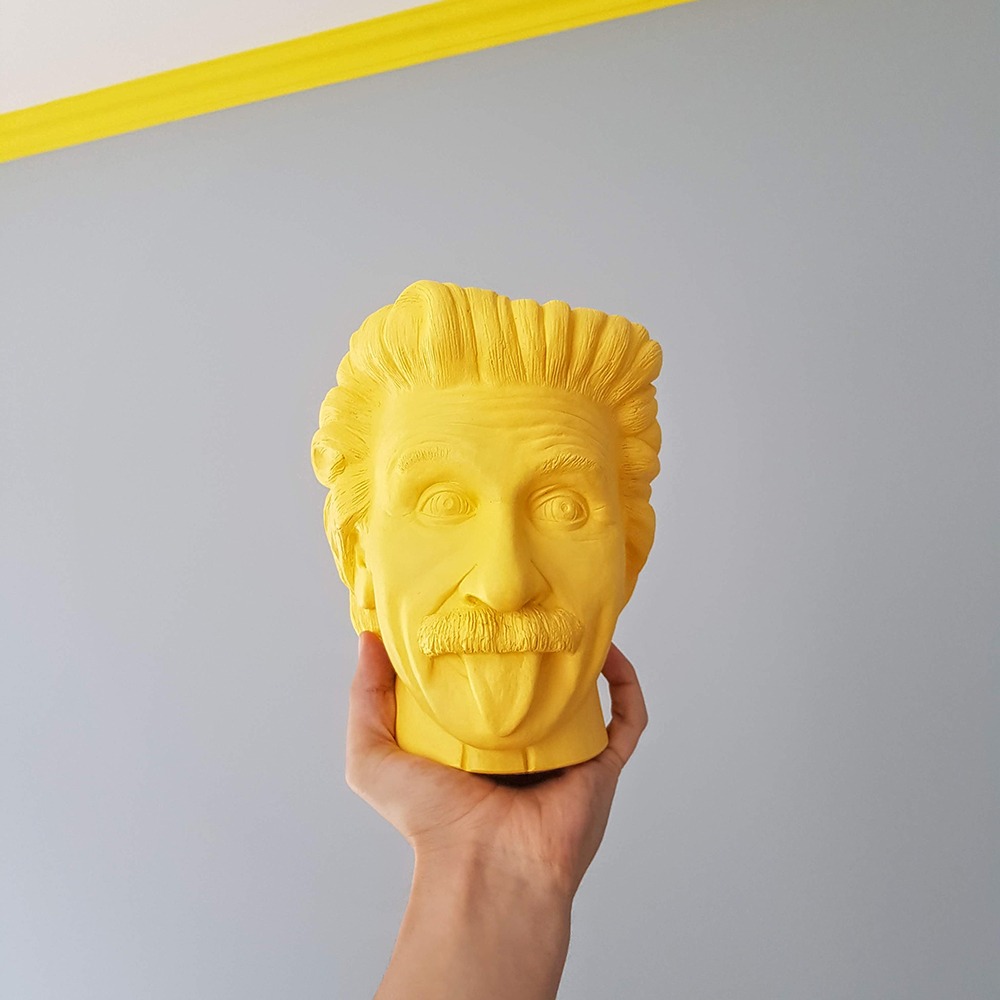
Einstein is a prototype ‘wise man’
The sage not only seeks truth, knowledge, or wisdom but also has the urge to share this with others. In short, the Sage wants to understand the world and teach others what he knows. With the right knowledge, anyone can make good decisions, so the sage contributes to a better world.
When we think of the Sage – that is the power of brand archetypes – we all imagine a wise old man on a mountain who can point us in the right direction. Or think of Oprah Winfrey, who became the wise woman for an entire generation of TV viewers.
Customers who perfectly fit Sage brands are looking for knowledge and expertise that make them smarter, help them better understand the world around them, and make the right choices. Not blindly following what is said, but making a well-considered choice based on (preferably factual) information. Therefore, the Sage Brand Archetype fits perfectly with brands that distinguish themselves from brands with questionable quality or performance and can prove it convincingly.
Characteristics of Brand Archetype Sage
A brand that embraces the sage archetype is a brand that sees knowledge as the highest good. They are geared towards continuous learning and the analysis, planning, and research that underpins it. Such an organization is often also decentralized or more democratically structured because this ensures the autonomy of employees. This is an important condition to attract and retain knowledge workers. At the same time, the typical customer of the Sage is also a customer who values a brand that provides them with the knowledge to make their own choices.
 Example Brand Archetype Sage: Audi
 Example Brand Archetype Sage: Audi
Car brand Audi is by far a brand that embraces the Sage archetype. Their slogan ‘Vorsprong door techniek’ (Advancement through technology) anchors this belief in everything the brand does. For example, Audi was the first car brand to develop a high-performance four-wheel-drive car and won the rally championship two years in a row with it. A few years later, the first Audi Quattro became available to consumers.
Recently, the brand was under fire with this slogan. Audi’s role in the diesel scandal made the brand’s American slogan and advertising message ‘It’s not easy being green’ completely unbelievable. Especially for the knowledge- and truth-conscious target group of a Sage, this is a deadly sin.
Example Brand Archetype Sage Business Services: Boston Consulting Group
Management consulting organization Boston Consulting Group (BCG) is closely related to McKinsey. Not only in terms of brand archetype but also in its (origin) history. Both companies laid the foundation for what we now call strategy (source: Lords of Strategy) and were the first to advise companies on strategy. It may be hard to believe, but about 60 years ago, no one had heard of strategy outside the military domain. BCG was – with its matrix – the basis of an entirely new industry.
Unlocking the potential of those who advance the world.
The above slogan perfectly indicates that BCG is in the game as a Sage. The brand deploys teams worldwide with deep and functional expertise to support their clients. And, as befits a Sage, its people are its most valuable asset. In the words of Richard Lesser, President and CEO of BCG:
We do this by channeling the diversity of our people and their thinking, as well as our shared commitment to uncovering the truth.
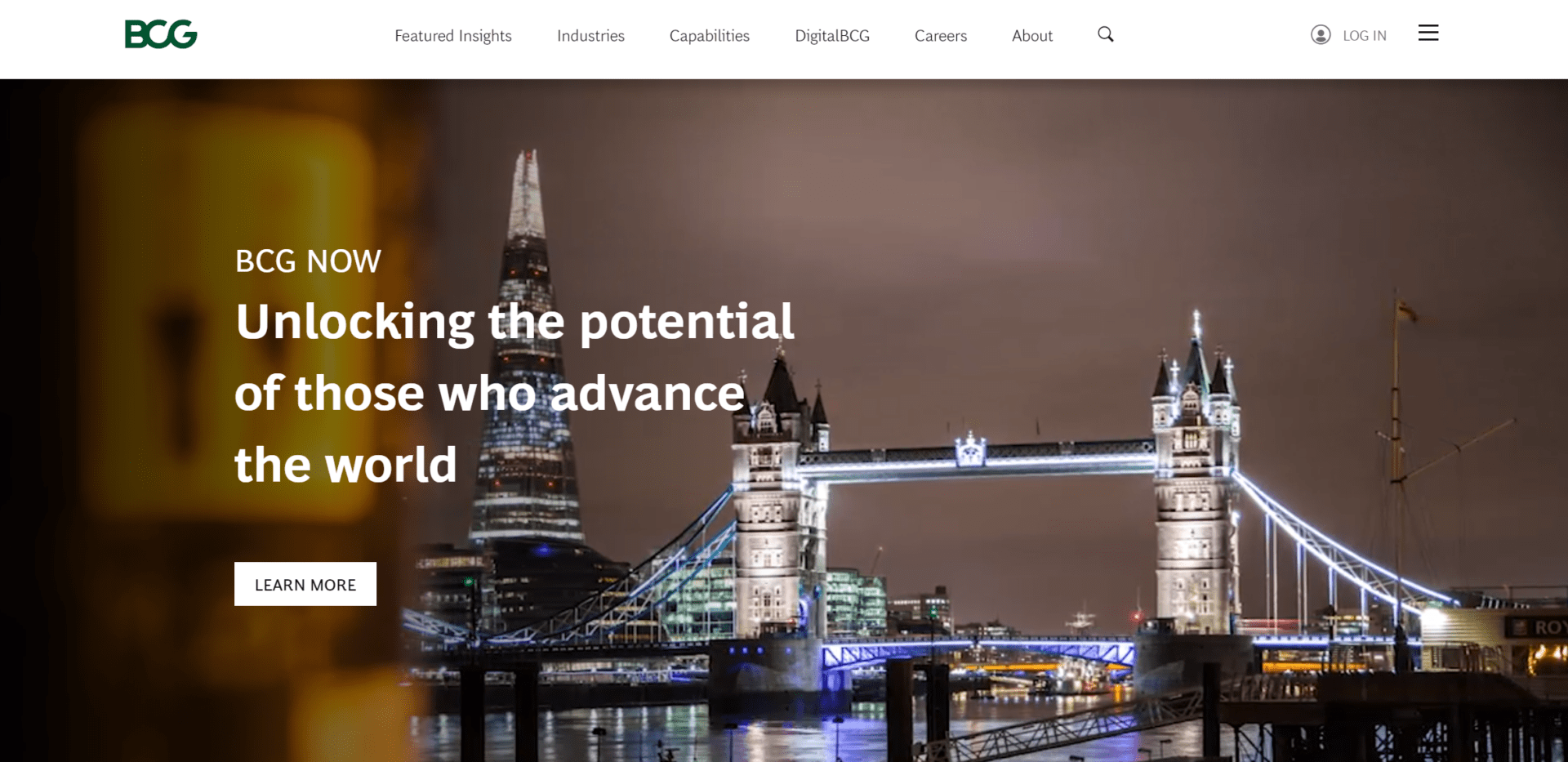
The company shares its ‘latest thinking’, hosts its own TED conference, and places collaboration with its clients (leaders) at the center. BCG believes its clients can make the right decisions through the knowledge and information it provides. Its communications usually focus on insights, not the conclusions the company draws from them. Unspoken is the expectation that everyone will come to the same conclusion with this information.
The company’s corporate identity is very white and ‘clean’ with a green accent or background as a base. This lets the data speak for itself and does not distract from what matters: the content. Moreover, BCG does not show the world differently than it is; photos are only lightly edited and, for example, show no discolorations or other changes compared to reality.
Example Brand Archetype Sage Industry
Closer to home, we find another almost prototype Sage brand: TNO. This independent research organization’s mission is to connect people and knowledge to create innovations that sustainably strengthen the competitiveness of companies and the welfare of society. TNO is proud of its good reputation as an innovation and knowledge organization but attributes this to only one thing: its 3,200 employees.
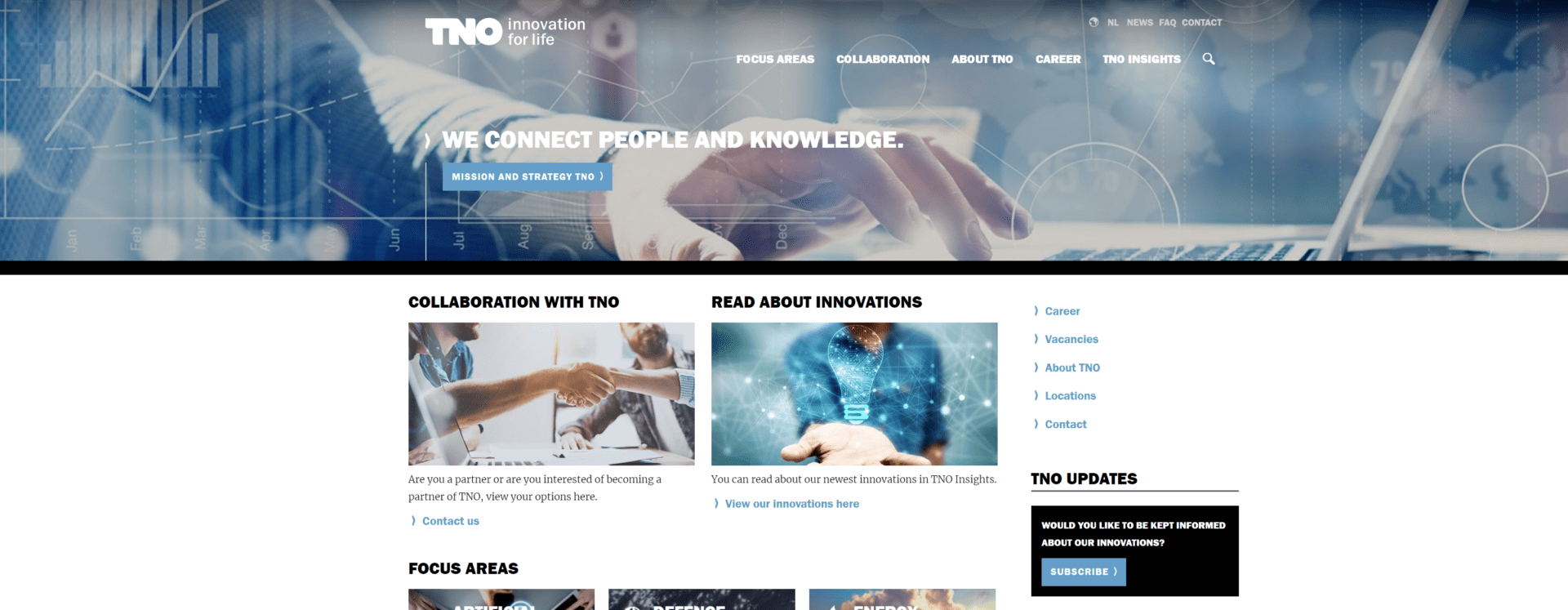
As befits a Sage, TNO follows the description of this brand archetype to the letter:
If you do business with TNO, you can expect a lot from us in terms of content. Besides the substantive expertise, which may vary per employee, we share a number of common values: integrity, independence, professionalism, and social involvement.
The slogan: innovation for life says something about the company’s goal and future and how steadfast it is in this. Its communications focus solely on the substantiated results or achievements of TNO, and all innovations are categorized by sector. TNO also uses a restrained style with few striking colors; here too, the data must speak for itself.
Advantages of Brand Archetype Sage
Brand archetypes project their own qualities onto their customers. Or customers look for a brand with a personality that suits them. A Sage must therefore give its customers the feeling that with your help, they are an expert. Confirm the wisdom of their preference, and you are assured of their loyalty. This archetype fits exceptionally well with high-quality or complex products and services such as investment advisors. Charles Schwab, for example, states: ‘Schwab’s expertise can help you get the most from your investments.’
Pitfalls
The biggest pitfall for the Brand Archetype Sage is to use a condescending, lecturing attitude or a forceful persuasion style. The customers of a sage will quickly lose trust (in your knowledge and wisdom). They want to make the most logical decision themselves, partly based on the knowledge and information you provide.
Another pitfall is that a certain dogmatic belief becomes central – think of Kodak, which did not believe in digital photography even though they invented it themselves – or a brand reasons too much from an ivory tower. At all times, (practical) applicability must be central, a rule that TNO, for example, has taken to heart.
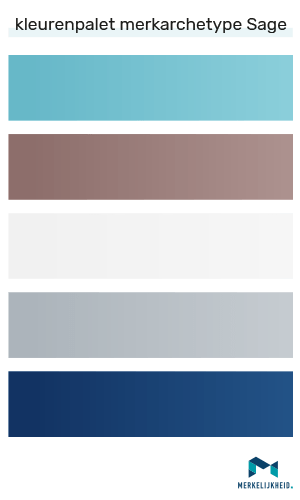
A typical color palette that fits the brand archetype Sage; subdued colors that highlight data well
Marketing of Brand Archetype Sage
The core of marketing for a Sage revolves around knowledge and information. A sage brand either shares the results of their own research and experience or the knowledge of its customers. The latter is mainly in the vein of ‘smart people choose us’. In short, a Sage brand helps its customers act smarter or appear smarter.
The main colors for the Sage are the somewhat cooler, flatter colors that let the data speak for itself. Gray, beige, light blue, and green often take the lead in Sage brands and provide calmness and uniformity.
Related Brand Archetypes
The two related brand archetypes of the Sage are the brand archetype Explorer and the brand archetype Innocent. These two brand archetypes also strive for a better world but from a different fundamental belief. Is your brand not primarily driven by knowledge and understanding but, for example, by a desire for freedom or rather safety and simplicity? Then the Explorer and Innocent may be more applicable.
Brand Archetype Explorer
Fits your brand if you mainly seek or offer the freedom to find out what really suits you. The journey and experience (of your customer) are more important than the final destination. As a brand, you offer the possibility to make that journey. This fits not only brands that enable literal travel but also more abstract tools fit this archetype. The Explorer is searching together with its customers for their perfect world.
Brand Archetype Innocent
Fits your brand if you, as a true optimist, are looking for the perfect world. The Innocent offers customers a simple choice for a better world. It strives, like its customers, for happiness and harmony. A motto of the Innocent could be ‘improve the world, start with yourself’. With honest, pure products that contribute to a better world, the Innocent binds customers based on shared ideals.
Want to read more about brand archetypes? Take a look at our page about brand archetypes, where we share our knowledge and examples of the twelve brand archetypes.