LinkedIn Advertising Benchmark 2026: Results per € 1,000
Practical benchmarks for every LinkedIn campaign type in 2025, with a year-on-year comparison showing exactly what changed.
Read moreLinkedIn CPM explained! We tell you what CPM on LinkedIn is, which factors influence CPM, and how you optimize your campaign.

You likely already know what CPM stands for: Cost Per Mille. But what does this figure actually tell you? In this article, we explain everything you need to know about CPM on LinkedIn. It is a valuable KPI for assessing your campaign performance. We will share the average LinkedIn CPM for various campaign objectives and discuss how to further optimize a LinkedIn campaign based on CPM data.
Understanding LinkedIn CPM is an essential prerequisite for setting up an effective LinkedIn campaign. It is both a key bidding strategy and a practical KPI to steer on. But first, let’s answer the question: what does CPM actually mean?

CPM stands for Cost Per Mille, or the cost per 1,000 impressions. On LinkedIn and many other advertising platforms, you can view this at both the campaign and ad level. This tells you how much it costs to display your campaign 1,000 times, as well as the cost to show a specific advertisement 1,000 times.
CPM is a standard factor across (online) advertising platforms. This makes it a handy KPI for comparing the costs and effectiveness of different platforms. However, there are more reasons to use CPM when analyzing and optimizing campaigns:
In LinkedIn Advertising, CPM holds a very unique position. This is because CPM determines 100% of your campaign costs. While on Google you might pay per click (CPC) in an auction, the costs of your LinkedIn ad campaign are determined by the CPM associated with your specific audience. Is your target group popular? Expect a high CPM (> €100 to sometimes even €300). The flip side is also true: if you have a target group that is not frequently targeted by advertisers, you can sometimes appear for < €30.
The fact that CPM determines your LinkedIn advertising costs isn’t always a disadvantage compared to Google’s CPC model. If you have a campaign that performs exceptionally well (high engagement), you can achieve a much higher return from your budget.
Regardless, LinkedIn is often known as a relatively expensive advertising platform. And indeed, LinkedIn’s CPM is higher compared to Instagram or Facebook. However, a higher CPM doesn’t necessarily mean you should ignore LinkedIn as an advertising platform. It is important to understand why the LinkedIn CPM is higher so you know for which audiences and campaigns LinkedIn can be used most effectively.
The main difference between LinkedIn and other (social) advertising platforms is the strong business focus. This is reflected in the users, the content, and the targeting options. On LinkedIn, you aren’t just reaching people with a focus on career-related topics; they are also more inclined to share and consume content with a professional angle. Furthermore, the targeting options have a unique professional focus, such as company names, job titles, education, and specific skills. These three factors combined mean that an impression or click on LinkedIn is considered more valuable from a B2B perspective—and therefore costs more.
While this is a result of the professional focus mentioned above, it is worth highlighting separately. The business focus of LinkedIn, combined with specific campaign and audience settings, allows you to collect very high-quality leads through the platform.
Although LinkedIn is known for higher costs per 1,000 views, practice shows that this varies greatly per target group. The degree of competition heavily influences the CPM; for example, marketers, IT professionals, and healthcare professionals are audiences where we typically see a higher CPM. However, in niche markets, the CPM can actually turn out relatively low while maintaining the benefits of a professional audience.
What can you expect from a LinkedIn CPM? We show what you can expect for some of the campaign objectives we frequently use.
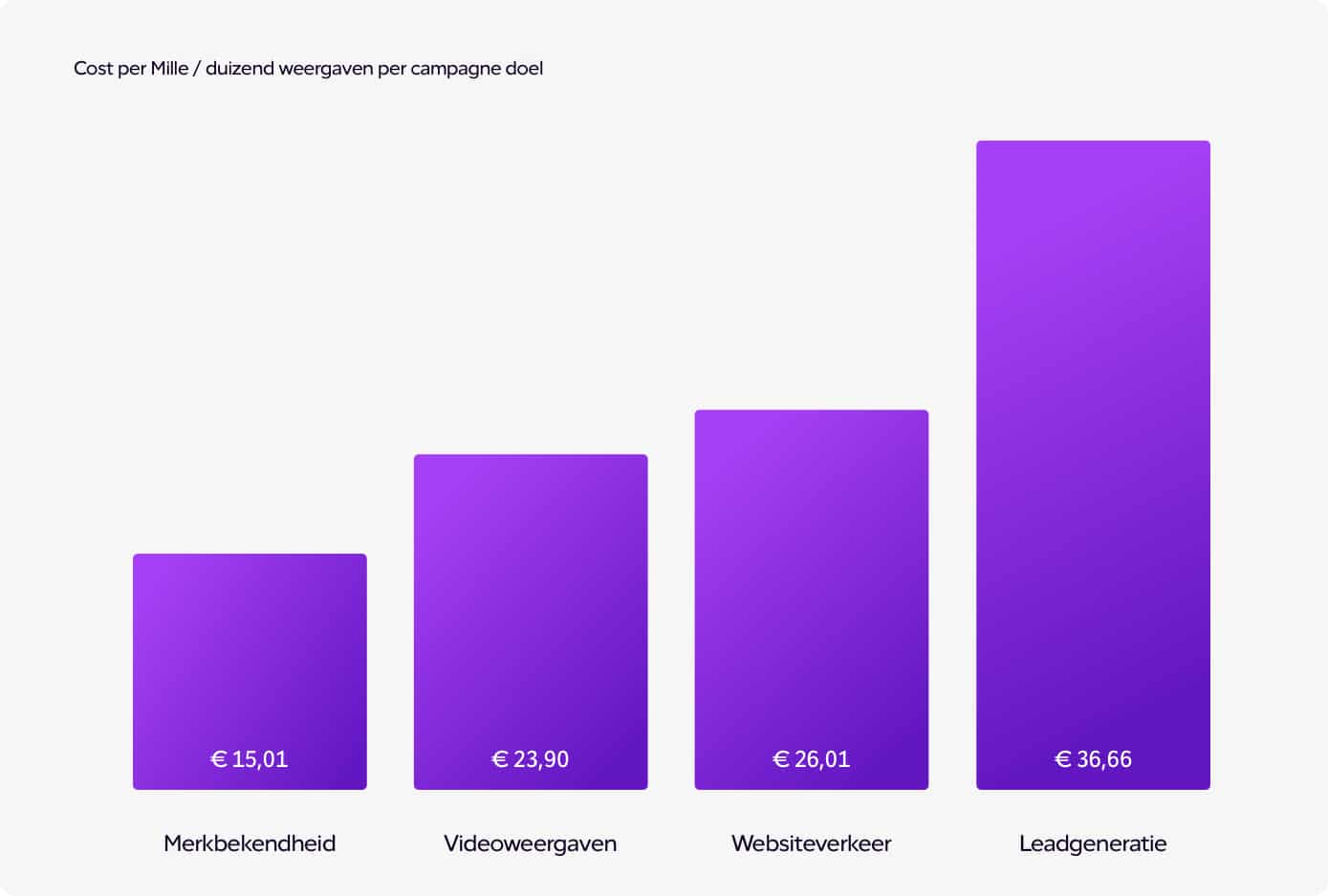
The graphic above is unfortunately outdated. For the most recent figures, please refer to our LinkedIn Benchmark.
To truly understand LinkedIn CPM, it’s important to know which factors influence it. We’ve already mentioned audience and competition, but those aren’t the only ones. These factors also affect your LinkedIn CPM:
Now that you understand what LinkedIn CPM is and how it works, you naturally want to know how to achieve a lower CPM for your campaigns. The most important tip we can give you is to optimize your target audience. Take advantage of the unique possibilities LinkedIn offers and define your audience as specifically as possible. Not only does this allow you to focus on the people most valuable to your campaign, but it also allows you to create highly specific ads. This immediately strengthens your ad relevance. From there, it is a matter of testing and optimizing. Consider the type of ad, your bidding strategy, campaign objective, and the timing of your advertising.
If you want to read more about LinkedIn CPM or the possibilities of LinkedIn, check out our page on LinkedIn advertising. Prefer to discuss the possibilities further? We are happy to share our knowledge and experience with LinkedIn campaigns for various B2B markets in a personal conversation.
More like this
Practical benchmarks for every LinkedIn campaign type in 2025, with a year-on-year comparison showing exactly what changed.
Read more
Video CPM has tripled, but engagement has strengthened. What does that mean for video as a format in your LinkedIn strategy?
Read more
The cost per click on LinkedIn has tripled. Understanding why requires looking at two forces that moved against advertisers at the same time.
Read more