LinkedIn Advertising Benchmark 2026: Results per € 1,000
Practical benchmarks for every LinkedIn campaign type in 2025, with a year-on-year comparison showing exactly what changed.
Read moreLinkedIn advertising costs: Expect an average of €16 for 1,000 impressions, but keep in mind this varies per target(audience)

What does advertising on LinkedIn cost? It’s a question we hear often, and we’re happy to provide the answer. LinkedIn is an outstanding advertising platform for reaching your B2B target audience. Let’s get straight to the point: yes, advertising on LinkedIn is more expensive than on Facebook or Instagram, and in many cases, it’s pricier than Google Ads too. And in 2025, it has become meaningfully more expensive than it was just two years ago. However, we believe it’s more than worth the investment, thanks to the unique way you can build and target your audience. Here is a deep dive into the costs of LinkedIn advertising, based on our 2026 LinkedIn Advertising benchmark.
While a simple answer is always efficient, it doesn’t tell the whole story because LinkedIn costs vary significantly depending on your campaign objective. To give you a clear picture, we’ve broken down the average costs per objective based on our benchmarks:
One thing is consistent across all objectives: costs have risen substantially since our previous benchmark. The median CPM across all campaigns has gone from around €26 in 2023/24 to €74 in 2025 — an increase of roughly 185%. The numbers below reflect what campaigns actually delivered in 2025. If you are working with expectations from previous years, they will need recalibrating.
If your goal is visibility and brand recognition, but you don’t necessarily require a click or an immediate action, you’ll likely choose a Brand Awareness campaign. LinkedIn’s algorithm will focus on showing your campaign as often as possible to maximise your reach.
On average, a campaign budget of €100 yields approximately 1,530 impressions, at a median CPM of €65. In 2023/24, the same budget delivered around 5,300 impressions at a CPM of roughly €19.
Brand awareness remains the most cost-efficient objective for generating raw impressions — its CPM is lower than website visits or lead generation. The median CTR of 0.46% means that roughly 7 in every 1,530 impressions result in a click of some kind, including profile views, page follows, and other engagement actions.
The CPM increase for brand awareness is partly driven by the growing use of highly specific audience targeting. Campaigns aimed at small, senior decision-maker audiences — common in Account Based Marketing strategies — carry a significant CPM premium compared to broader campaigns. Audience size and seniority are the two biggest cost drivers within this objective.
Is visibility — specifically views of your video — the primary goal? By choosing the Video Views objective, the algorithm seeks out people within your target audience who are most inclined to actually watch your video.
On average, a €100 campaign budget generates around 360 video views, at a median cost per view of €0.28.
The story for video in 2025 is more nuanced than the headline number suggests. In our 2023/24 benchmark, video carried the lowest CPM of any campaign type — making it a cost-efficient format for reach. In 2025, video CPM has risen to €91, in line with lead generation and above website visits. Video has lost its cost advantage as a reach format.
What has genuinely improved is engagement. The median video view rate — the share of impressions that result in a view — rose from 31% in 2023/24 to 38% in 2025. More than one in three people who see a video ad now watch it. LinkedIn counts a view when someone watches for more than 3 seconds, activates full screen, or plays audio. For cold audiences who are not yet familiar with your brand, or for complex propositions that take more than a static headline to explain, video remains a strong format — just at a higher price than before.
Is your focus on driving traffic to your site? In a Website Traffic campaign, the focus shifts to clicks. While impressions and reach are less of a priority here, they are still useful for comparison.
On average, a €100 campaign budget results in approximately 1,380 impressions and 3 to 4 clicks to your landing page, at a median cost per click of €29.
Website traffic is the campaign type that has changed most dramatically. In 2023/24, a €100 budget typically delivered around 19 landing page clicks at a CPC of roughly €5. In 2025, the same budget delivers 3 to 4 clicks — a reduction of more than 75%.
This is the compounded result of two forces moving against advertisers simultaneously: CPM has roughly doubled (+104%), and the median CTR has dropped from 0.69% to 0.27% (−61%). When impressions cost twice as much and fewer of them convert to clicks, the cost per click does not double — it nearly quintuples.
The practical implication is that the economics of website traffic campaigns now require careful scrutiny. A click that costs €29 needs to be assessed against your downstream conversion rate and the value of a customer. For companies where LinkedIn-sourced visitors convert at meaningfully higher rates than other channels, the case remains intact. For those running campaigns to generate volume traffic, the numbers warrant re-evaluation.
Perhaps the ultimate LinkedIn objective: Lead Generation. In our experience, this works exceptionally well for B2B companies. By offering your audience something of value — such as a white paper, factsheet, or e-book — you can capture their professional details directly through LinkedIn’s native lead forms.
On average, a €100 campaign budget generates approximately 0.5 leads, at a median cost per lead of €207.
In 2023/24, the same budget typically produced around 1.3 leads at a cost of about €75 per lead. The cost per lead has roughly tripled.
A cost per lead of €207 needs to be assessed in the context of what LinkedIn leads are worth. For B2B companies selling complex, high-value solutions, a qualified lead from a senior decision-maker at a target account can easily justify this — particularly compared to the fully-loaded cost of other demand generation channels. For companies with shorter sales cycles or lower deal values, the economics require more careful scrutiny.
One practical note: we generate almost all of our leads using LinkedIn’s native lead forms rather than directing people to an external landing page. In our experience, this consistently produces higher completion rates — the friction of leaving LinkedIn is removed, and form fields are often pre-populated from the member’s profile. If you are currently sending traffic to a landing page for lead generation, testing native lead forms is the single change most likely to improve your cost per lead without changing anything else.
As you’ve seen, costs have risen significantly across every objective. The median CPM has increased by around 185% since our 2023/24 benchmark, and cost per click and cost per lead have followed. Understanding these numbers is important — not to discourage LinkedIn investment, but to set the right expectations before a campaign launches.
We also continue to see significant variation within each objective, based on geography, audience seniority, audience size, and content format. Campaigns targeting senior decision-makers in small, specific account lists carry a substantial CPM premium over broader campaigns. This is not a flaw in the platform — it is the price of precise, high-quality reach.
Despite the higher price tag, advertising on LinkedIn remains one of the most effective tools for B2B marketers. No other paid channel offers the same combination of professional audience targeting, seniority filters, and native lead generation. The quality of the audience has not changed — only the cost of reaching it.
Cost is a major factor, but it shouldn’t be the only one. Consider the potential return, the precision of your targeting, and whether you could reach this exact professional audience elsewhere for less.
In 2025, the lever that matters most is efficiency within the campaign itself. Creative that generates a higher CTR directly reduces your CPC. A lead form that converts more impressions directly reduces your CPL. Because each impression now costs more, the quality of every element in your campaign — targeting, creative, offer, format — carries more weight than it did when costs were lower.
When we manage and optimise campaigns, we look far beyond just the spend. We focus on best practices for audience segmentation, campaign structure, and high-impact creative. We’re always happy to start a conversation to discuss how to balance these costs with your specific KPIs.
Want to go deeper? We publish regular benchmark data and strategic analysis. Our full 2026 LinkedIn Advertising Benchmark covers results per €1,000 across all objectives with detailed year-on-year comparisons. Feel free to explore our other articles on LinkedIn advertising where we regularly share new data and strategic insights.
More like this
Practical benchmarks for every LinkedIn campaign type in 2025, with a year-on-year comparison showing exactly what changed.
Read more
Video CPM has tripled, but engagement has strengthened. What does that mean for video as a format in your LinkedIn strategy?
Read more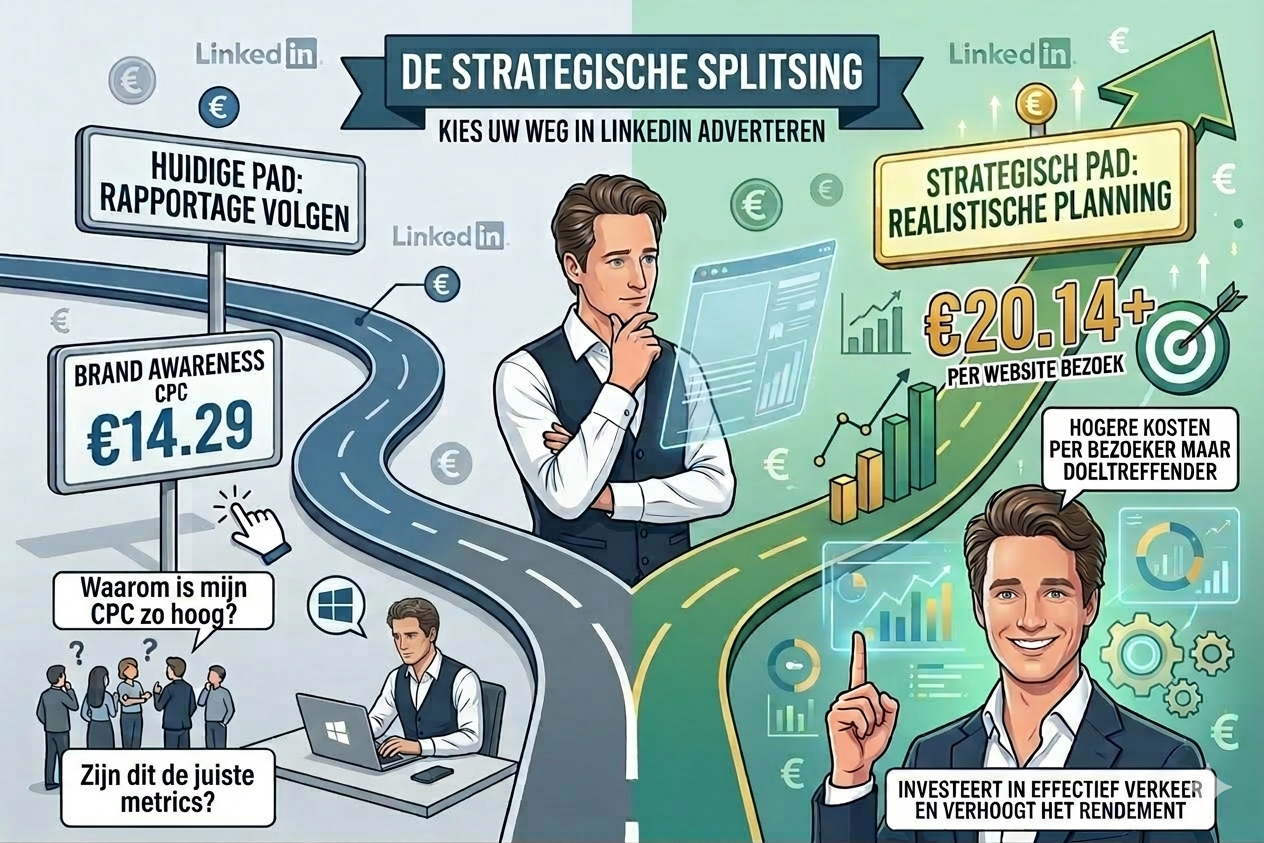
The cost per click on LinkedIn has tripled. Understanding why requires looking at two forces that moved against advertisers at the same time.
Read more