LinkedIn Advertising Benchmark 2026: Video – Is the cost advantage gone?
Video CPM has tripled, but engagement has strengthened. What does that mean for video as a format in your LinkedIn strategy? In our last benchmark, we concluded that LinkedIn was actively pushing the video ad format by offering a cheaper CPM compared to other campaign types. So, in this article, we’re diving into the changes, looking at how to still make an impact with video ads and answer the question: when do you use video in your campaigns?

Video in 2025: a changing equation
For two years, video was the cost-efficient choice on LinkedIn Advertising. In 2024, video CPM was lower than every other campaign type — making it the most affordable format for reach and brand building. Advertisers who wanted to maximise impressions for a given budget had a clear case for video.
In 2025, that advantage disappeared. Video CPM rose from €25.92 to €90.84 — a 251% increase, the sharpest rise of any campaign type in our benchmark. Video now sits at roughly the same cost level as lead generation and above website visits. The cost argument for video has changed fundamentally.
But cost is only one side of the equation. The other side — engagement — moved in the opposite direction. The median video view rate increased from 31.3% to 37.6%, meaning more than one in three people who see a video ad now watch it. In a more expensive, more competitive environment, video continues to earn genuine attention at a rate that other formats do not match.
LinkedIn Advertising 2026 video benchmark
Based on the video campaigns in our 2025 dataset, the key performance figures are:
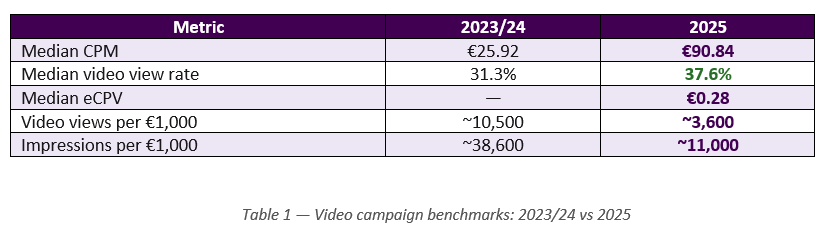
The median eCPV (effective cost per view) in 2025 was €0.28 — meaning each view of your video cost approximately 28 cents. Given that LinkedIn counts a view after just 3 seconds of watching, this is a relatively demanding standard: it excludes anyone who scrolled past without stopping. An eCPV of €0.28 reflects the higher CPM environment, partially offset by the improved view rate.
What counts as a video view on LinkedIn?
LinkedIn’s definition of a video view is stricter than it may appear. A view is counted when one of the following occurs:
- The video plays for longer than 3 continuous seconds
- The viewer activates full-screen mode
- The viewer turns on audio (videos autoplay silently in the feed)
This means that someone who pauses briefly on your video but moves on in under three seconds is not counted as a view. The 37.6% view rate therefore represents people who made a deliberate choice to engage with the content — not passive exposure.
Videos autoplay silently as members scroll through their feed. The vast majority of views begin without sound. This has a practical implication for creative: the opening seconds of a video must communicate something meaningful visually, without relying on audio. Captions, motion graphics, and strong visual contrast perform better in feed environments than content that requires sound to understand.
The view completion funnel
Beyond the headline view rate, the completion data reveals how deeply audiences engage with video content. The figures below show the percentage of total impressions that reached each milestone:
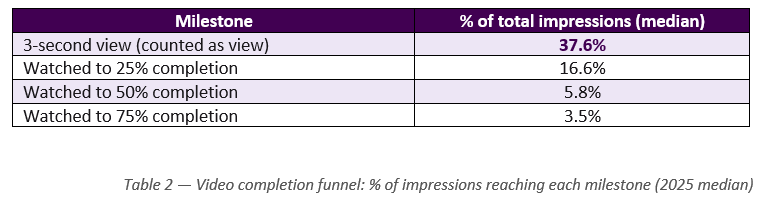
The drop-off between the initial view (37.6%) and the 25% completion mark (16.6%) is significant. Of everyone who watched at least 3 seconds, fewer than half continued to the 25% mark. By 50%, only about one in six initial viewers remained; by 75%, roughly one in ten.
This pattern is typical of video in feed environments and is not unique to LinkedIn. Audiences make rapid judgements about whether content is worth their time, and most decisions to continue watching — or stop — happen in the first few seconds. The completion funnel underscores the importance of front-loading your message: the most critical information, the clearest value proposition, or the strongest hook should come in the opening moments, not after a slow build.
It also informs how to interpret the view rate. A 37.6% view rate is a strong signal of initial interest — but it does not mean 37.6% of your audience absorbed a full-length message. For longer-form content (60 seconds or more), the effective reach of the complete message is substantially smaller than the headline view count suggests.
Why video CPM tripled
Video campaigns in LinkedIn’s ad auction do not compete in a separate silo from other campaign types. They bid for the same impressions against the same target audiences as sponsored content, document ads, and other formats. As the overall LinkedIn auction became more competitive in 2025 — driven by growing B2B advertiser adoption and increased budget recovery post-2022 — video CPM rose alongside all other formats.
In 2024, video may have had a lower CPM partly because fewer advertisers were running video campaigns with sufficient production quality, and partly because the format was less proven as a B2B performance channel. As video matured and more advertisers entered, that pricing gap closed. The 2025 data suggests video CPM has now converged with other formats.
The audience size and seniority dynamics that affect CPM for all campaign types apply equally to video. Video campaigns targeting senior decision-maker audiences or narrow account lists will face the same CPM premium as any other format aimed at those audiences.
Video versus static formats: what the data shows
Now that video CPM sits at roughly the same level as other campaign types, the case for video rests entirely on what it delivers differently — not on cost efficiency.
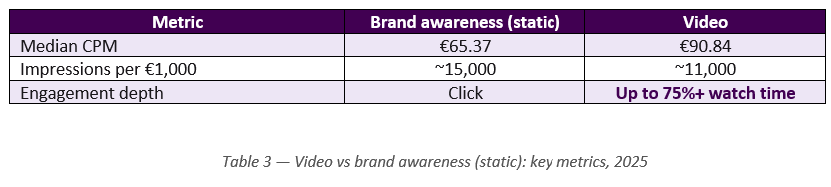
Video costs more per impression than static brand awareness content (€90.84 vs €65.37 CPM), meaning it delivers fewer impressions for the same budget. The trade-off is depth: a video view — even at 3 seconds — represents a qualitatively different form of engagement than an impression of a static image. For audiences at the very top of the funnel who have no prior familiarity with your brand, video’s ability to convey personality, context, and narrative in a short window is a genuine advantage.
For audiences already familiar with your brand — or in campaign types focused on conversion rather than awareness — the additional CPM cost of video is harder to justify. Static formats with compelling creative can drive equivalent CTR at a lower cost per impression.
When video makes sense in a LinkedIn strategy
Given the cost and engagement profile, video is best suited to specific points in a campaign strategy:
- Top-of-funnel audience warming. For audiences who do not yet know your brand, video can establish identity, tone, and credibility more efficiently than static content. A short, well-produced video can do in 15 seconds what a series of static impressions builds over weeks.
- Complex or nuanced propositions. For complex B2B propositions that are difficult to convey in a single image and headline, video provides the space to explain the problem, the solution, and the proof — in an engaging format that holds attention better than text-heavy alternatives.
- Social proof and testimonials. Customer testimonials, case study interviews, and behind-the-scenes content build trust in ways that static creative cannot. Video is the natural format for this type of social proof, and a 37.6% view rate suggests these formats do find willing audiences.
- Retargeting sequences. Video and static campaigns can be sequenced so that members who watched a video ad are subsequently targeted with a more direct message — website visit or lead generation. The video builds context; the follow-up converts. This approach makes the cost of video more accountable by attributing downstream conversions to the awareness it created.
Getting the most from video on LinkedIn
The completion funnel data and the silent autoplay context have direct implications for how video should be produced for LinkedIn. Based on our 2025 campaign data, the following principles consistently support strong view rates:
- Design for silent viewing. Most viewers will never turn on sound. The opening seconds must communicate something meaningful through motion, text overlay, or visual storytelling alone. Do not open with a speaker talking to camera without captions.
- Front-load the message. Completion data drops sharply after the first few seconds. If your video contains one key message, it should appear in the first 5–10 seconds — not after a build-up. Treat the opening as both the hook and the payload.
- Keep it short. In feed environments, videos under 30 seconds consistently outperform longer content on completion metrics. Save longer formats for retargeting audiences who have already shown interest.
- Native-looking content performs. LinkedIn’s feed is predominantly professional content. Videos that look like advertising are scrolled past more readily. Content that looks native — interview format, screen recording, whiteboard — tends to earn more initial attention.