LinkedIn Advertising Benchmark 2026: Results per € 1,000
Practical benchmarks for every LinkedIn campaign type in 2025, with a year-on-year comparison showing exactly what changed.
Read more
Website visits CTR has dropped 61% since 2023/24 — from a median of 0.69% to just 0.27%. And here’s the thing: it’s not because campaigns got worse. The entire distribution shifted down. The best-performing website visits campaign in 2025 had a CTR of 0.65%. Two years ago, that would have been a below-average result. In this article, I’ll use our benchmark to show what happened and what you can do about it.
Of course, there’s more to LinkedIn Advertising than website traffic campaigns. But I didn’t want to bury the headline. So, let’s dive in to the CTR of LinkedIn Advertising.
What percentage of your LinkedIn ad impressions actually lead to a click? That is what the Click Through Rate (CTR) measures, and it is one of the first KPIs we look at in any campaign. A high CTR signals that your audience finds your ad relevant and compelling. A low CTR is a prompt to investigate — the creative, the message, the targeting, or increasingly in 2025, something outside your control entirely.
Our 2025 benchmark data, based on campaigns across clients in Western Europe, tells a clear story: CTR has declined significantly compared to 2023 and 2024 — especially for website visits campaigns. And when you look closely at why, the explanation points less at campaign quality and more at a structural shift in how LinkedIn itself treats outbound clicks.
Before getting into the year-over-year story, here are the CTR benchmarks for 2025 by campaign objective.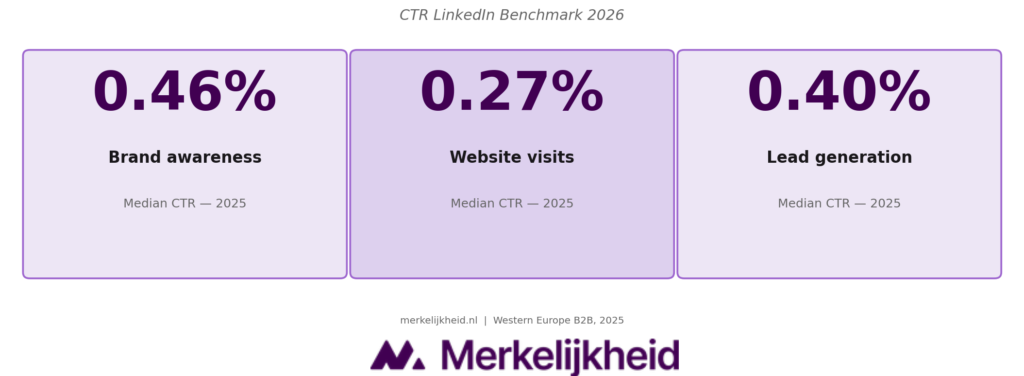
Brand awareness campaigns (median CTR 0.46%, 75% of campaigns between 0.31% and 0.67%): CTR here is calculated on all clicks — including clicks to your LinkedIn company page, reactions, and follows. The number of people actually clicking through to your website is lower, something we explore below.
Website visits campaigns (median CTR 0.27%, 75% of campaigns between 0.19% and 0.31%): Here, only a click to your website counts. This is the most directly comparable figure to what most advertisers think of as CTR.
Lead generation campaigns (median CTR 0.40%, 75% of campaigns between 0.32% and 0.48%): CTR here reflects clicks that open the lead form. We use native LinkedIn lead forms for virtually all lead generation campaigns — not landing pages — which is important context for interpreting this number.
LinkedIn calculates CTR differently depending on the campaign objective, which makes direct comparisons between campaign types misleading if you are not careful.
For brand awareness campaigns, CTR includes every type of click: clicks to your website, clicks to your LinkedIn company page, reactions, follows. For website visits campaigns, only the click to your website counts. This means a brand awareness CTR of 0.46% and a website visits CTR of 0.27% are not measuring the same thing.
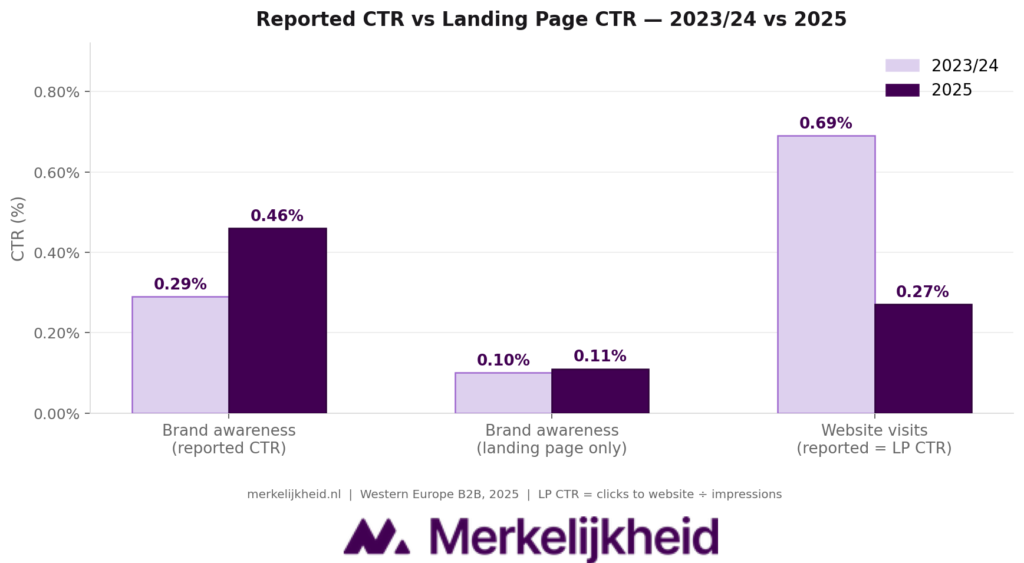
When we strip this back and calculate a landing page CTR for brand awareness — that is, clicks to the actual website divided by impressions — the picture changes:
Or as a table:
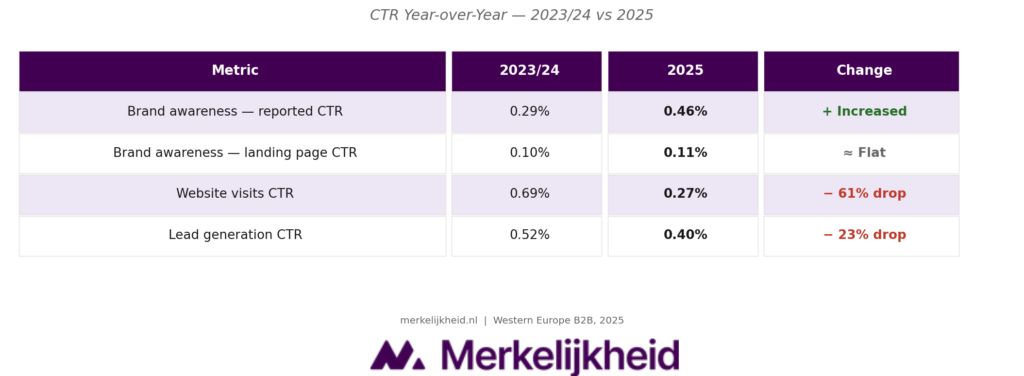
Only about one in four clicks from a brand awareness campaign actually goes to your website. The rest go to your LinkedIn page or represent other engagement. This is worth bearing in mind when setting expectations for brand awareness campaigns as a traffic driver — that is not really what they are for.
With a like-for-like comparison in hand — using landing page clicks for brand awareness and the reported CTR for website visits and lead generation — here is how 2025 compares to 2023/24:
The reported brand awareness CTR has actually increased, from 0.29% to 0.46%. But the landing page CTR — the number that actually matters for website traffic — has barely moved: 0.10% to 0.11%. More people are engaging with brand awareness ads in other ways (company page visits, reactions), but the proportion clicking through to the website has stayed essentially flat.
The real story is website visits: a 61% decline in CTR, from a median of 0.69% in 2023/24 to 0.27% in 2025. Combined with a CPM that has roughly doubled in the same period, this has driven the cost per landing page click up by nearly five times.
There is no single answer, but we believe it is a combination of two reinforcing factors — one structural, one behavioural.
Over the past couple of years, LinkedIn has made a series of changes that signal a clear platform preference: keep users on LinkedIn. Organically, posts that include external links are suppressed in the algorithm — they simply reach fewer people. LinkedIn has also experimented with post formats that make links less prominent and less clickable.
It is reasonable to assume that the same logic extends to the advertising side. You are paying significantly more in CPM than you were two years ago, and receiving fewer clicks per impression in return. The platform is charging more to reach the same people and simultaneously nudging those people away from leaving. That is not a coincidence — it is the direction LinkedIn is heading as a platform.
LinkedIn’s advertising volume has grown substantially. More advertisers are competing for the same feed positions, which means users are seeing more ads. The result is a well-documented phenomenon: ad fatigue. Users become less responsive to ads in general, and the bar for earning a click gets higher.
This shows up clearly in our data. The CTR distribution for website visits campaigns has not just shifted down — the ceiling has dropped. The best-performing website visits campaign in 2025 had a CTR of 0.65%. In 2023/24, that would have been a below-average result. Even highly optimised or aggressive campaigns are working within a structurally lower range than before.
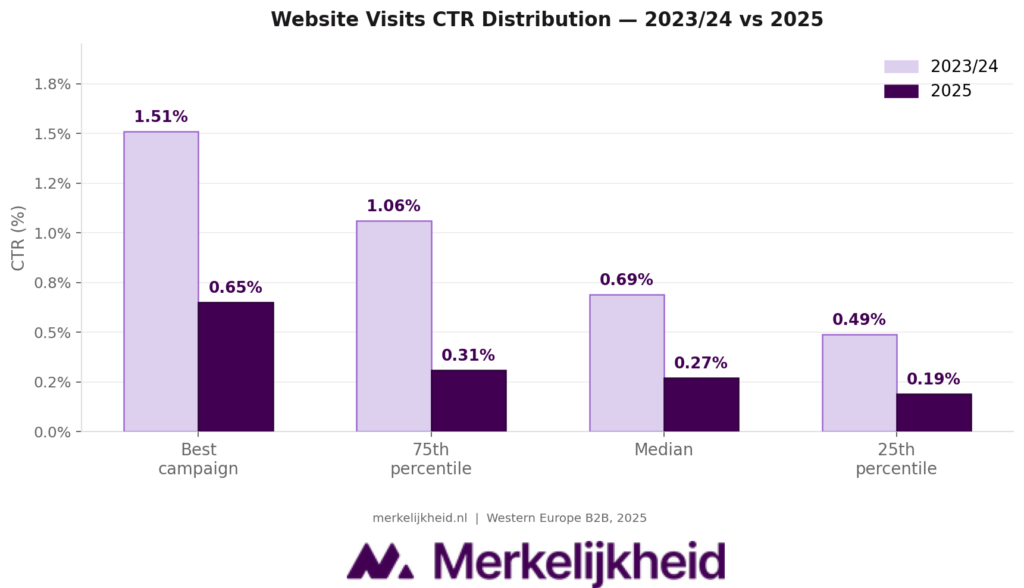
Creative quality and targeting still matter — there is a roughly 3x difference between the 10th and 90th percentile within 2025 data. But optimising your way out of this structural decline is not realistic. The whole market has moved.
The decline in website visits CTR is not primarily a creative problem. It is a platform problem. LinkedIn is deprioritising the behaviour you are trying to drive — clicks away from LinkedIn — both organically and in advertising.
That has a few practical implications:
The 2025 CTR benchmark is not a sign that LinkedIn advertising has stopped working. It is a signal that the platform has changed, and that the strategies that worked in 2023 need updating. The advertisers who adapt — by leaning into lead forms, investing in brand awareness, and calibrating their budget expectations — will be better positioned than those waiting for CTR to return to where it was.
Of course, we are servicing a specific type of client. And our campaigns are now more targeted than before. But what we’re seeing is very consistent across markets, audiences and clients. So, do you see the same thing?
More like this
Practical benchmarks for every LinkedIn campaign type in 2025, with a year-on-year comparison showing exactly what changed.
Read more
Video CPM has tripled, but engagement has strengthened. What does that mean for video as a format in your LinkedIn strategy?
Read more
The cost per click on LinkedIn has tripled. Understanding why requires looking at two forces that moved against advertisers at the same time.
Read more