LinkedIn Advertising Benchmark 2026: Results per € 1,000
Practical benchmarks for every LinkedIn campaign type in 2025, with a year-on-year comparison showing exactly what changed.
Lees meerHas LinkedIn Advertising become too expensive? In this article, we determine if CPM has made the platform's price prohibitive.

Has LinkedIn Advertising become too expensive? That’s probably the first question that pops up in your head. The answer is that I don’t think so. For years, LinkedIn Advertising was simply extremely effective. And now, the price has simply caught up to its potential somewhat.
In this article, we’re detailing our findings based on the campaigns Merkelijkheid ran in 2025. These were all campaigns for B2B clients in Western Europe, most of them targeting the Netherlands and we did have a tendency toward more focused (smaller) target audiences. So, for you, the CPM may be different, but I’m certain it will trend the same. I hope this benchmark will help you plan and execute your own LinkedIn Advertising campaigns more efficiently.
CPM — cost per mille, or cost per 1,000 impressions — is the core pricing metric for LinkedIn advertising. Unlike Google Ads, where advertisers bid on clicks and pay a cost per click (CPC), LinkedIn’s auction is fundamentally impression-based. You are not bidding to generate a click or a lead. You are bidding to show your ad to a specific audience — and you pay for every 1,000 times it is shown, regardless of what happens next.
This distinction is important. Two campaigns running on the same target audience will face the same CPM auction and pay the same effective rate per impression. But their results can differ dramatically: one might generate a click-through rate twice that of the other, leading to radically different cost-per-click or cost-per-lead figures. CPM itself will not change. The implication is that CPM is a fixed input — determined by your audience selection — while creative quality and relevance determine what you get out of each impression.
This also means that CPM is largely outside your direct control once you have defined your audience. LinkedIn’s auction operates invisibly: the price you pay is set by what every other advertiser competing for that same audience is willing to spend. Your only lever is audience definition. Choose a competitive audience and your CPM will be high. Choose a less-contested one and it will be lower — even if the audience size is similar.
The cost of advertising on LinkedIn has risen sharply. In 2025, the median CPM was €73.83 across all campaign types. In 2023/24, that figure was €25.92 — a 185% increase over two years.
The increase is not uniform. Website visits and lead generation campaigns roughly doubled in cost. Brand awareness campaigns nearly tripled. The message is clear: attention on LinkedIn has become substantially more expensive, regardless of what you are advertising.
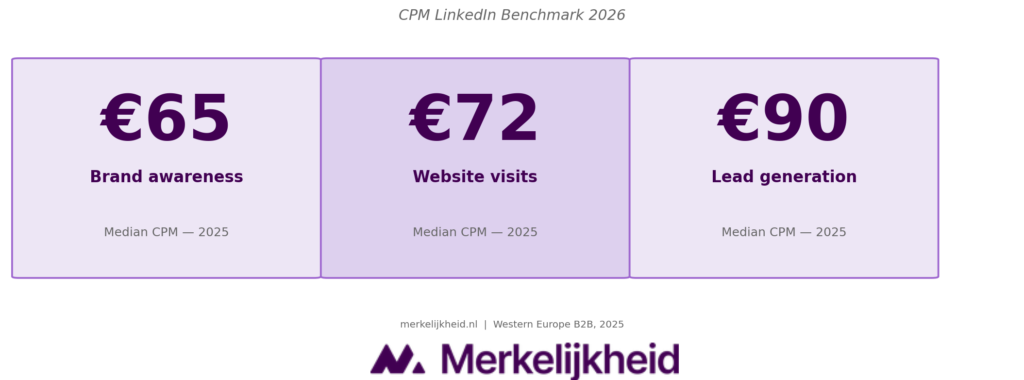
Across the campaigns analysed in 2025, lead generation was the most expensive objective with a median CPM of €89.57. Brand awareness and website visits sat closer together at €65.37 and €72.44 respectively.
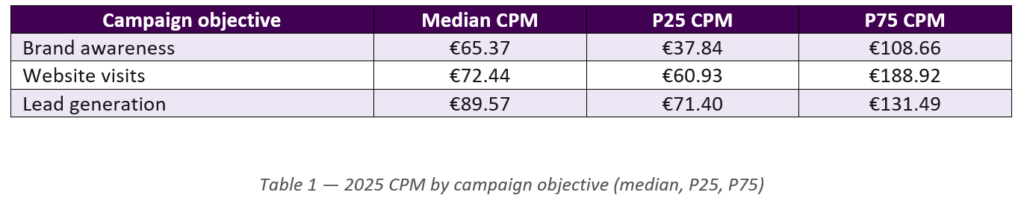
The table includes P25 and P75 values alongside the median. These are percentile figures: P25 is the point below which 25% of campaigns fall, and P75 is the point above which 25% fall. In plain terms, P25 is the lower end of the typical range and P75 is the upper end. Half of all campaigns land somewhere between the two. The wider the gap between P25 and P75, the more variable the CPM is within that objective — meaning campaign characteristics such as audience definition, seniority targeting, and geographic focus make a significant difference to what you pay.
The website visits objective shows the widest spread (€61 to €189), reflecting the variety of targeting approaches used within it — from broad industry audiences to tightly defined account lists. This spread is explored further in the audience sections below.
The comparison with our 2023/24 benchmark data reveals the scale of the price increase. Every campaign objective saw its median CPM at least double over this period.
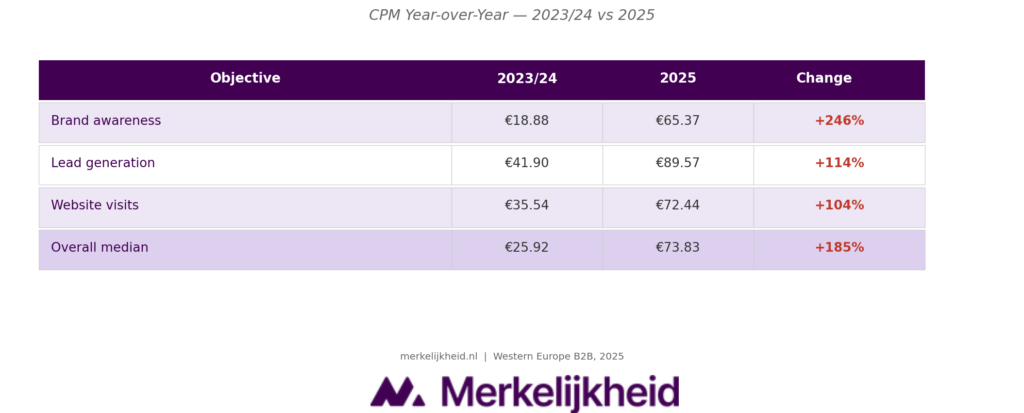
Brand awareness stands out as the sharpest mover: up 246% from a median of €18.88 to €65.37. This is partly a function of how brand awareness campaigns are priced — LinkedIn charges for reach rather than action — but the magnitude of the increase goes well beyond any structural explanation. The cost floor has simply shifted upward.
Website visits and lead generation show increases of roughly 104% and 114% respectively. While less extreme, these also represent a fundamental step-change in what B2B advertisers must now budget for each impression.
One factor that contributes to elevated CPMs is audience size. LinkedIn’s auction mechanics mean that smaller, more competitive audiences attract higher bids from multiple advertisers, driving up the clearing price. The 2025 data supports this — campaigns targeting fewer than 1,000 people paid a median CPM of €107.85, compared to €61.18 for campaigns above 10,000:
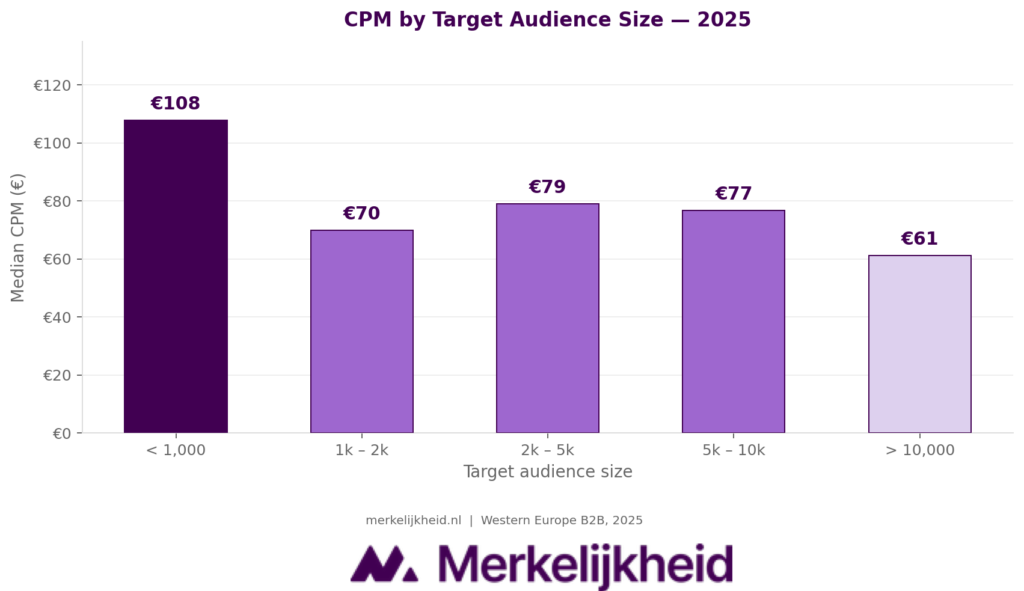
The effect is particularly pronounced for brand awareness: sub-1,000 audiences had a median CPM of €221, compared to €34 for audiences above 10,000 — a difference of over 6x.
It is important to note that this comparison cannot be made against 2023/24 data, as audience size was not recorded in the earlier benchmark dataset. We cannot therefore determine whether the audience size premium has grown over time, or whether it is a stable structural feature of LinkedIn’s auction.
What the data does show is that the overall CPM increase is not entirely explained by a shift towards smaller audiences. Even when campaigns with CPMs above €200 are excluded — removing most extreme outliers — the baseline CPM across all audience segments (€68–73) is still nearly three times the 2023/24 overall median (€25.92). The price increase is structural, not compositional.
Audience size is only part of the story. The composition of the audience — specifically the seniority and role of the people being targeted — has an equally significant effect on CPM. This is something we have observed directly in our own campaigns.
As part of a shift towards Account Based Marketing (ABM), we have increasingly been targeting senior Decision Making Unit (DMU) members: C-suite executives, VPs, and directors at specific target accounts. These are among the most commercially sought-after audiences on LinkedIn. Every major B2B advertiser is competing for the same small group of people, which pushes auction prices up significantly — independent of how large or small the overall audience is.
Conversely, campaigns targeting a broader spread of job titles and seniority levels — including mid-level roles — have produced noticeably lower CPMs, even when the raw audience size was comparable. The competition for a senior VP of Finance at a specific target account is simply far more intense than the competition for a financial analyst in the same industry.
This means that two campaigns with similar audience sizes can produce very different CPMs depending on the seniority profile being targeted. When planning ABM programmes, this premium should be treated as a given — not as a signal that something has gone wrong with the campaign.
The most expensive campaigns in the dataset combine both factors: small audience size and senior seniority targeting, often within a specific geography. The most expensive campaign in CPM terms reached a regional Belgian audience of 670 people at a CPM of €776.80 — over ten times the overall median. Swiss market campaigns with similarly specific audiences saw CPMs above €300.
These are not outliers to be dismissed. They reflect a real and predictable outcome of targeting scarce, high-value audiences. Advertisers running account-based programmes or activating in small markets should plan for this as a structural cost, not an anomaly.
LinkedIn operates a real-time auction for advertising inventory. CPM is not set by LinkedIn directly — it emerges from what advertisers collectively bid for the available impressions. When more money competes for the same inventory, prices rise.
Several factors are likely compressing supply and inflating demand simultaneously:
The practical consequence of doubling CPMs is straightforward: the same budget now buys roughly half as many impressions as it did in 2023/24. For advertisers used to LinkedIn performance from two or three years ago, current campaigns will appear to underperform on reach without any change in campaign quality.
Because CPM is determined by your audience selection and the auction that follows, it cannot be optimised directly through bid adjustments in the same way as CPC-based platforms. The most effective lever is audience design: who you target, how broadly, and at what seniority level. Budget planning should now anchor to current benchmarks rather than historical baselines.
Verder lezen
Practical benchmarks for every LinkedIn campaign type in 2025, with a year-on-year comparison showing exactly what changed.
Lees meer
Video CPM has tripled, but engagement has strengthened. What does that mean for video as a format in your LinkedIn strategy?
Lees meer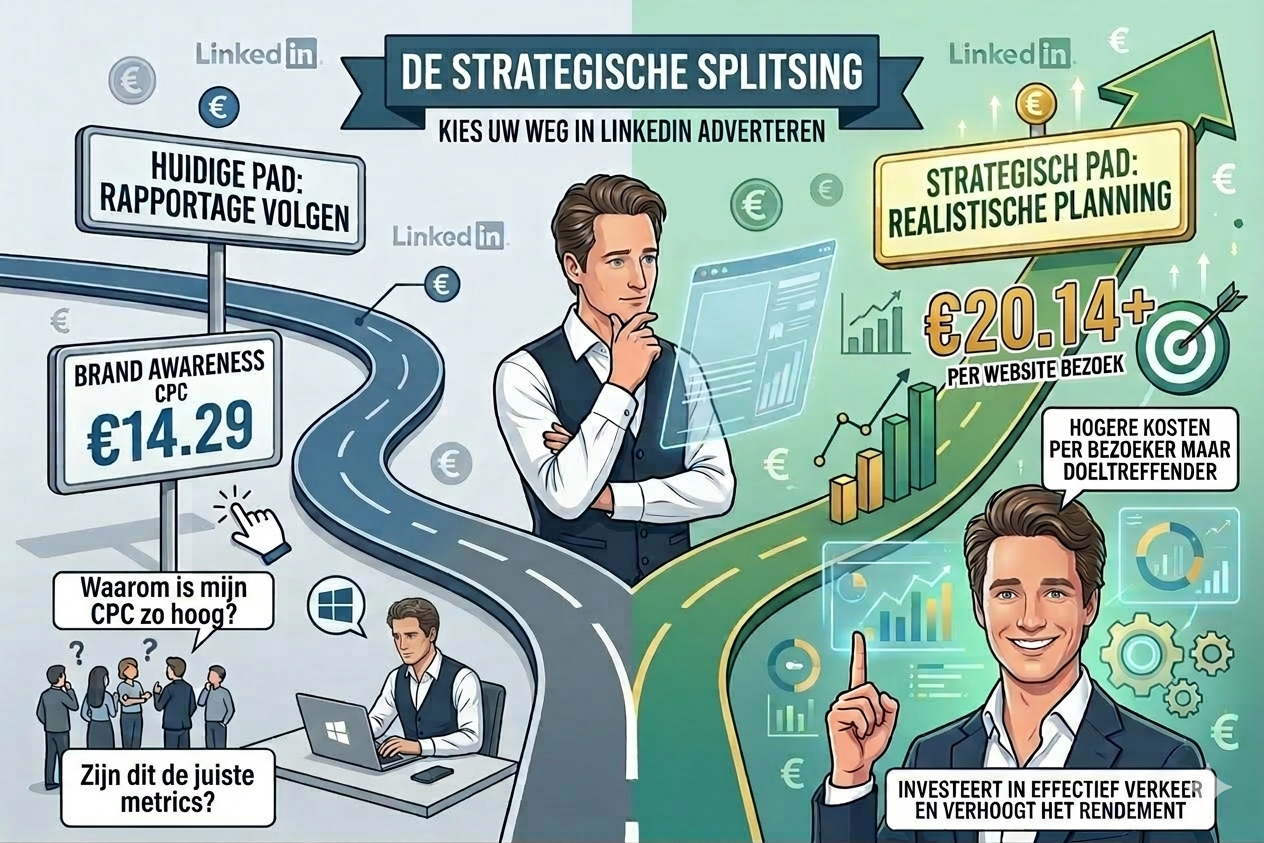
The cost per click on LinkedIn has tripled. Understanding why requires looking at two forces that moved against advertisers at the same time.
Lees meer