LinkedIn Advertising Benchmark 2026: Results per € 1,000
Practical benchmarks for every LinkedIn campaign type in 2025, with a year-on-year comparison showing exactly what changed.
Read moreThe cost per click on LinkedIn has tripled. Understanding why requires looking at two forces that moved against advertisers at the same time.
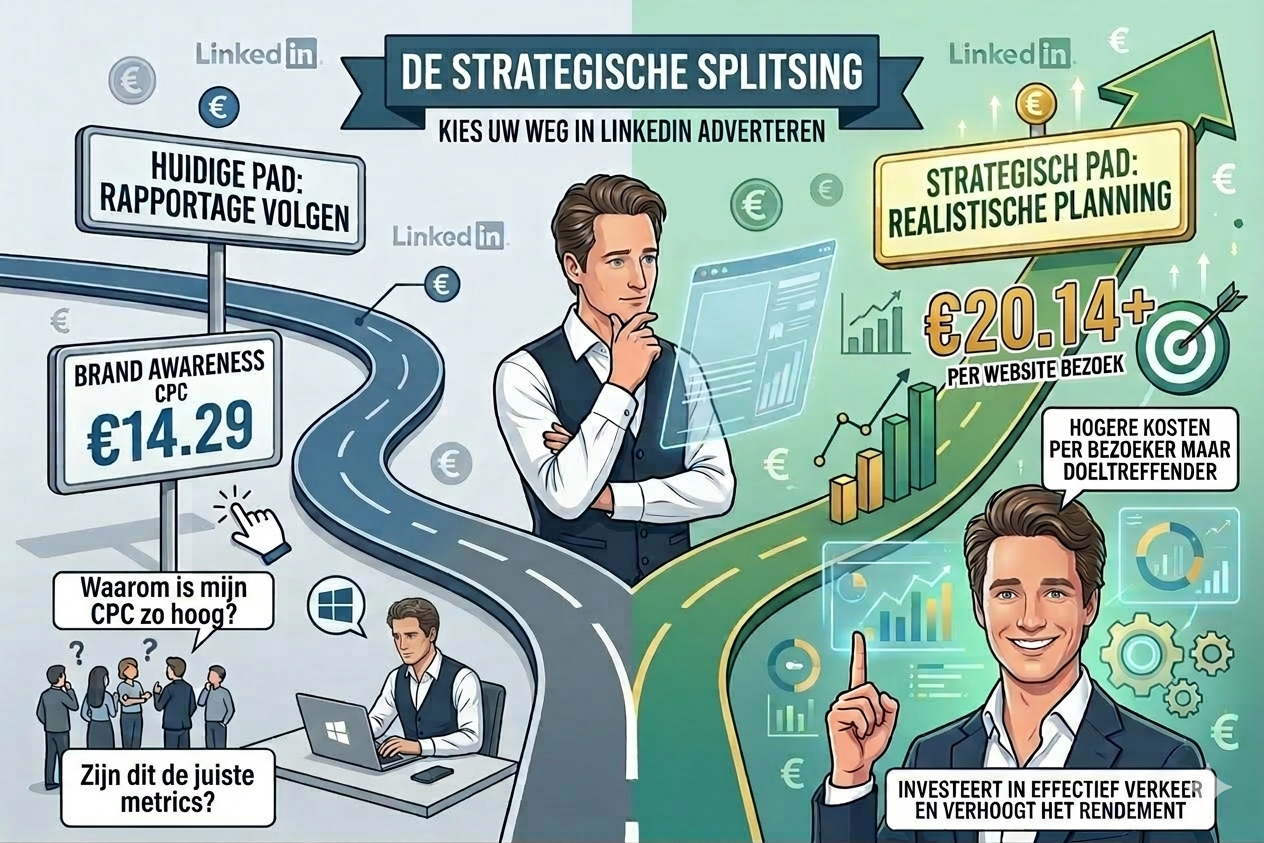
The cost per click on LinkedIn has tripled. For website visits campaigns, it has nearly quintupled. Understanding why requires looking at two forces that moved against advertisers at the same time. So, that’s what we’ll do in this article that is part of our series about our 2026 LinkedIn Advertising Benchmark.
Cost per click (CPC) is often treated as a primary performance indicator. In practice, it is a derived figure — the result of dividing CPM by CTR, scaled to a per-click basis:
CPC = CPM ÷ (CTR × 1,000)
This relationship has a direct practical consequence: CPC can increase for two entirely different reasons. It rises when impressions become more expensive (CPM up), and it rises when those impressions are less likely to generate a click (CTR down). When both happen simultaneously, the effect is multiplicative — not additive.
This is exactly what happened between 2023/24 and 2025. CPM roughly doubled or more across all campaign types. CTR declined, particularly for website visits campaigns. The combined effect drove CPC increases that far exceeded what either factor alone would produce. This means that having the right strategy and, sometimes even more crucial, having the right advertising creative, is more important than ever when LinkedIn advertising.
Across the campaigns with measurable click activity in 2025, the median CPC was €20.14. Website visits was the most expensive objective at €29.00, followed by lead generation at €20.79 and brand awareness at €14.29.
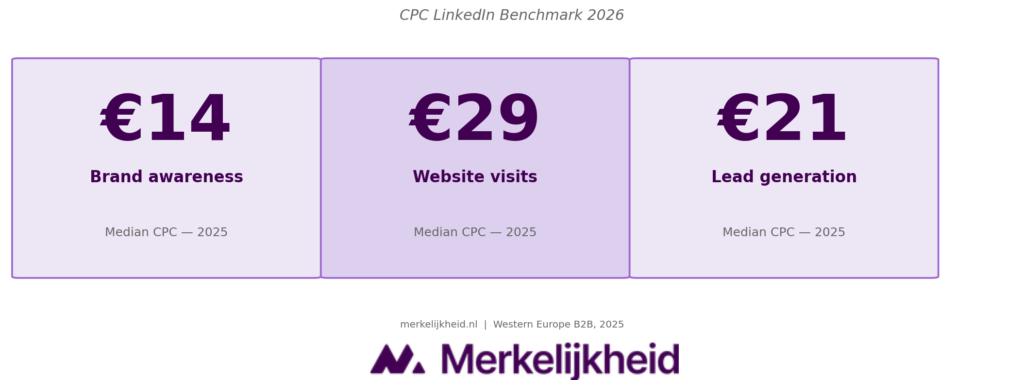
In more detail:
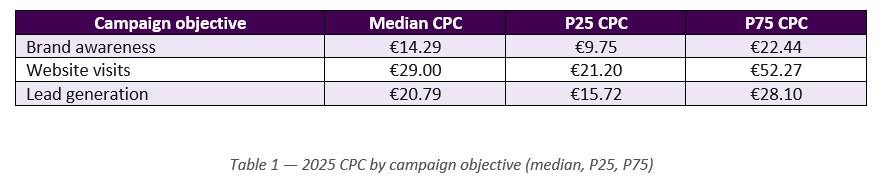
The website visits P75 of €52.27 deserves attention. A quarter of website visits campaigns cost more than €52 per click — a figure that would have been considered extreme two years ago. The spread between P25 (€21.20) and P75 (€52.27) reflects the compounded effect of audience targeting: campaigns using narrow, senior, or competitive audiences face both higher CPMs and often lower CTRs, pushing CPC upward from both ends.
The scale of the CPC increase only becomes clear against the 2023/24 benchmark. The overall median tripled from €6.58 to €20.14. But the per-objective picture is more striking:
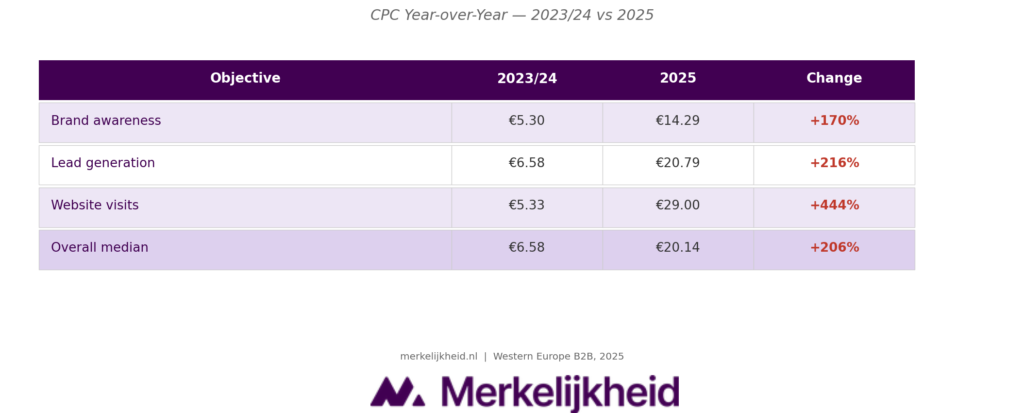
Website visits stands apart from the other objectives. A +444% increase — from a median of €5.33 to €29.00 — is not a marginal change in platform pricing. It is a fundamental shift in the economics of driving traffic from LinkedIn to an external website. Brand awareness and lead generation also increased substantially, but the website visits figure reflects the combined pressure of two compounding forces.
For website visits campaigns, CPC was hit by both inputs deteriorating at once. Recall the formula: CPC = CPM ÷ (CTR × 1,000). Between 2023/24 and 2025:
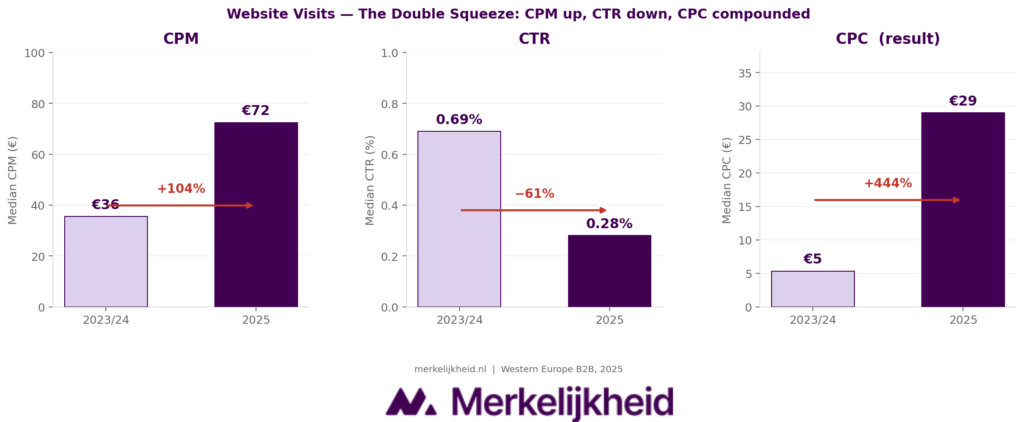
CPM doubled (+104%) while CTR fell by more than half (−61%). Individually, either change would have pushed CPC significantly upward. Together, their effect compounds: the cost of each impression rose, and each impression became far less likely to result in a click. The outcome is a CPC that is nearly five times what it was in 2023/24.
This is not a coincidence. Both forces are connected to the same underlying platform dynamic. As LinkedIn has grown more expensive to advertise on, and as the platform has algorithmically reduced the prominence of outbound-link content, website visits campaigns have been hit from both sides. The CPM article in this series addresses the cost side; the CTR article addresses the engagement side. For website visits, these two pressures converge most acutely.
Brand awareness CPC increased 170% — from €5.30 to €14.29. This increase is driven primarily by the CPM side: brand awareness CPM nearly tripled (+246%), while the CTR for brand awareness campaigns actually increased slightly in reported terms (though the landing page CTR remained flat, as detailed in the CTR article). The CPC for brand awareness is therefore mainly a reflection of rising impression costs.
Lead generation CPC rose 216% — from €6.58 to €20.79. This is a meaningful increase for a campaign type where the primary goal is lead volume rather than traffic. However, lead generation campaigns are less exposed to the CTR-driven squeeze that affected website visits, since their click behaviour is governed by lead form interactions rather than outbound link clicks. The CPM increase is the dominant driver here.
The reported CPC figure includes all clicks: clicks to the LinkedIn company page, follows, and other non-website interactions. For advertisers whose primary objective is driving traffic to their website, the more meaningful metric is the cost per landing page click — the cost of a click that actually reaches the destination URL.
For website visits campaigns, the reported CPC and the cost per landing page click are effectively the same, since virtually all clicks in that objective type go to the landing page. The median of €29.00 is the cost of bringing one visitor to the website.
For brand awareness campaigns, the picture is different. The median cost per landing page click in 2025 was €75.35 — more than five times the reported CPC of €14.29. This is because the majority of clicks on brand awareness ads do not go to the website. Only about one in five clicks from brand awareness campaigns results in a landing page visit. Advertisers using brand awareness as a traffic driver are paying a steep premium for each visitor delivered.
The CPC increase is real and structural. Budgets built on 2023/24 assumptions will now generate significantly fewer clicks for the same spend. Some practical considerations:
More like this
Practical benchmarks for every LinkedIn campaign type in 2025, with a year-on-year comparison showing exactly what changed.
Read more
Video CPM has tripled, but engagement has strengthened. What does that mean for video as a format in your LinkedIn strategy?
Read more