Brand Archetype Jester: the comedian among brands
Is your brand or company focused on playfully and cheerfully conveying your serious vision and mission and addressing issues? Do you present yourself in a funny, yet subtle and taboo-breaking way? There’s a good chance your company is the Jester brand archetype! Despite the name suggesting that these brands behave mostly silly and like a clown, that’s not what we mean by the Jester. The hallmark is that it uses humor to highlight a critical message that is bigger and goes beyond just the company or brand itself. And it is precisely through this approach that a Jester can go far in conveying their vision.
Jester Brand Archetype in Various Forms and Sizes

SMART and FIAT 500 were each the jester of their time
A Jester, also known as a fool in Dutch, is certainly not just crazy and funny. The Jester values that customers have a good time and relax; the key word is fun and humor. You shouldn’t take life and yourself too seriously and should have some self-mockery. When we look at the communications of Jester brands, we see that a serious message or even a bigger, sometimes societal, problem is addressed with a wink and humor. This is reflected not only in the company philosophy but – if done correctly and consistently – also in all communication, design, visual expressions, company culture, employment conditions, management, and employees.
The Jester makes life a bit lighter and knows how to put things into perspective. A Jester is honest, diplomatic, and charming. Although you might think you don’t have to take a fool too seriously, he definitely has an opinion or message and can even be critical.
The role of a fool is essentially that of a comedian. A comedian often talks about social relations and societal developments and gives his view on them through humor. The comedian of today is the fool of the past. The fool was the only one allowed to go against the king or express criticism. The rest were careful and only said yes and amen. There is a whole spectrum of nuances between a clown and a comedian.
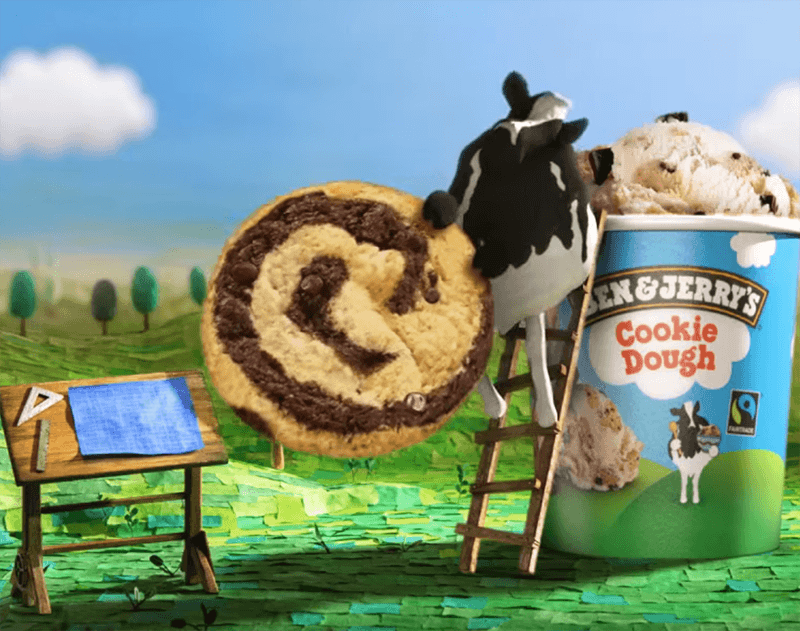
Funny, cheerful, and playful but often with a serious message
Ben & Jerry’s is, for example, a successful Jester. The design of their site and the tone of communication are cheerful, funny, and accessible. The serious undertone is that they are developing a system that ‘regenerates, enriches, and improves life; and not just causes less harm.’ A sentence typical for a Jester. Ben and Jerry’s serious message is to further explain the concept of fair trade, encourage its implementation, and counter polarization. Challenging other brands to uphold the same ideals, a call to the business world to work in a way that is ethical, sustainable, and profitable.
Now you might think: this is far from my world. I’m involved in something completely different than food or retail. Not B2C but B2B, please! Then definitely read on; below we elaborate on 2 examples that are a bit more relatable.

Jester brand archetype as a recruitment agency
Jester Brand Archetype Example in Business Services
YoungCapital is the Dutch temp and recruitment agency for young working Europe. They have more than 16,000 candidates working daily with an average age of 28 years. In 3 years, they grew from 500 to 1,300 employees across 28 different locations in the Netherlands. In 2018, they ranked number 5 among the fastest-growing companies. A good example of a business service provider for whom the Jester profile works excellently.
The problem YoungCapital addresses is the gap between student and professional and the stereotypical image of what exactly a millennial is. Recent graduates have little to no experience and must compete against Young Professionals with some (years of) experience. YoungCapital offers millennials the chance to gain experience and further develop into true professionals and successfully fills that gap; young people want to work for and employers want to work with YoungCapital.
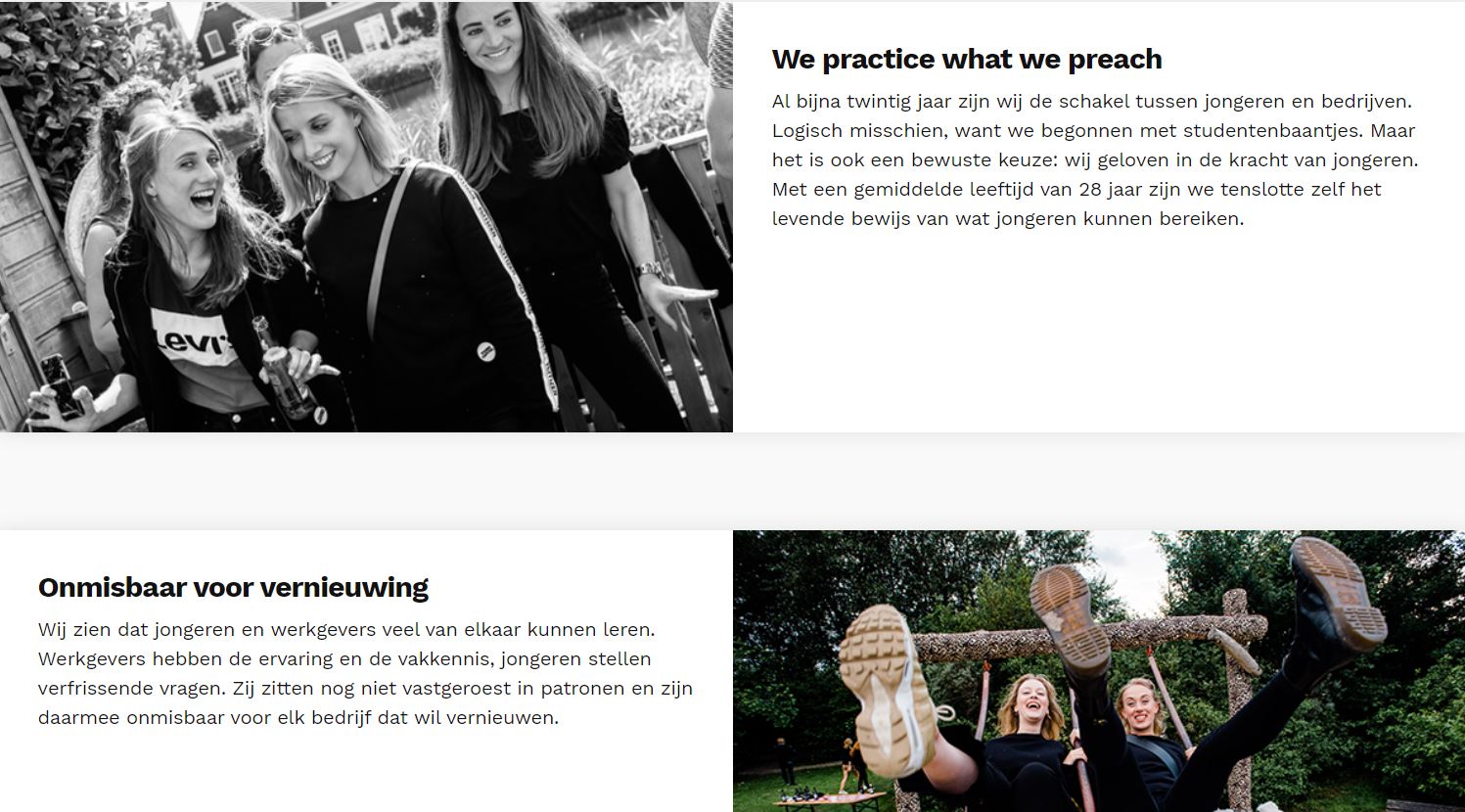
Website excerpt YoungCapital
Looking at the website, we see a sleek, more confident, and clearly present, somewhat loud visual language. Orange and black are the company colors, and headlines are placed in bold sans-serif uppercase letters on a contrasting rectangular background. Regarding photo usage, many young people are photographed in a casual and exuberantly laughing manner. It is clear they mainly draw from a self-made image bank with one clear style. This creates cohesion and calm on the site. The people in the photos radiate fun, freedom, and a certain nonchalance.
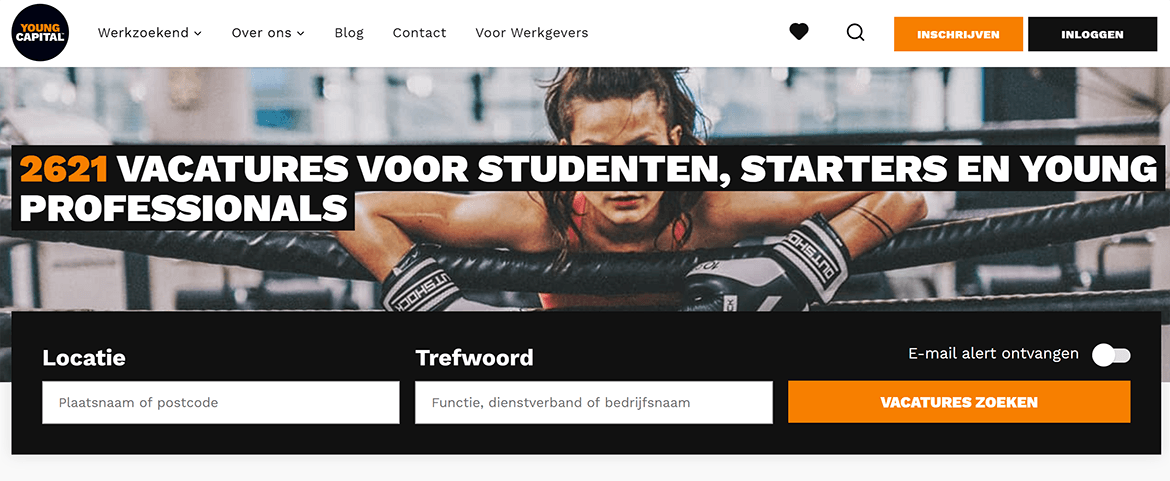
The homepage of YoungCapital
Looking at the website content and what they actually communicate (message and tone), with titles like “Let the duck out. Become a full-time flügel-duck,” we can say we are dealing with a Jester. But also, digging deeper into the company vision and culture, we see sentences like “doing business is pleasant with happy people (read: YoungCapital employees)” and “we are energetic, optimistic, and enormously driven to do better today than yesterday … Moreover, we have fun doing what we do. Come visit us, and you’ll feel it immediately,” where fun and optimism are central.
YoungCapital: Work hard play hard
They also organize an annual YoungCapital festival for their employees. It strengthens the community feeling; in this way, they connect their employees to the company, who thus become a kind of brand ambassadors. The idea behind the festival is based on YoungCapital’s core values: “We achieve results together” and “We have fun.” It hardly gets clearer than that, right?
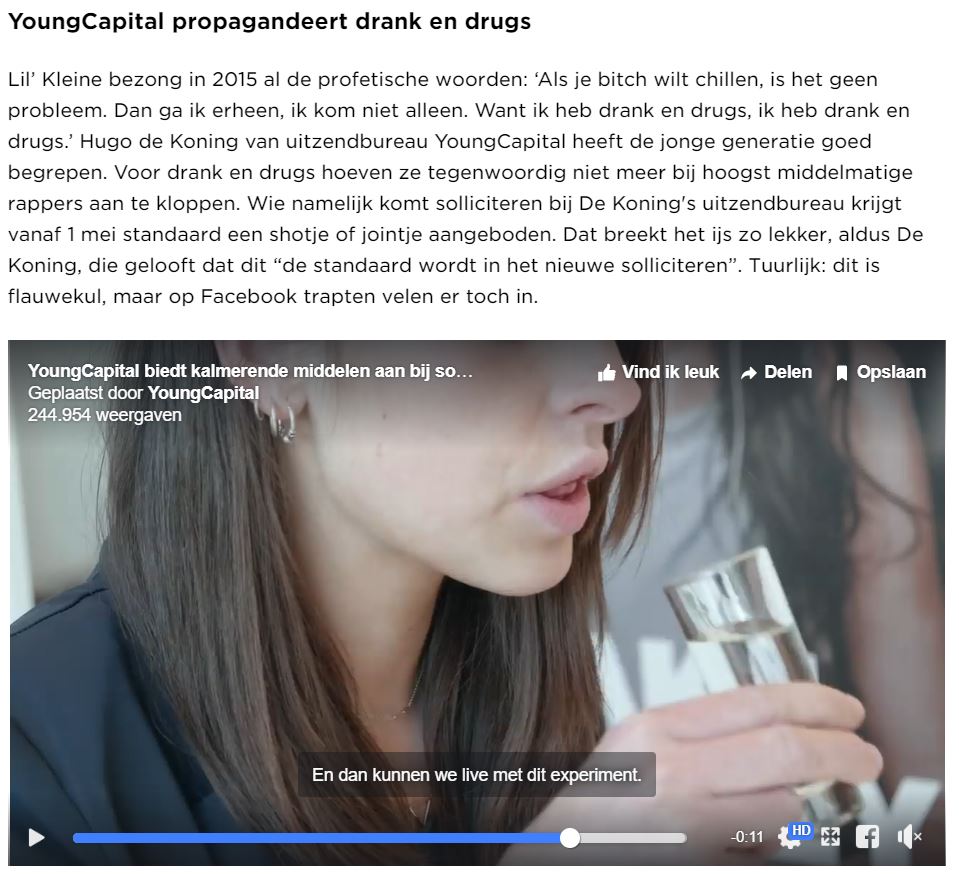
Response by Sprout to YoungCapital’s April Fools’ joke
As a Jester, you can’t just let April Fools’ Day pass by. This year, they posted a video introducing taking a shot of alcohol or a joint as a new way to relax just before a job interview. Later, a video followed with further explanation from the founder, making clear it is about a bigger challenge: young people experience a lot of stress before going to a job interview. To solve that problem, they devised a WhatsApp service that supports candidates at the last moment with tips and answers. In my opinion, it was a brilliant way to address this and launch a new service.
Jester Brand Archetype Example in the Industrial Sector

Sounds cool but often looks different in practice
Segway is a good example of a Jester who is a bit less ‘in your face.’ The founder saw someone in a wheelchair struggling to get up a curb and realized that the world is built for well-mobile people. He decided to invent a device that also makes the world navigable for less mobile people. This is also where the name Segway comes from: a phonetic variant of the word ‘segue,’ which can be translated as “smooth transition from one state to another.”
The first Segway failed. The main reason was that it was too far ahead of its time and mainly ‘famous tech wizards’ were enthusiastic. Not the best influencers for mass adoption. At that time, the company also communicated much more seriously and was focused on the mobility of the future. The current iteration of the company takes itself much less seriously but still aims to make the world navigable for everyone. You also see Segways more and more on the streets, mainly used by tourists, which unfortunately is a different target group than the maker had in mind.
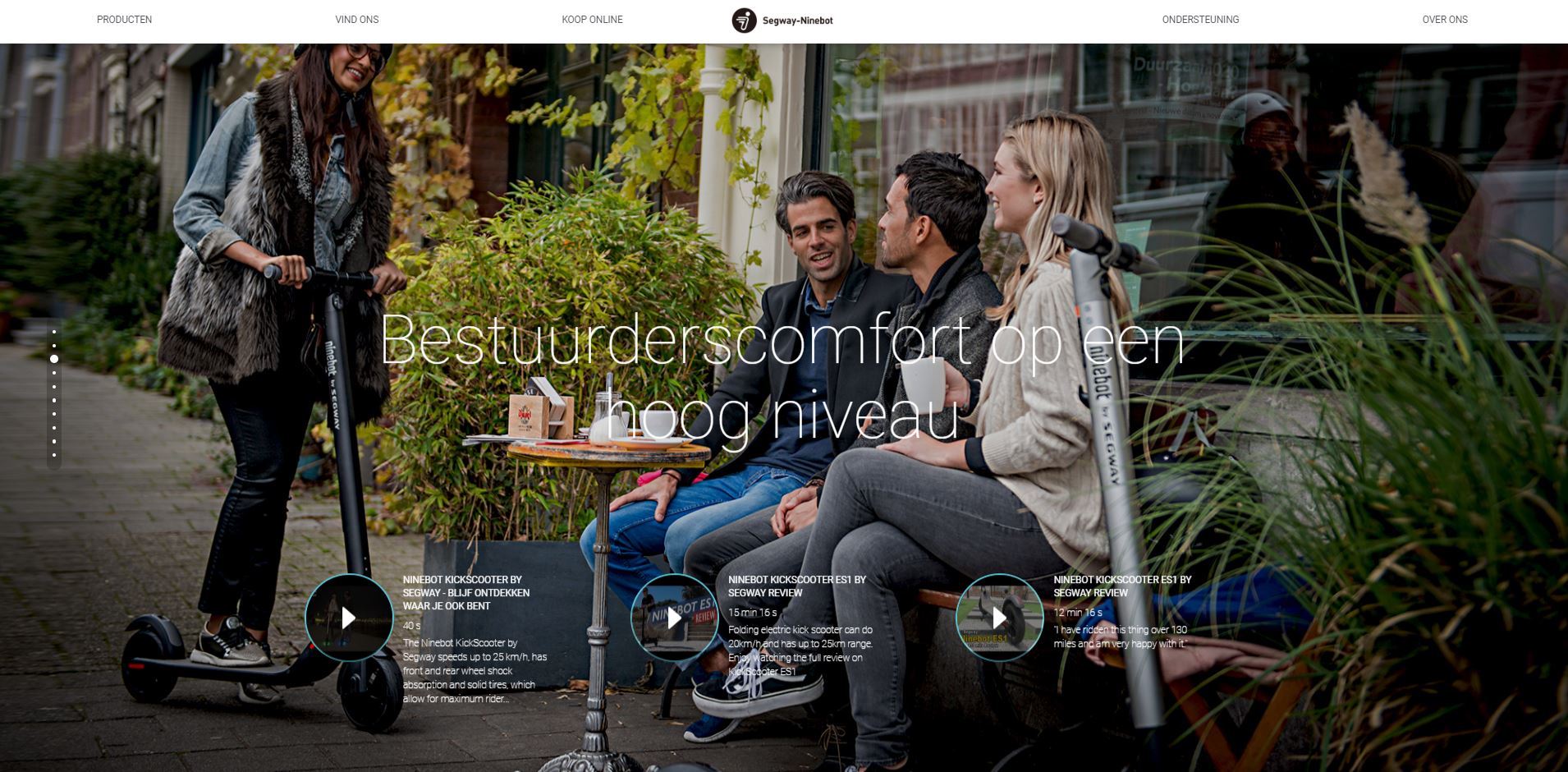
Screenshot of the website of Segway
Segway has not lost sight of its mission and has now fully embraced the Jester brand archetype. The advertising photography and commercials promote fun and the freedom spirit of the Jester, and the brand has slogans like “adventure seeking to robotics” and “where style meets fun.” All images radiate a certain freshness, mainly with well-dressed and active young people in their work and social environment. And precisely in that tension, between a young, hip, and active life and the – let’s be honest – somewhat ridiculous-looking Segway devices on which we’d rather not be seen, lies the Jester brand archetype.
We do wonder whether the company actually contributes to solving the problem it addresses. Does it make the world more accessible for everyone, or does it remain a toy manufacturer for adults? We are curious whether the brand can avoid this pitfall.
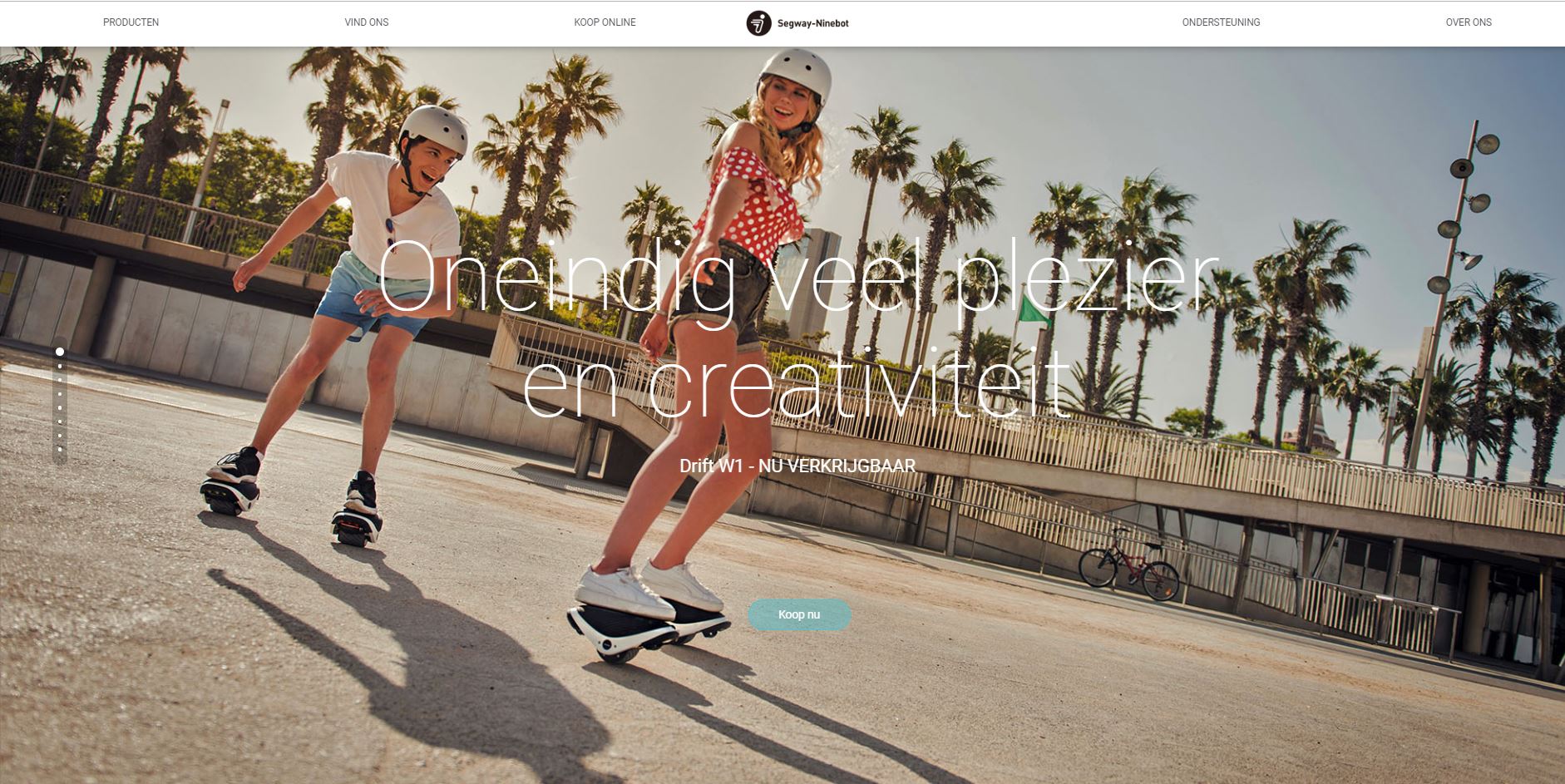
Website excerpt Segway
Advantages of the Jester Brand Archetype
There are different styles within the Jester brand archetype, but what do they have in common? What is the strength of a true Jester?
Jester mobilizes customers and fans, generates PR
If you hit the right tone and chord, as a Jester you can go far and address and solve a serious societal problem. The public and your target audience appreciate the light or humorous message but recognize the validity of the problem. You also get the chance to convince people more easily and more often the benefit of the doubt. Once a fan, people are more likely to become brand ambassadors. This enables the Jester brand archetype to relatively quickly conquer a target group and market, even if there are strong, established players.
Just google the reactions to YoungCapital’s April Fools’ joke; nice free publicity!
Pitfall of the Jester Brand Archetype
As with other brand archetypes, you need to think carefully about how you express it, and nuances make the difference. The pitfall of a Jester is – when used incorrectly – that your brand is not taken seriously, the customer cannot properly distinguish or extract the message, and the silliness overshadows the point you are making.

Related Brand Archetypes: the Outlaw and the Everyman
Is the Jester not quite the DNA of your company/brand? Related brand archetypes are the Outlaw and the Everyman.
The Outlaw is rebellious and goes against the established order. He challenges and wants to do everything radically differently. The courage and extroverted character of the Outlaw correspond with the behavior of the Jester, but the origin or underlying thought differs. So you might initially hesitate between these two, but when you look at the brand’s drivers, it becomes clear which of the two archetypes it is. The Jester wants to change the market; the Outlaw wants to create his own market.
The Everyman is likable and has a no-nonsense attitude. He is realistic, down-to-earth, social, and above all honest. The social and honest aspect of the Everyman can be found in the Jester brand archetype. With his people skills and social, diplomatic character, he knows perfectly how to best make a problem discussable. Where the Everyman differs from a Jester is the ‘we’ mentality and helpfulness. The Jester is not there for others and does not necessarily do things together. He addresses problems that others may benefit from but from an intrinsic value.
It is worthwhile to also check out articles about the Outlaw and the Everyman or read our page about brand archetypes.