Top of Google: Search Engine Advertising (SEA) Explained
Your brand at the top of Google as quickly as possible? Search engine advertising is the answer to your question. With a good campaign, your target audience will always find your brand, and you will always have control over the costs. In this article, we explain what search engine advertising is, how Google Ads works, and what costs you should consider.
Online Marketing is an important, if not the most important, marketing channel for almost every brand. An increasingly larger part of the customer journey takes place online here. McKinsey even concludes that this has accelerated due to the Covid-19 pandemic. Buyers not only orient themselves online, but an increasingly larger part of the actual sales process also takes place online.
This article focuses on an important aspect of Online Marketing: search engine advertising. This channel is valuable for brands taking their first steps in Online Marketing because it allows them to appear at the top of the search results immediately. Results from long-term initiatives like Content Marketing and SEO usually take longer to show. But even for brands that have been active online for years, search engine advertising is an important tool.
What is Google Ads?
Google’s search results – the Netherlands’ largest search engine with about 95% of the searches – can be divided into two categories:
- Organic search results
- Paid search results
Organic search results are the results that Google’s algorithm considers the best match for the search query. Through SEO and Content Marketing, people work on positioning their website in this category.
Paid search results are the ads from brands that pay the most for them. For a certain search query, for example ‘apply for a mortgage’, companies pay an amount to appear to the searcher. Prices range from about €0.30 per click to €100 or even more for very valuable search queries.
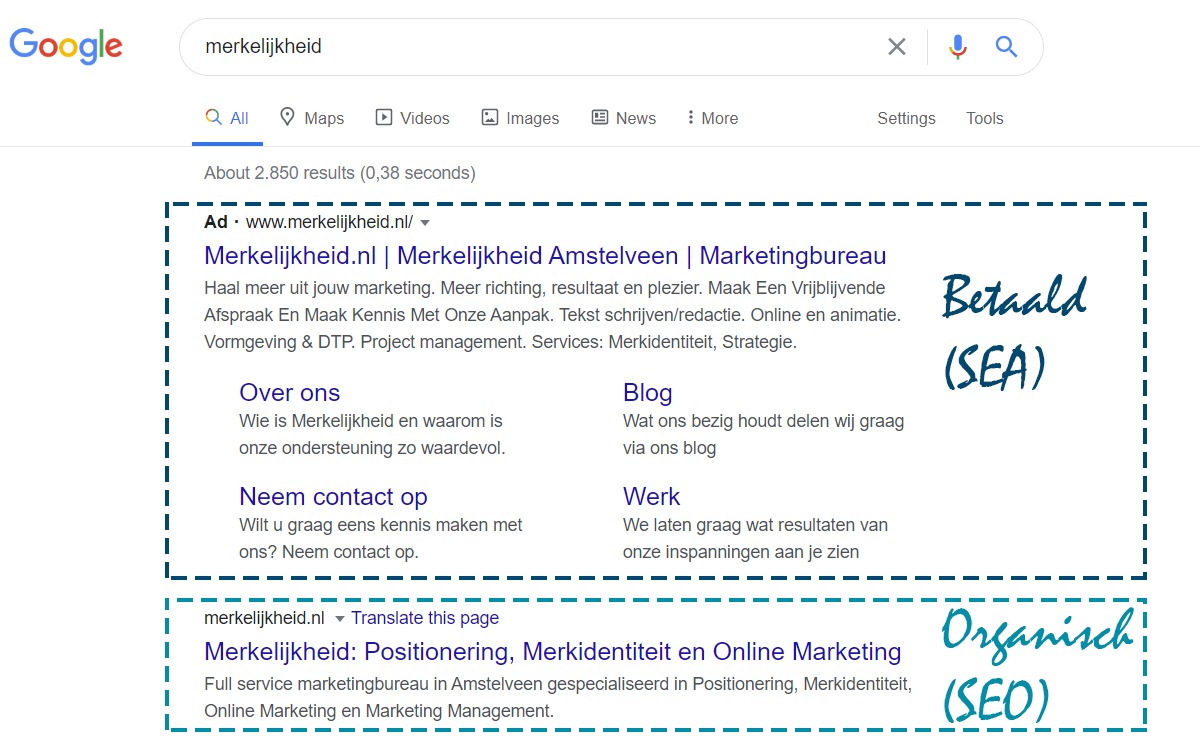
Difference between paid and organic search results SEO vs SEA
Google Ads is Google’s platform for selling ads in its search results and therefore the tool for SEA. There are few markets where it is effective to advertise paid ads on other search engines.
How does Google Ads work?
Google Ads is an apparently simple program with enormous depth. This makes it easy to start with (and explain) but a specialty to use optimally. But even starting with Google Ads requires some explanation.
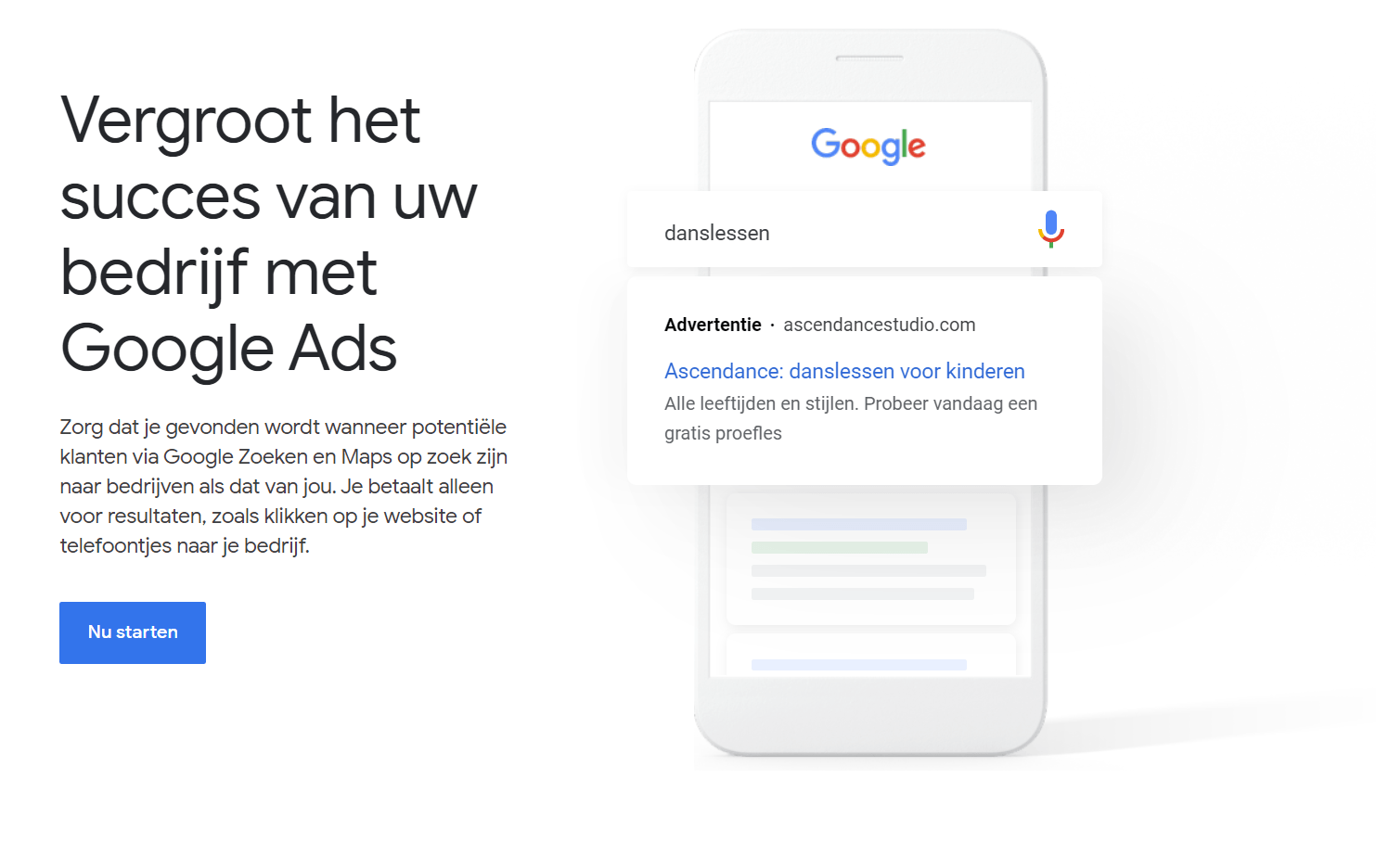
Getting started with Google Ads is fairly simple but requires some explanation.
In Google Ads, users enter a keyword and a corresponding bid. When someone uses that keyword, Google looks at all available bids and places the ads of the brands that bid the most next to the search results. That also means your ad will not be shown if you bid 1 euro but three competitors bid at least €1.10.
At the same time, Google Ads works with a daily budget, the amount in Euros you want to spend per day on buying ads. When the budget is spent, your campaign automatically stops buying ads. In practice, it often happens that the highest bidder’s budget is already spent halfway through the day. Then it’s your ad’s turn. Who has the best deal then?
Long tail keywords in search engine advertising
But then we are talking about competition on one keyword. What happens if people bid on different words that appear in one search query?
For example, search for ‘mortgage’ and you will see ads from price comparison sites, advisors, and banks. Then search for ‘apply for a mortgage’ and you might see completely different names. A brand that bids on ‘mortgage’ also appears for the search term ‘apply for a mortgage’ unless you explicitly indicate that this is not intended. But how does Google then decide who appears at the top?
Google wants to sell as many clicks as possible. Therefore, the algorithm tries its best to estimate which ad has the highest chance of being clicked. And for Google, the more specific, the better. Someone who bids specifically on ‘apply for a mortgage’ probably has a better offer than someone who only advertises on ‘mortgage’. Additionally, it also uses a quality score for both the ad and the landing page to reinforce this.
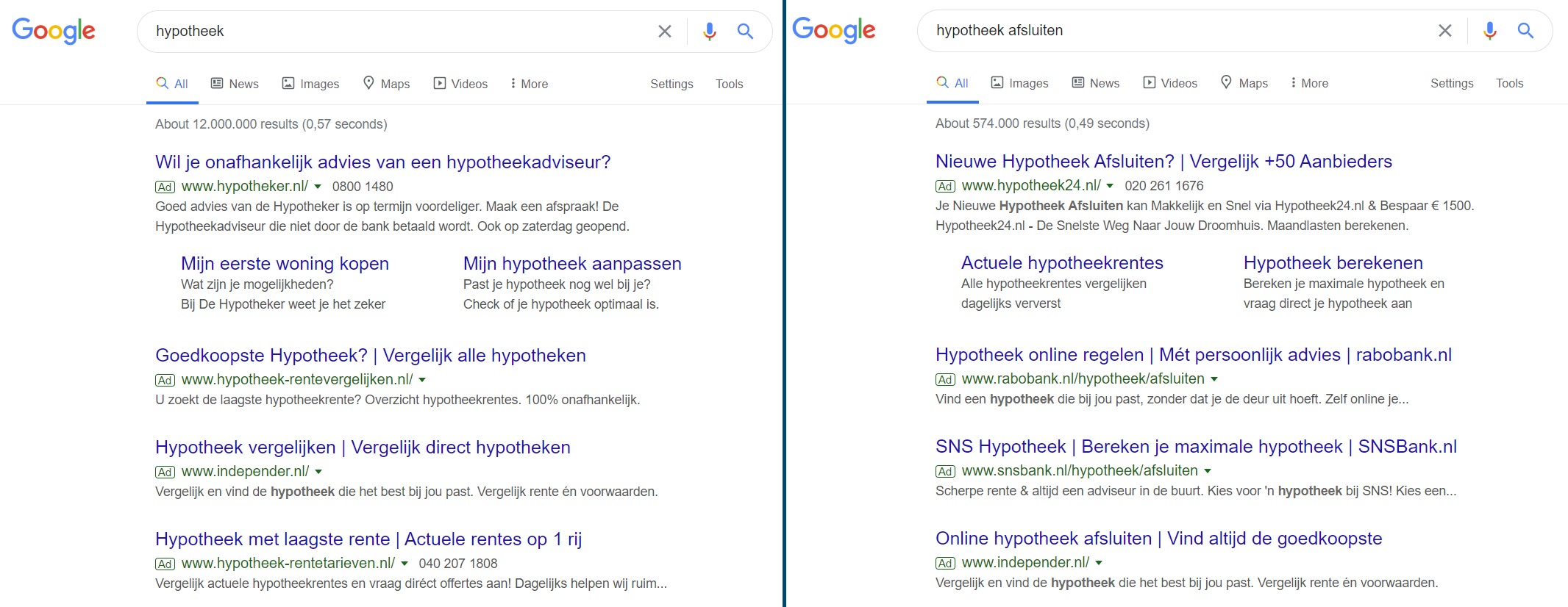
This screenshot shows that the intent – what the searcher exactly wants – differs in both cases. Comparing or just applying probably has a big impact on the value of a click
In short, search engine advertising is a complex and often opaque auction system in which many different factors play a role. SEA is therefore often part of our Online Marketing (link) services, as clients often do not have the time or knowledge to use this tool optimally.

Example of Display ads
Display Ads explained
After you have searched for “fridge” on Google, you often see ads for the fridge you just viewed, for example on Nu.nl. How does that work? These are so-called Display Ads.
Using cookies, Google stores which search queries you have recently performed. Companies can use this and place ads on sites you visit after your visit to Google. You almost buy such a campaign in one breath with your search engine campaign and it can improve the result. An additional advantage is that, unlike search engine ads, you can use images and banners. This makes your brand stand out even more.
Because banners and other Display ads generally have a much lower measurable return than search engine ads, Display Ads are relatively cheap. In some cases, only 10% of the cost of a click in the search results. Display Ads are therefore a welcome addition to many brands’ SEA tactics and a way to keep their brand in the spotlight for relatively low costs.
Costs of advertising on Google
The costs of advertising on Google are determined by two factors:
- Budget and maximum cost per click
- Costs for creation, optimization, and administration
The first factor is simple: how much do you want to spend on search engine advertising? SEA tools make it possible to set your budget and maximum cost per click down to the cent. So you will never be surprised.
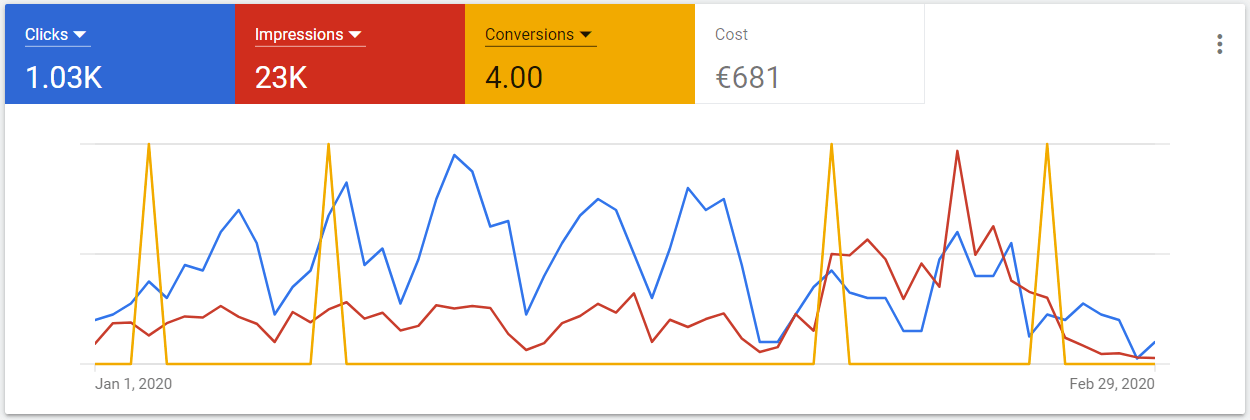
The above example is an overview of the results and costs of a campaign in the first two months of 2020
But how do you allocate a budget to search engine advertising? The best way is to calculate back how much a visitor is worth. How many people do you need to get to your website to sell your product or service, and what does that yield? If you need 100 visitors to your webpage to sell 1 product with a margin of €500, you should theoretically pay up to €4.99 per click.
Have a search engine ad campaign set up
In addition, you have to deal with the costs for creation, optimization, and administration. Many brands hire companies like Merkelijkheid to manage their search engine ads. They realize that by properly maintaining and optimizing the campaign, more results and lower costs are achieved while it costs them little time.
Merkelijkheid provides search engine advertising as part of our Online Marketing services. We offer a complete package in which our client regularly receives a short but powerful report and thus keeps control over this marketing channel.