Using long-tail keywords in your Google Ads campaigns
What are long-tail keywords and why use these keywords? In this article, we further explain the advantages of long-tail keywords compared to short-tail keywords and how you can incorporate them into your strategy. Using various examples and bullet-point explanations, we provide you with deeper insight into why you should focus your strategy on using long-tail keywords.
What are long-tail keywords
When people need information, they quickly turn to Google. It is the easiest way to find answers to their specific questions or solutions to their problems. They do this by entering different terms into the search bar. The more terms you enter, the more specific your results will be on Google. Google ranks pages based on these terms, better known as keywords. Companies and organizations optimize the content on their websites using these keywords. This happens through blogs, articles, landing pages, pillar pages, and product/service pages. An important strategy here is the use of long-tail keywords.
The term “long-tail” comes from statistics and was popularized by Chris Anderson’s 2004 article and his later book “The Long Tail: Why the Future of Business is Selling Less of More.” Anderson argues that companies can make significant profits by selling a large number of less popular products that together form a large market share. This concept is especially relevant in sectors such as media and entertainment, where digital distribution enables a wider range of products than traditional physical stores could offer.
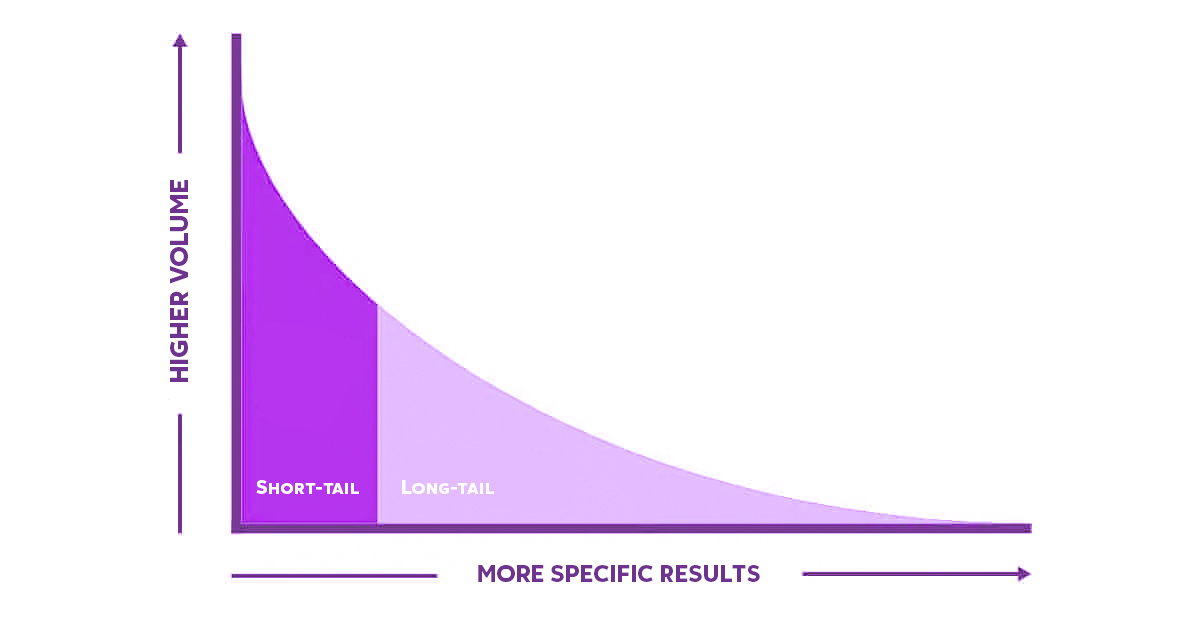
In the context of search engine optimization (SEO), the long-tail theory works similarly. A small number of very popular keywords have high search volumes, while the “tail” (the long-tail) consists of many specific keywords with low search volumes. Although each of these specific keywords individually attracts little traffic, the combined search volume of all long-tail keywords together can be substantial.
A practical example: suppose your company offers detergent for shoes. It would be illogical to optimize your website for the general keyword “detergent,” because this is too broad and unlikely to reach the right target audience. Instead, you can better focus on more specific keywords such as “detergent for sneakers” or “cleaning supplies for shoes.” This way, Google clearly understands which specific product you offer, and you avoid unnecessary competition with broader markets where you do not want to be found. By focusing on long-tail keywords, you can improve your website’s visibility and attract more relevant traffic, which ultimately contributes to the growth and success of your online presence.
The benefits of long-tail keywords in your Google Ads campaign
The main benefits of long-tail keywords are:
- Cheaper
- Less competition
- Higher conversion rate
The biggest and most obvious advantage of long-tail keywords is that they are often significantly cheaper. This is because the competition is lower; Google charges advertisers more for keywords used by many companies in their campaigns, which is almost always the case for short-tail keywords. Besides lower costs, long-tail keywords also deliver more valuable visitors because you attract specific traffic. This specific traffic often consists of people who are already closer to making a purchase decision, increasing the chance of conversions.
By focusing on long-tail keywords, you improve the relevance of your content and attract more qualified traffic to your website. This is especially important for smaller businesses or niche markets where the advertising budget may be limited. Using long-tail keywords allows you to spend your marketing budget more efficiently while achieving a higher return on investment (ROI).
Moreover, using long-tail keywords helps you refine your content strategy. By analyzing which specific search queries users use, you can better respond to their needs and interests. This leads to content that not only performs better in search engines but also provides more value to your target audience. This can result in higher engagement, longer visit durations, and a greater chance that visitors return to your website, but ultimately the most important: more conversions!
What is the difference between long-tail and short-tail keywords
The opposite of a long-tail keyword is a “short-tail keyword” or “head term.” These are short, broad search terms usually consisting of one or two words and have a high search volume. Short-tail keywords are often highly competitive because many companies and websites target these popular terms. They attract a broader audience, but the user intent is often less clear, which can result in lower conversion rates compared to long-tail keywords. Examples of short-tail keywords are “shoes” or “laptops.”
Want to be found? Then you need to make clear choices about how you want to reach your target audience via SEO and SEA within a certain market. For example, if you sell valve caps for bicycle wheels in the B2B sector, it is essential to focus on long-tail keywords. If you are a large manufacturer of bicycle wheels operating both B2B and B2C, you can tailor your strategy to both short- and long-tail keywords.
Competition on Google is extremely high and changes daily. Additionally, the Google search algorithm is complex and takes hundreds of factors into account to determine which websites are most relevant for a particular search query. This includes factors such as content quality, keyword usage, page load speed, user experience, and much more. Furthermore, Google uses machine learning and artificial intelligence to understand search queries and deliver the best possible results. This means the search algorithm is becoming smarter at recognizing the intent behind search queries. When you use long-tail keywords, you help Google match your content with users who are specifically looking for what you offer. This increases the chance that your website is shown to the right audience and can significantly boost your conversion numbers.
Merkelijkheid specialist in deploying long-tail keywords SEO/SEA
At Merkelijkheid, we are experts in strategically deploying long-tail keywords in SEO and SEA. With our high-quality keyword research, we develop a transparent and effective strategy together with our clients. Our goal is clear: generating relevant conversions.
Through our detailed and targeted approach, we help your company increase online visibility and achieve sustainable growth. We carefully analyze the search behavior of your target audience, allowing us to identify very specific and valuable keywords that your competitors often overlook. This ensures that your content and ads reach exactly the right people at the right time.
Additionally, we offer continuous optimization and monitoring so that your campaigns always perform optimally. Choose Merkelijkheid and experience the power of long-tail keywords in your online marketing campaigns. With our expertise and dedication, we achieve your business goals together.