A practical view on brand hierarchy strategy and brand architecture
How to identify brand positioning opportunities before your competitors see them? And how do you give your new brand a higher chance of success? Brand architecture and brand hierarchy are strategic activities that can make or break your success. In this article, we look at the main types of brand architecture and examine the brand architecture of Unilever and Heineken. After reading this article, you will know which brand architecture and strategy best suit your organization.
Every company with multiple brands – a brand portfolio – automatically has a brand architecture or brand hierarchy. But is this really the result of a clear strategy?
Many marketers only think about their brand architecture during major changes such as mergers, acquisitions, launches, or rebrands. They are then forced by the situation to take an overview of the whole. Suddenly, problems emerge that have been invisible for a long time, such as poor reputations, cannibalization, or disappointing growth compared to the market average. How can you prevent this?
Brand Hierarchy
A clear brand hierarchy ensures that your company optimally uses its brand portfolio to achieve its objectives. Is one brand with several variants active in different categories within the same market? Then the brand hierarchy tells you, for example, how these brands relate to each other and reinforce each other. But of course, you can also launch a different brand for each market or category, as Unilever successfully demonstrates.
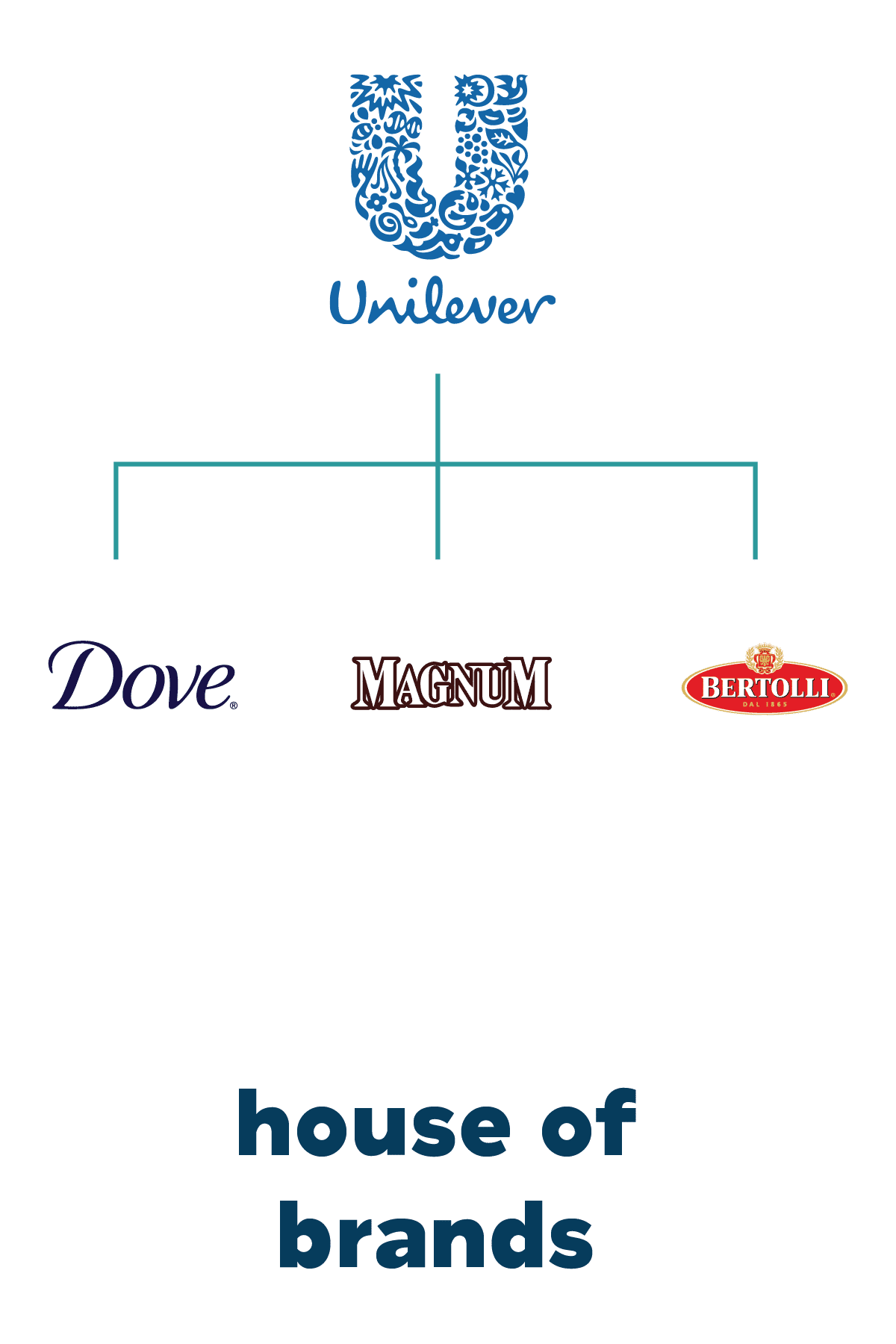 Unilever Brand Architecture
The brand architecture of the Dutch/British FMCG giant Unilever consists of about 400 different brands that stand alone in their respective category or market. The combined revenue of these brands is around 50 billion euros, of which 13 individual brands are responsible for more than 1 billion euros in revenue. This type of brand architecture is called a House of Brands. Why? We explain that later in this article.
Definition of Brand Architecture
Brand architecture is the structure of brands within one organizational entity and the way brands in the company’s portfolio are connected or distinguished from each other.
Brand architecture ensures that customers can easily see how certain brands are connected or not at all, and makes it easy for them to find what they are looking for. For one company, this means that one brand name appears on all services, while for another, each brand stands alone in the respective category or market. These are all deliberate choices made based on strategy. But what types are there?
Brand Hierarchy Types
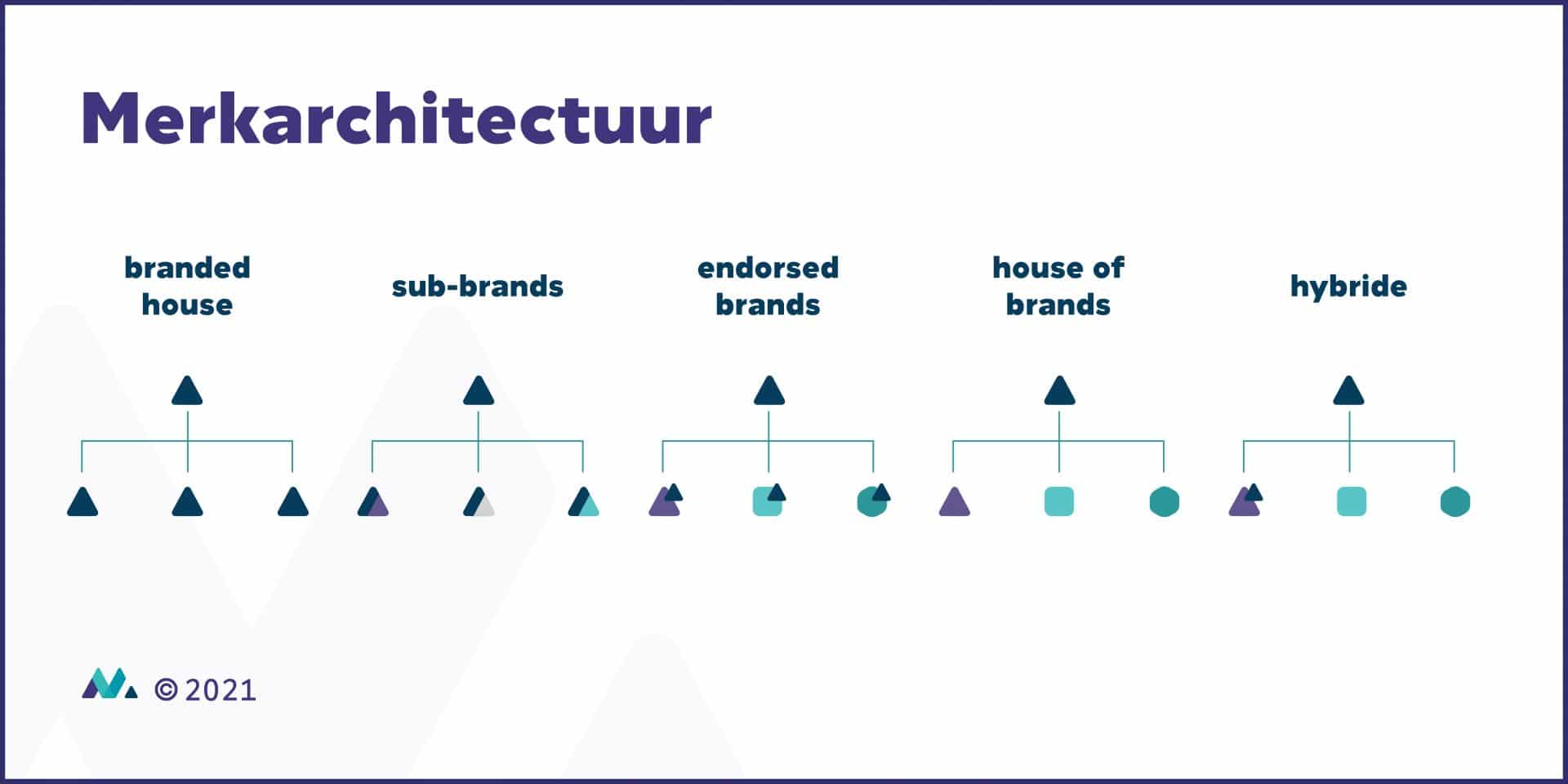
The most commonly used brand hierarchy types come from the Brand Relationship Spectrum by Aaker and Joachimsthaler, which are:
- Branded House
- Sub-brands
- Endorsed Brands
- House of Brands
- Hybrid
The last type, hybrid, was added later because due to acquisitions and increasing globalization, companies increasingly used a mixed brand hierarchy. Brand hierarchy is clearly a spectrum of options from which companies can choose. We discuss the pros and cons of each type separately.
Branded House Brand Architecture
 In a Branded House, there is a main brand that acts as an umbrella over a broad product range, possibly spread across multiple categories and markets. A well-known example is carrier FedEx, which became a huge name in the transport world and always put its one brand first.
Advantages of Branded House Brand Structure
This structure provides a consistent brand experience that minimizes any confusion for your customers. You benefit from synergy and economies of scale between activities, allowing you to work simultaneously on your brand value both in individual markets and for the overall brand.
Disadvantages of Branded House Brand Architecture
At the same time, there is a significant risk that a scandal or other failure in one market negatively affects activities in other markets. This can be political in nature, as we saw with Chinese electronics manufacturers, but can also be due to PR factors such as the emergence of a report on child labor at one of the suppliers. This last example caused Nike to lose revenue on all fronts, not just its shoe-selling division.
Monolithic Brand Strategy
In Dutch, the Branded House approach is also called a monolithic brand strategy because there is one brand that stands out above many individual brands in all respects (revenue, brand awareness, reputation). Think of Samsung, which not only stands for electronics and white goods but is also one of the largest shipbuilders and life insurers in the world.
Sub-brands Brand Architecture
Even with sub-brands, the main brand is the most important element, but it is possible to add other associations to it. Sony was known for the Walkman and its televisions but managed to attract a large new fan base with the Playstation brand. Richard Branson’s Virgin also has a wide variety of Virgin brands under its umbrella, from mobile phones to space travel; Virgin makes maximum use of its brand awareness.
Advantages of Sub-brands Brand Structure
It may be the best of both worlds. You use this structure to quickly gain credibility and brand awareness in certain markets or categories but also have the freedom to position this new brand in its own way. It is therefore an ideal way to explore new markets without risking too much damage to the main brand.
Disadvantages of Sub-brands Brand Architecture
The biggest disadvantage is that a sub-brand remains very close to the main brand and therefore struggles with values or associations that are far removed from it. A very solid brand will have difficulty establishing an experimental image under one of the sub-brands, for example. And a brand like Nivea – which revolves heavily around softness – would find it difficult to launch a razor on the market.
Endorsed Brands Brand Architecture
Endorsed brands have a unique name but use elements of the main brand, for example as a subtle quality guarantee. A well-known method is the so-called token endorser, where an element of the main brand appears subtly on the product, for example. But a connection in terms of name is also possible; Nestlé has Nespresso, Nestea, and Nescafé as endorsed brands. Finally, there are also unspoken connections; Lexus is unmistakably a Toyota brand, although this fact is nowhere emphasized.
Advantages of Endorsed Brands Brand Structure
With Endorsed Brands, you get even more flexibility than with sub-brands, and whether this is desirable depends on the market. The further categories or markets are apart, the more value an endorsed brand has for a main brand. It can give a more own charge and associations and still somewhat benefit from the brand awareness of the main brand.
Disadvantages of Endorsed Brands Brand Architecture
And that last point is also the main disadvantage; there is less synergy and economies of scale than in the first two examples. An Endorsed Brand requires a completely separate approach and investment and is therefore often a costly endeavor if success is uncertain.
House of Brands Brand Architecture
The fourth and originally last type of brand architecture is the House of Brands, where each brand is an independent, standalone brand. The best-known example of this is, of course, Unilever, which with its various brands belongs to the absolute top in many markets. The positioning of Dove, Magnum, and Lipton is unique and unrelated, but each of the brands has a leading market share. Unilever is organized so that these brands, within certain frameworks, can do exactly what they want.
Advantages of House of Brands Brand Structure
The American P&G is the counterpart of Unilever and realized in the 1950s that their traditional organizational structure caused many of their brands to underperform. By reorganizing as a House of Brands, many of these brands recovered and became profitable. Since then, the company has followed a clear brand strategy, sometimes successfully having multiple brands in one market. P&G’s success led Unilever to embrace this approach as well.
Disadvantages of House of Brands Brand Architecture
In the case of a House of Brands, there is naturally very limited synergy and economies of scale. There may still be some overlap in purchasing advertising space and back-office services, but the unique brands often require a completely separate approach here as well. Costly but worthwhile if a brand manages to gain a significant market share in an important market.
Hybrid Brand Architecture
In practice, almost all large companies have a mixed strategy. Due to mergers, acquisitions, or unexpected growth, a brand architecture arises that is, for example, monolithic but in some cases includes an endorsed brand. This is called a hybrid brand architecture. Depending on the balance you choose, the above-mentioned pros and cons naturally also apply to the hybrid brand architecture.
 Heineken Brand Architecture
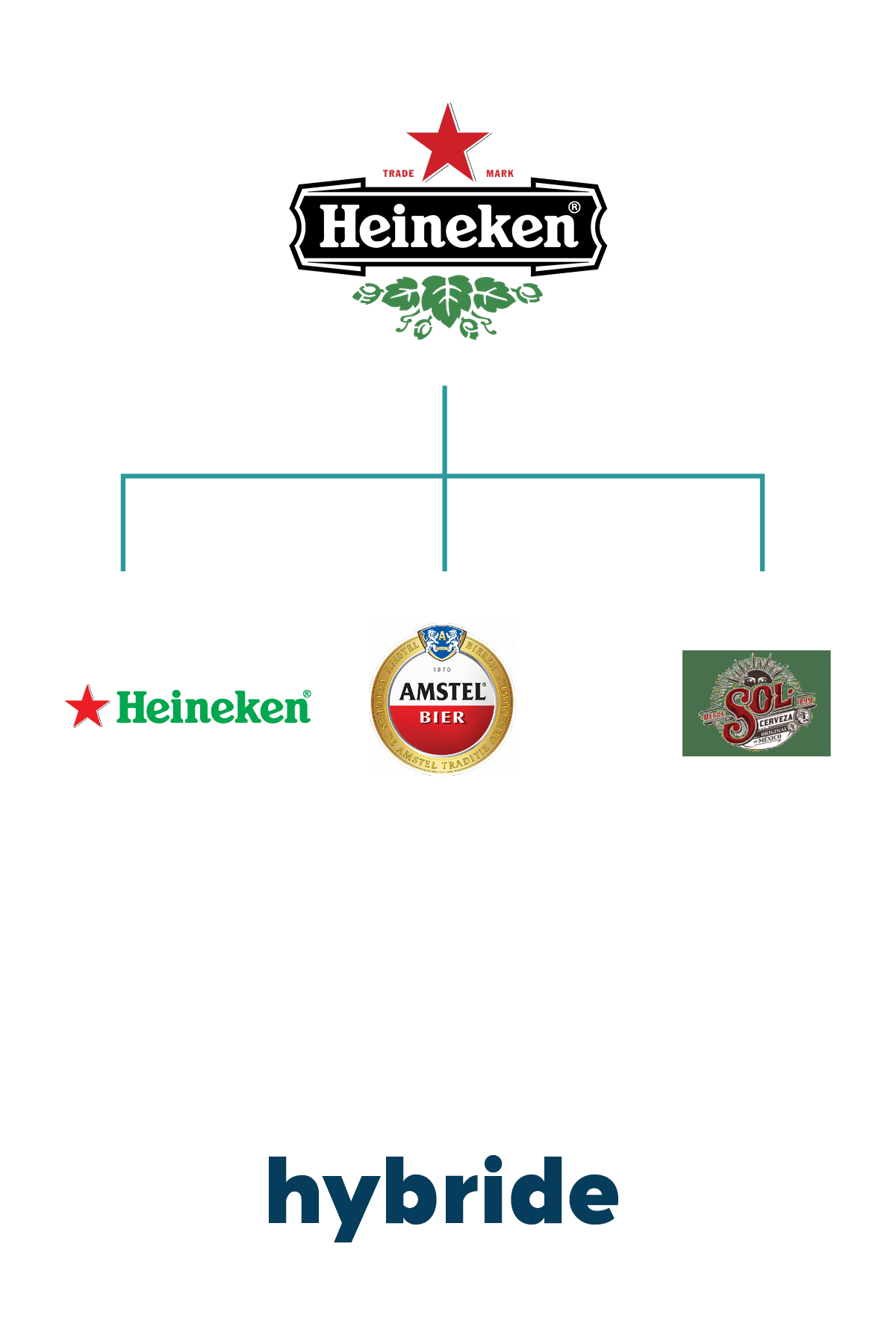 Heineken Brand Architecture
Heineken’s brand architecture is a Hybrid brand architecture. The main brand Heineken is not only the company name; the brand name also appears on the world’s most famous beer. There are quite a few variants under the same brand – Extra Cold, club bottle, and the portable keg – but the most important are the regular beer and the 0.0 variant. In addition, the company also owns Amstel, Brand, Affligem, Desperados, Wieckse, and Sol. With a total of about 400 brands, Heineken is one of the largest brewers in the world.
Choose the Right Brand Architecture Strategy
Based on the pros and cons of each of the four types described above, you can find the brand architecture that best fits your organization and portfolio. At the same time, companies must realize that brand architecture is not a static given; by continuously assessing whether your brand architecture still serves your goals, you keep this sharp. This ensures that you have a better chance to:
- Identify brand positioning opportunities before your competitors do
- Avoid high costs of rebranding or discontinuing brands
- Launch new brands that will survive longer
- Discover new markets and/or target groups faster
- Maintain brand consistency in the long term and build stronger brands
- Feel more confident about your strategic brand choices